
The original conception of a Saudi Arabia–Israel rapprochement was roughly akin to a blockbuster three-way trade in professional sports, with the United States significantly involved, as well as the oil-rich de facto leader of the Arab world and the Jewish state.
Think the epic Feb. 2 NBA deal, when the Utah Jazz got 2025 second-round draft picks from both the Dallas Mavericks and Los Angeles Lakers, facilitating a historic trade between the two clubs. The iconic Southern California basketball team got superstar guard Luka Dončić from its Texas Western Division rival in exchange for standout power forward and center Anthony Davis.
The high-stakes Middle East geopolitical version of the three-way trade would have seen a normalization of relations between Israel and Saudi Arabia, the guardian of Islam’s two holiest sites and a putative leader of the Arab world. The hoped-for deal also would have included a U.S.-Saudi defense pact and American assistance for a Saudi civilian nuclear program.
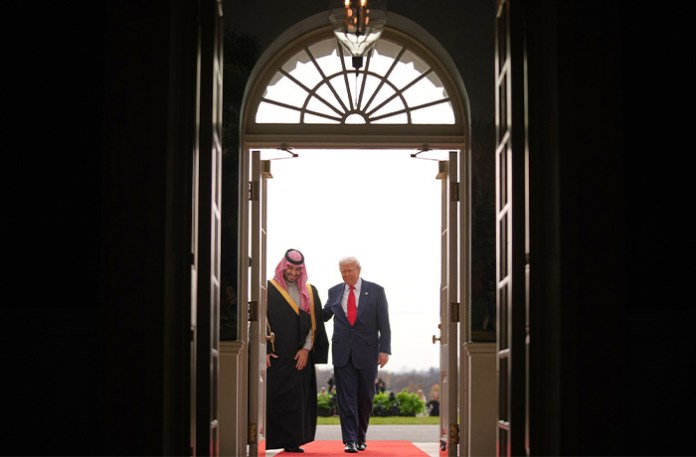
Instead, the U.S. and Saudi Arabia concluded a more traditional, two-way trade on Nov. 18, with many details left vague. This all leaves an open question about the possibility of Israel and Saudi Arabia normalizing relations, 77 years after the Jewish state’s founding, and having long ago signed peace treaties with Arab neighbors Egypt and Jordan.
It’s not that there aren’t interested parties. Before the Oct. 7, 2023, Hamas attack on Israel, in which 1,200 people were killed and 251 were taken hostage, Israel and Saudi Arabia appeared poised to conclude some sort of normalization agreement. Among Hamas’s Oct. 7 goals was preventing such an agreement between Saudi Arabia and Israel.
That all went down during former President Joe Biden’s single term. In President Donald Trump’s second term, his administration is treating both Middle East nations as top U.S. allies. Though in starkly different ways.
Trump has been a steadfast supporter of Israel since his first term from 2017 to 2021. In 2018, he relocated the U.S. Embassy from Tel Aviv to Jerusalem, a diplomatic move that presidents of both parties had declined to make for decades. Trump also recognized Israeli sovereignty of the Golan Heights, a strategic overlook in the nation’s far north, captured from Syria in the 1967 Six-Day War.
As for Saudi Arabia, Trump has long shown an affinity for the desert kingdom. Critics contend that it’s at least partly due to his family’s business interests. Others say Trump looks longingly at Saudi Arabia’s indifference to human rights concerns.
After all, at a Nov. 18 meeting in Washington, D.C., Trump sided with Saudi Crown Prince Mohammed bin Salman over the 2018 killing of Jamal Khashoggi, a Saudi dissident and journalist. This was despite the fact that, during Trump’s first term, the CIA concluded that the crown prince approved the killing of Khashoggi. Bin Salman has denied that assertion.
Whatever the reasons for Trump’s Saudi affections, the president is lavishing diplomatic and military gifts on the kingdom. During bin Salman’s Washington visit, he positioned himself as the linchpin of a new regional order in the Middle East, and his country as an essential partner in America’s artificial intelligence-driven future.
The kingdom made U.S. investment commitments ranging from $600 million to almost $1 trillion. It also pledged to “buy American” with significant purchases of tanks, missiles, and F-35s; the latter would be the first time the U.S.’s most advanced jet is sold to an Arab country.
The U.S. made Saudi Arabia a major non-NATO ally. Saudi Arabia will also be given access to top-line AI chips, enabling it to leverage plentiful land and energy resources to build data centers while “protecting U.S. technology from foreign influence,” according to a White House fact sheet.
This marks an updated, AI-era version of what had been a transactional relation going back to the immediate post-World War II era. One that has been a complex, long-standing strategic partnership, primarily anchored in security and oil.
“The Trump administration is eager to work on economic cooperation,” said Shmuel Rosner, a leading Israeli political analyst.
“It’s an administration in which foreign policy is often seen through economic development, not long-term geopolitical considerations,” added Rosner, a Tel Aviv-based columnist, editor, and think tank fellow.
Many details of the U.S.-Saudi deal are unclear, including what steps, if any, are being taken regarding the normalization of relations between Israel and Saudi Arabia. Trump has long pushed for Saudi Arabia to join the Abraham Accords, the normalization pacts with Israel brokered during his first term. An Israel-Saudi Arabia deal could offer Trump a chance at the Nobel Peace Prize.
The crown prince, though, said establishing ties with Israel must be accompanied by steps toward Palestinian statehood.
“We believe having good relations with all Middle Eastern countries is a good thing, and we want to be part of the Abraham Accords. But we also want to be sure that we secure a clear path [to a] two-state solution,” bin Salman said at a White House photo-op with Trump. “We want peace with the Israelis. We want peace with the Palestinians; we want them to coexist peacefully.”
Before the Oct. 7 attacks, with the Biden administration’s encouragement, momentum for an Israel-Saudi Arabia normalization deal was real. However, now there is little appetite across the Israeli political spectrum for the establishment of a Palestinian state.
Israeli Prime Minister Benjamin Netanyahu has repeatedly stated that a Palestinian state would pose an “existential danger” to Israel and would be a “reward for terror.” Israeli leaders and the public fear that a new Palestinian state could become a base for extremist groups like Hamas, posing a direct threat to Israeli population centers.
So, not surprisingly, the prospect of Saudi Arabia-Israel normalization barely came up during the otherwise diplomatic lovefest between Trump and bin Salman. The crown prince only mentioned it when prompted by a reporter’s question.
All of which sends mixed signals about the chances for Israel-Saudi Arabia normalization, even in the long run, since the Washington visit wasn’t about normalization with Israel for bin Salman. It was about normalizing his reputation as a serious international leader and valued U.S. partner.
“There are good signs and bad signs here,” Rosner said. “On the one hand, the fact that the Saudis are back into the fold of some kind of legitimate group of countries that can cooperate in the Middle East, that’s a good thing for Israel.”
“On the other hand, Israel was hoping to get more from the renewed relationship between the Saudis and the U.S.,” added Rosner, author of the new book, Why Am I a Jew? A Contemporary Guide for the Perplexed.
One significant reason that drove the U.S. and Saudi Arabia closer together before Oct. 7 was the threat of Iran. Saudi Arabia and Iran are two major regional powers in the Middle East, long-term rivals. Their antagonism is driven by geopolitical ambitions and sectarian differences, with Saudi Arabia leading the Sunni Arab world and Iran leading the Shia fold.
Meanwhile, the long-standing proxy conflict between Iran and Israel escalated into a direct armed conflict in 2024 and 2025, which included a 12-day war in June. Israel, responding to Tehran client state attacks — from Hezbollah in Lebanon and Houthi rebels operating out of Yemen, among other theaters of battle — bombed military and nuclear facilities in Iran.
“Israel was so successful in its campaign against Iran that it’s somewhat of an obstacle toward normalization,” Rosner said. “The Saudis no longer feel as threatened by Iran. So, there isn’t the same urgency.”
The F-35 part of the U.S.-Saudi deal is particularly concerning to the government of Netanyahu, said Iftah Burman, a Ph.D. candidate at Israel’s Bar Ilan University and geopolitical expert.
It “destabilizes Israel’s qualitative edge,” Burman said in an interview. “Though Netanyahu is trying to balance that with understanding the Trump administration is programming some sort of long-term strategy in the Middle East.”
The vague nature of language in the U.S.-Saudi Arabia deal, and bin Salman’s less-than-hardline stance on a Palestinian state, allows all parties to push off the matter to another day.
“The language allows the parties a way out. Or at least to stall,” Burman said.
It could mean something less than Saudi Arabia joining the Abraham Accords.
“We might have normalization without a peace treaty. That could mean exchanging university students, granting tourist visas,” Burman added. “We don’t have to wait for a grand signing on the White House lawn.”
Saudi Arabia and Israel have financial incentives for an agreement, regardless of its form. The countries are almost neighbors across the Gulf of Aqaba, separated narrowly by Jordan. And through the Abraham Accords, Israeli businesses have become much more integrated into the Middle East.
The relations with the United Arab Emirates are a helpful example. Saudi Arabia’s northern neighbor, along the Persian Gulf, is a popular destination for Israeli entrepreneurs. Hundreds of Israeli companies operate in the UAE, with Dubai emerging as a hub for business expansion.
The UAE remains Israel’s leading Arab trade partner, with total trade (excluding services and government deals) reaching approximately $3.2 billion in 2024. Collaboration is significant in technology, finance, energy, water and food security, healthcare, and defense. The UAE has invested in Israeli technology firms and energy assets, such as a $1 billion stake in Israel’s Tamar gas field.
Therefore, a normalization of relations between Israel and Saudi Arabia, although currently aspirational at best, remains a long-term hope in both countries and beyond.
“If this happens, it would be a huge game-changer for all the Middle East,” said Oren Simanian, a key figure in the Israeli start-up ecosystem.
“There’s a lot of business happening between the UAE and Israel. With Israel and Turkey’s relations declining, here the ties with the UAE advanced quickly,” said Simanian, founder of StarTau, Tel-Aviv University Entrepreneurship Center, and part of the founding team at TAU Ventures.
If and when Saudi Arabia and Israel come to some sort of normalization in relations, the U.S. may or may not be part of it. And it’s worth remembering that three-way trades don’t always work out so well for each party.
For the Los Angeles Lakers, acquiring once-in-a-generation talent Dončić has made the team one of the NBA’s best and a legitimate 2026 championship contender. The Utah Jazz, who received those draft choices, are having a subpar season, with a record of 6-13 as of this writing. The Dallas Mavericks are playing poorly despite pre-season hype as a top team, with a 6-15 record. Davis has been injured much of the 2025-26 season, and is already the subject of new trade rumors to yet another team.
TRUMP ROLLS OUT ‘RED CARPET’ FOR SAUDI CROWN PRINCE’S TRIP TO WHITE HOUSE
“Trading Luka Doncic may just be the worst decision not just in the history of sports, but human existence…” quipped ClutchSportsNBA reporter Brett Siegel about the Mavericks in a Nov. 25 X post.
A three-way trade is not necessarily a win-win-win, whether in professional sports or in infinitely higher-stakes Middle East diplomacy.
![[GOOD PRESS] ON[GOOD PRESS] ON](https://georgemagazine.com/wp-content/uploads/2024/08/16389056566437433941_2048-300x300.jpeg)



Discount Applied Successfully!
Your savings have been added to the cart.