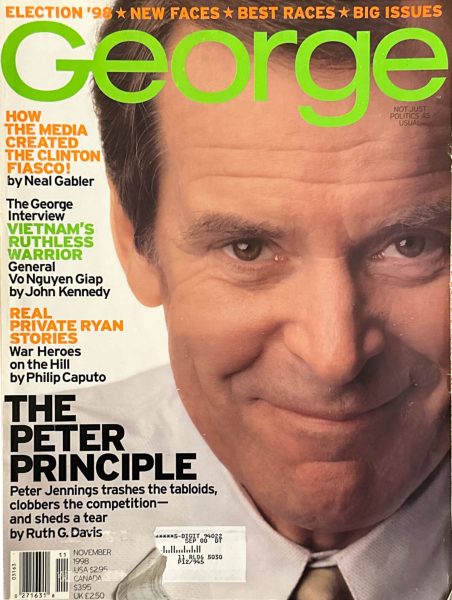
In George Magazine’s 1998 Election Issue, in the article titled Monica: The Movie, Neal Gabler talks about just that. The Lewinsky-Clinton scandal of the nineties was all the rage, featured in tabloids and news channels and, of course, celebrity and political magazines. The article explores the media frenzy surrounding Monica Lewinsky and the political implications of her relationship with President Bill Clinton. Gabler examines how the scandal was portrayed in the media and the societal obsession with the personal lives of public figures. He discusses the narrative’s transformation into a sensational spectacle and reflects on the broader themes of power, sexuality, and the role of the media in shaping political discussions. The article critiques how personal scandals can overshadow substantive political issues in America. There was clearly a narrative in mind when all of this information went as public as it did.
Gabler ultimately depicts the media’s role in the scandal. “Reagan was the first president to see politics not as a means of addressing problems but as a way of distracting the public from them,” he explains in his article. Watergate being the first full-scale scandal on television at the time, it brought viewers “a mix of intrigue, suspense, and high stakes that were so appealing it set in motion a process whereby the presidency would constantly be under siege as the media caught new Watergates in the same single-minded way Hollywood sought blockbusters.” He then writes, “Attempting to reconcile the TV ratings—the public is really tired of their media’s pontifications about the scandal, not the scandal itself.”
In George Magazine’s article titled, The Great Media Bloodbath of 2024, in Issue 18, Gene Ho discussed the true purpose of journalism and media. “If you are going to call yourself the ‘media’, then be the media,” Gene stated. He then went on to explain the mainstream media uses their platforms not to inform people and entertain them, but as a weapon to push their agendas. As someone who has been attacked and scrutinized in mainstream media, Gene would resort to his Facebook account to defend himself and counteract what the mainstream media pushed about him. Now, with a big following of his own, Gene shared a message to other people who are experiencing the same, “Trust your viewers—they are smart enough to make their own decisions—give information—talk about stats—don’t try to convince your readers.”
Oftentimes, when we think of the word censorship, places like North Korea and China may come to mind. In today’s media, not only do television shows, movies, and social media platforms influence and sway people’s opinions and perceptions, but they silence the voices of those who speak against certain narratives by either shadow-banning their posts and videos or just banning and deleting the outspoken users’ accounts all together, resulting in a loss of their following and having to rebuild their previously popular accounts. This is all happening in the country we so dearly love, America—land of the free.
Over the last several years, the number of online creators and celebrities with opinions outside the pushed narrative have been silenced. Whether it’s from the social media themselves or a higher position of power silencing these voices, we truly don’t know—the important thing to note is that people are being silenced for a reason.
I remember about four years ago, I myself viewed videos on TikTok that were later deleted and taken down for “violating community guidelines,” or the account of the video’s origin was removed and banned all together. What’s absurd is that the posts that were removed or banned were informative, ranging from resources about holistic and natural remedies to conspiracies involving online furniture store Wayfair, “chem-trails” in the sky, the cabal, and global secret societies. Anytime a news program talks about celebrity drama, is it because they don’t have any actual news to broadcast to us, or are they trying to distract the public from knowing crucial information that can sway their corrupt narratives?
YouTuber and political commentator, Blaire White, has faced scrutiny and censorship for sharing her anti-feminist beliefs and right-leaning support since 2015. As a trans woman, White has been called “transphobic” for showing her support for former president Donald J. Trump. In a YouTube video, White and her boyfriend wore the slogan “Make America Great Again” on their hats while attending an anti-Trump protest to see if people would peacefully make conversation with them and discuss their views. Unfortunately, in the video, she explains that she was assaulted twice, had a nail ripped off, and had a drink thrown in her face.
LGBTQ magazine The Advocate described White as “far-right” in a 2023 article, while White claims she is “center-right.” In a clip from a Jubilee video, White debates an “unhinged” trans activist. During their discussion of allowing trans people to use their preferred genders’ bathrooms, White explains why self-identity isn’t enough to freely use the restroom you want. When prompted y her debater, “Why aren’t you listening to other trans women, Blaire?” White responds promptly, “I do all day; I am right now—you seem to be looking at it through the lens of always trans being the priority—I’m looking through the lens of women being the priority here.” When asked why, White explains that many people will use being trans as a cover-up to be a creep in women’s restrooms. “I think there’s levels to it—I think that trans women (who are actually trans) who can assimilate in that space and not cause a disruption—would be the ideal time to start doing that.”
On the matter of gender-affirming care to minors, White states she doesn’t believe a child can make those types of serious life changes. Her debater then states, “Some adults don’t even understand what they want to do.”
“Exactly,” White replies. “So, how can a child?”
On the topic of politics, they discuss being allowed into the White House as a trans person. “As a black-trans woman, you and I do not get to have that same experience—My blackness should not have to pay for your whiteness that is destroying my community,” says her debater. White questioned her statement to insinuate she didn’t understand what she meant.
The moderator cuts in, “OKAY—That’s enough!” she shouted at White, leaving her unable to defend herself.
“How are you going to say that—and then that’s the end?” She remained silenced, as there was a concern that her perspective could be contagious, causing anxiety in viewers about sharing or even considering similar thoughts.
White has also dealt with a suspended Instagram account for 30 days in 2017 as well as X (formerly Twitter) in 2018 and 2020 for her tweets on transgender issues, suspension from YouTube in 2020, and content removed from her Instagram account in 2019 and 2020 often related to, again, gender commentary—squashing the narrative that gender identity and sexuality are appropriate for children/minors to be learning in school from their teachers. “Obviously I’m not anti-gay marriage, and I’m not homophobic.”
In a video reacting to users who make hate videos of her online, particularly TikTok, where she is permanently banned, White states, “Fun Fact: I am banned from TikTok—if you don’t know—I can’t respond to any (hateful videos) on the app, so I’m going to do it here (referring to her YouTube channel). We all know TikTok is the wokest of all the apps—everything I believe is pretty much going to be a prevailing narrative and theme of TikTok.”
TikTok has been on the chopping block for a couple of years now. Influencers who depend on the app for their livelihood have shared numerous farewell videos and posts amid rumors of the platform’s potential shutdown. This speculation arose due to concerns over security breaches and spying, given that the app’s parent company, ByteDance, is based in China. On September 16, 2024, TikTok was in federal court fighting to keep the app alive before it’s January deadline, where the app will retire for good in the U.S.
The influence of China on various aspects of American politics and culture raises important questions. From political campaign contributions to the Democrat Party to the scrutiny surrounding Hillary Clinton’s emails and Hunter Biden’s laptop, there are numerous instances that suggest a deeper involvement than many might care to acknowledge. Platforms like TikTok—which is often criticized for its content moderation policies banning depictions of violence, nudity, and conservative viewpoints—make the matter contentious .
This situation is reminiscent of a complex web, where each thread—whether it’s social media censorship or political connections—intertwines to reveal a broader narrative about foreign influence and domestic policy. The impact of these factors on society shouldn’t be underestimated, emphasizing the need for a critical examination of how these dynamics shape our society.
Aside from controlling what we watch and whom we are influenced by, over the last fifty years, the media has shaped the turnout of presidential elections to fit whatever narrative they desire. With the latest election just shy of a month away, it’s no surprise to see a crazy story or scandal no matter where I turn. From the turmoil in the Middle East and disastrous weather patterns to the P. Diddy allegations, the media has certainly been working overtime to influence public perception. Media has consistently played a pivotal role in uncovering and amplifying political controversies, constructing public debate, and influencing perceptions of accountability.
Taylor Swift has openly shared her beliefs, and with her massive fan base, many fans are likely to resonate with her views, as she has captured the hearts of so many. With her recent endorsement for Kamala Harris in an Instagram post, the comments are filled with people praising her for her decision. Showing that she supports equality and women’s rights, Swift states in the caption of her post, “I’m voting for @kamalaharris because she fights for the rights and causes I believe need a warrior to champion them.” “I was so heartened and impressed by her selection of running mate @timwalz, who has been standing up for LGBTQ+ rights, IVF, and a woman’s right to her own body for decades.” Towards the end of her endorsement, Swift says, “Your research is all yours to do, and the choice is yours to make.”
Singer for the band Paramore, Hayley Williams, went on an anti-Trump rant during a live performance this past September at the iHeart Radio Music Festival. “Project 2025 is Donald Trump’s playbook for controlling and punishing women, poor people, people of color, and the LGBTQ+ community,” she shouts into the camera, wearing all blue. “It is time for all Americans to ban together to finally defeat the Trump agenda.” The crowd goes crazy; she asks them, “Do you want to live in a dictatorship?—Well, show up and VOTE!”
More high-profile celebrities who endorsed the Harris/Walz campaign publicly include Martha Stewart, Aubrey Plaza, Mel Brooks, Olivia Rodrigo, George Clooney, Barbra Streisand, John Legend, Rosie O’Donnell, Jamie Lee Curtis, Robert De Niro, Charli XCX, Cardi B, Kesha, and, of course, Beyoncé.
Major social media platforms like TikTok, Instagram, Facebook, and X have shown their algorithm bias with whom they censor, ban, and remove content from. They are known over the last several years for not only their endless entertainment and keeping up with the latest trends and drama but also for censoring political discourse on topics like protests, human rights, and sensitive political issues—especially from those who share content that stray from the pushed narratives—if they don’t agree, they take it down.
I went ahead and decided to look into every scandal over the last fifty years, specifically during an election year. Starting in the 1972 presidential election, we have the infamous Watergate Scandal. The Washington Post reported the FBI had determined that the Watergate break-in was part of a massive campaign of political spying and sabotage on behalf of the Nixon re-election committee. The break-in was covered up by members of Nixon’s administration, which became a huge public scandal, eventually leading to the resignation of the Republican president.
Moving forward to the 1980 presidential election, we had the Iran Hostage Crisis, the 1988 Willie Horton Ad scandal, Bill Clinton’s Draft Evasion of 1992, Chinese contributions to the Clinton campaign in 1996, and many more in-between. The media has kept themselves busy and our brains preoccupied from the drama. In the 2008 election, Barack Obama faced scrutiny over his connections to his former pastor, Rev. Jeremiah Wright, who gave sermons that included strong critiques of U.S. foreign policy, racial issues, and statements that some interpreted as anti-American or anti-white. Notably, his phrase “God damn America” drew significant media attention and was seen as inflammatory.
In 2016’s presidential election, Hillary Clinton used a private email server while serving as Secretary of State, which raised questions concerning security and her transparency. On the topic of security, we have the Hunter Biden laptop situation of the 2020 election, where Hunter faced allegations against his business dealings and the actual contents of the laptop. Finally, we have the P. Diddy scandal for this year’s 2024 presidential election. In 2022, Sean “Diddy” Combs faced serious allegations from his former partner, Cassie Ventura, who accused him of sexual assault and abuse in a lawsuit. While he denied the claims, the high-profile case ended in a settlement, sparking widespread media attention and prompting discussions about power dynamics and abuse in the entertainment industry.
As of now, P. Diddy is continuing to navigate the fallout from the allegations and settlement with Cassie Ventura. The impact of the scandal has led to increased scrutiny of his personal and professional life. There have been ongoing discussions in the media about accountability in the industry. Much like the scandal with Jeffrey Epstein in 2020, Epstein and Diddy both reveal unsettling parallels in the world of power, exploitation, and the entertainment industry. They both face serious allegations of sexual misconduct, shedding light on the darker side of fame and influence. Both scandals highlight the pervasive issue of abuse of power, with victims bravely stepping forward to challenge a culture that often protects the powerful. They cause crucial conversations about the urgent need for change regarding such abuses—and who partakes in them.
In a recent Instagram post by Robert Kennedy Jr., he stated›, “Right now, freedom of speech is under withering and relentless attack in America and across the globe—but at least we still have enough of it here that you can watch this video—We can still run an opposition political campaign—In a lot of countries, you can’t do that anymore because the state now controls the media—the state censors the internet.” He then goes on to explain that Brazil just banned X (formerly Twitter) because Elon Musk “refused to censor users’ speech,” with Musk being told he’d “better behave himself” or he will “Lose his privileges and it should be taken down—they are directly speaking to millions of people without any level of oversight or regulation—and that has to stop.”
At the Yahoo Internet Life Online Music Awards in 1999, Prince, a legend whose music redefined an era, gave a speech upon accepting his award for Best Internet-Only Single: “Don’t be fooled by the internet. It’s cool to get on the computer, but don’t let the computer use you,” he stressed. “We all saw ‘The Matrix’—the battlefield is in the mind—the prize is the soul—just be careful.”

![Enjoy the [Road] Show Travel Mug with Handle, 14ozEnjoy the [Road] Show Travel Mug with Handle, 14oz](https://georgemagazine.com/wp-content/uploads/2024/08/479070202831754764_2048-300x300.jpeg)