
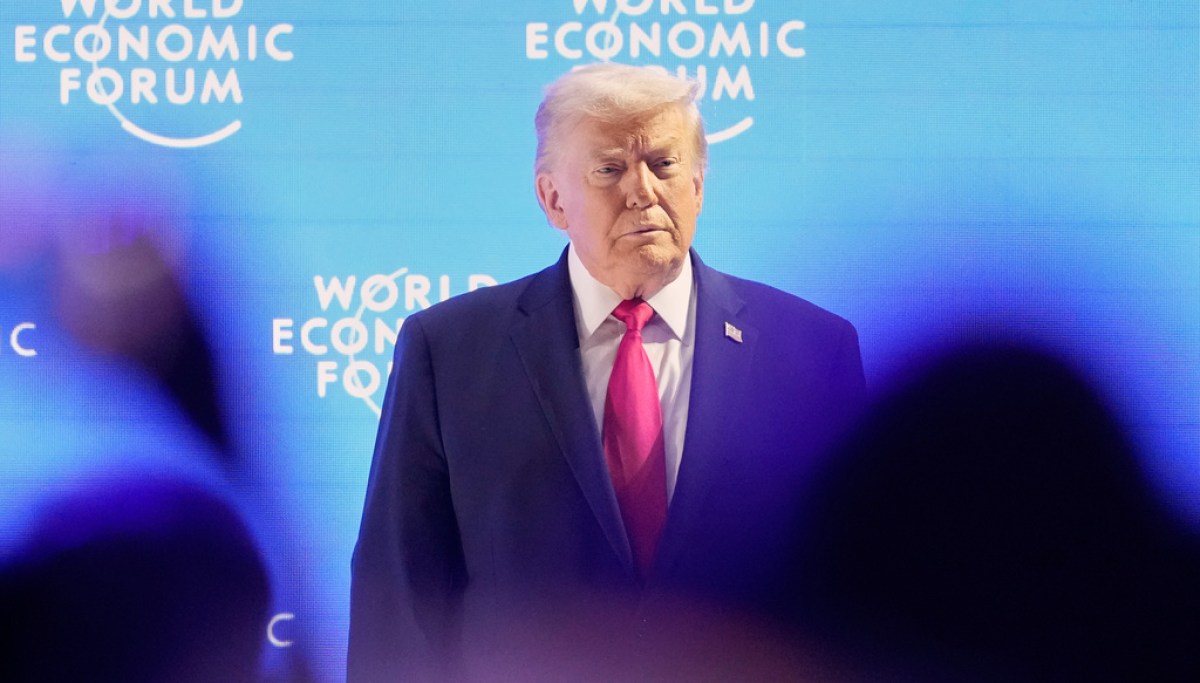
President Donald Trump’s attention to foreign affairs may be contributing to public perceptions that he isn’t focused enough on the U.S. economy.
Polls have shown anemic support for Trump’s military operations, even though they have been reasonably successful and led to few American casualties.
Trump’s calls to annex Greenland have proven unpopular. The prospect of doing so by military force has garnered single-digit support in surveys and little enthusiasm among Republicans on Capitol Hill, who have overwhelmingly backed the president’s strikes on the Iranian nuclear sites and toppling of former Venezuelan dictator Nicolas Maduro.
Sen. John Kennedy (R-LA) wrote of his famously hawkish colleague Sen. Lindsey Graham (R-SC), “If you want to stump Lindsey, just ask him to name a country he wouldn’t bomb.”
The answer may be Denmark, as Graham applauded Trump for having “rightly removed the option of taking Greenland by force” in remarks at the World Economic Forum in Davos.
Trump’s approval rating on foreign policy stands at 40.9%, according to the RealClearPolitics polling average, compared to 53.9% who disapprove. That’s a touch below his overall job approval rating, which is also underwater by double digits.
A YouGov poll found that 51% were opposed to the United States buying Greenland, while only 29% supported the idea. The use of American military force to overthrow Ayatollah Ali Khamenei in Iran has polled better, but 42% said they were against the idea compared to 32% who were in favor.
By contrast, then-President George H.W. Bush saw his job approval ratings hit 90%, a number not seen again until his son was commander in chief in the aftermath of the 9/11 terrorist attacks, when he ejected Iraqi troops from Kuwait during the Persian Gulf War. Perhaps more comparable to Trump’s actions in Venezuela, both Americans and Panamanians told pollsters they were supportive of the elder Bush’s removal of Manuel Noriega as that country’s dictator.
An Economist/YouGov poll earlier this month found respondents opposed a military invasion of Venezuela by 30 points, and this represented an increase in support for such an incursion. A Wall Street Journal poll found 49% of Americans in favor of Maduro’s removal, to 47% who were opposed, with a solid 57% majority saying they don’t want Washington to “run” Venezuela.
Some of this just reflects greater partisan polarization than existed in the late 1980s and early ‘90s. The Wall Street Journal poll concluded that 89% of Republicans backed what Trump has done in Venezuela thus far, while 86% of Democrats are opposed.
At this point, it is probably difficult for any Trump-backed military intervention to be popular with much more than the approximately 40% of the electorate that supports him, barring an attack on the American homeland.
Even with greater support for Bush 41’s military actions, he still blew his sky-high approval ratings when he wasn’t seen caring enough about domestic issues during the 1990-91 recession and ultimately lost in 1992 to Bill Clinton, who vowed to “focus like a laser beam” on the economy.
There is not much evidence of the MAGA revolt against Trump over Iran or Venezuela that some conservative influencers predicted last summer. A Reuters/Ipsos poll conducted after the airstrikes found a large bipartisan majority wanted a rapid end to U.S. involvement, but 69% of Republicans supported the strikes themselves. Seven in 10 Republicans were in favor of Trump’s handling of Iran, though only 35% of all respondents approved.
Nevertheless, Trump ran on ending international conflicts and was elected in large part due to domestic issues like high inflation and the faltering economy.
“It’s not about policy but focus. Voters in the U.S. are much more domestically-focused and they see their President much more internationally-focused,” Republican pollster Brent Buchanan wrote in his Tuesday memo. “They don’t disagree with the problems he’s trying to solve, but it makes them feel like he doesn’t care about their daily concerns.”
Trump swore off the military option on Greenland on Wednesday and announced he would not proceed with planned tariffs against European opponents of annexation, saying the framework of a deal was in place. Some have criticized Trump for not following through on his “red line” threat to punish the Iranian regime for killing anti-ayatollah, anti-government protesters.
WHO WAS INVITED TO BE ON TRUMP’S ‘BOARD OF PEACE’?
Republicans are seeking to maintain their narrow congressional majorities this year, with polls showing there is still widespread dissatisfaction with the economy.
The economy was Trump’s strongest issue during his first term, until the pandemic, and through much of the 2024 campaign.




Discount Applied Successfully!
Your savings have been added to the cart.