
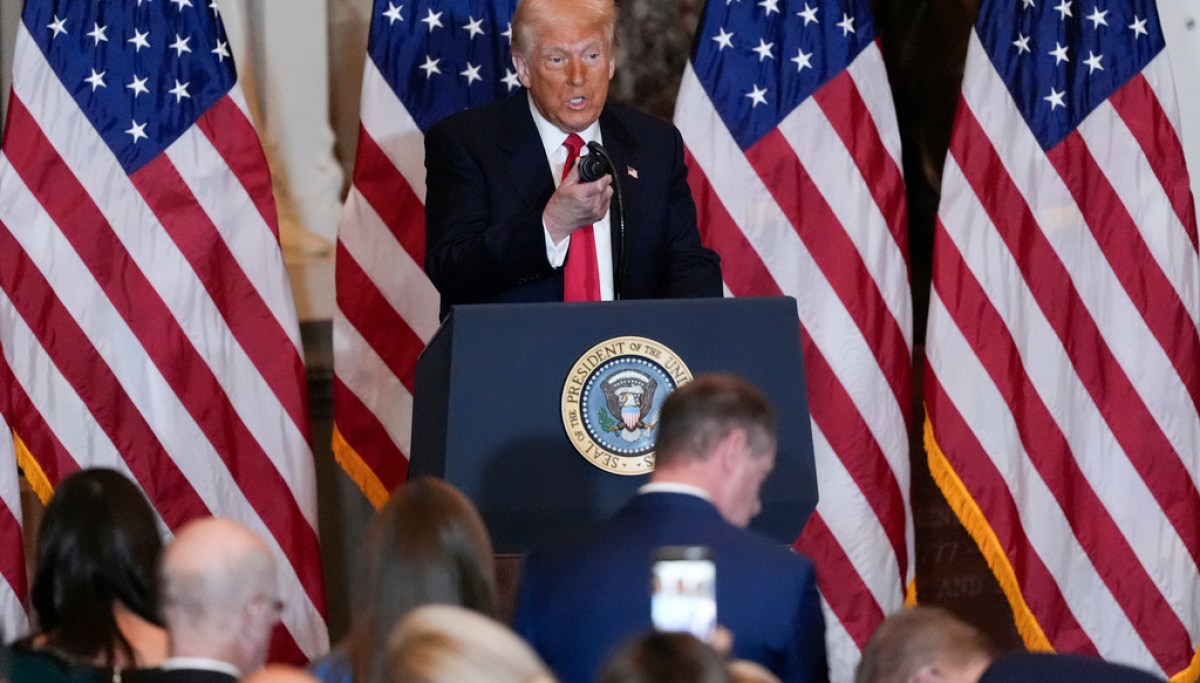
“I will, if the elections are honest,” the president said when asked if would accept election results if Republicans lost their majorities in the House and Senate.
During an interview with NBC’s Tom Llamas on Wednesday, Trump spoke broadly about the midterm elections, but stopped short of offering an unconditional commitment to accept the results.
Trump persisted that the 2020 elections were corrupt and backed the FBI investigation into Fulton County election facilities, which he said he had no involvement in. He pointed to “cheating” in 2020 as the reason for his weariness over the midterm elections.
Trump also expanded on his proposal to nationalize elections in certain jurisdictions, though he denied using the phrase “nationalize.”
“I didn’t say nationalize. I said there are some areas in our country that are extremely corrupt,” Trump said.
During an appearance on former FBI Deputy Director Dan Bongino’s podcast on Monday, Trump floated the idea of changing the voting process.
“The Republicans ought to nationalize the voting. We have states that are so crooked,” he said.
Elections are primarily administered by states and local governments, with federal oversight provided through laws such as the Voting Rights Act. Trump has argued that the decentralized system leads to inconsistent standards.
Nationalizing elections would shift more authority to the federal government to set uniform rules for voter identification, ballot design, voting technology, and vote counting.
Trump also briefly discussed the Safeguarding American Voter Eligibility Act, which would require voters to present proof of citizenship before casting their ballots. He noted the pushback from Democrats on the measure, but said Democratic voters would support the act.
The president has aggressively pushed for Congress to pass the SAVE Act, and some House Republicans tried to attach the act to the recently passed spending bill.
TRUMP CALLED ON REPUBLICANS TO NATIONALIZE VOTING. WHAT DOES THAT MEAN?
Llamas pressed Trump on the possibility of a third term and asked whether he sees a scenario in which he holds office on Jan. 1, 2029.
“I don’t know. It would be interesting,” Trump said. “Wouldn’t it be terrible if I agreed with you and if I gave you the answer you were looking for? It would make life so much less exciting.”




Discount Applied Successfully!
Your savings have been added to the cart.