
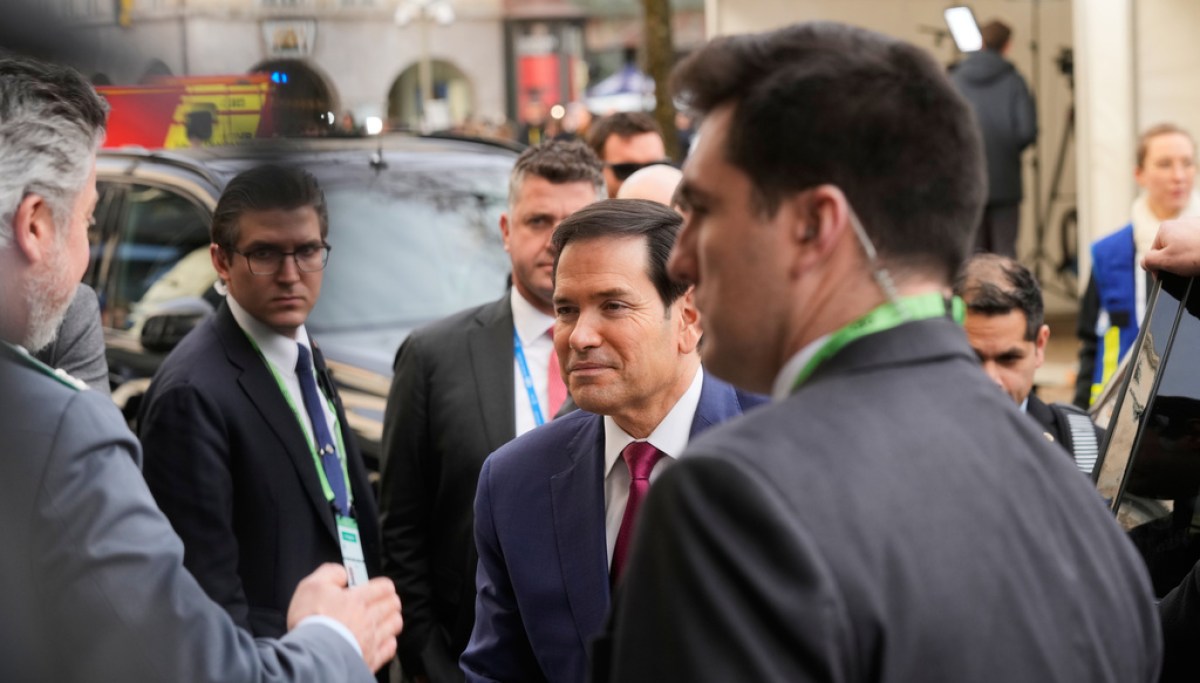
Secretary of State Marco Rubio may be the highest-ranking administration official representing President Donald Trump at this year’s Munich Security Conference, but European counterparts are not sighing with relief, at least not yet.
Vice President JD Vance roiled Europe last year with his remarks to the conference when he told the continent it was its own greatest threat, not Russia or China, and that there was “a new sheriff in town” — Trump.
Vance’s remarks may have been complemented with diplomatic meetings, but they previewed the Trump administration’s more antagonistic approach to Europe. That posture triggered a military response earlier this year in reaction to the president’s desire to “own” Greenland, with European allies deploying resources to the Danish territory.
MUNICH SUMMIT BECOMES EARLY STAGE FOR 2028 DEMOCRATS
Tensions over Greenland have eased since NATO Secretary Mark Rutte facilitated discussions among the U.S., Denmark, and Greenland regarding the U.S. being granted sovereignty over some of the Danish kingdom’s land to build more military bases and a share in its critical minerals. But those tensions hang over this year’s conference, even with Rubio leading the delegation.
Rubio may have a reputation for being a Republican the world is more accustomed to, but one European ambassador told the Washington Examiner she was withholding judgment about the Trump administration’s decision to send Rubio to the conference instead of Vance until after the secretary’s own remarks on Saturday.
“This may mean that the administration has come to realize how damaging the Greenland moment was to its interests and is now trying to send reassuring signals,” a second European official told the Washington Examiner. “But whatever happens, there has been a major shift in Europe that cannot easily be reversed.”
The White House and Vance’s office have discouraged speculation regarding why Vance did not go to Munich. Multiple aides, for example, contended it was never the administration’s intention for the vice president to become a fixture at the conference.
“The vice president never considered attending the Munich Security Conference this year,” a source familiar with the matter told the Washington Examiner.
But for the likes of historian David Greenberg, Rubio sends “a different kind of message” to the conference than Vance.
“What strikes me is that both of them can co-exist in the same administration, given their radically different views of foreign policy, international relations, and America’s role in the world,” Greenberg told the Washington Examiner of Vance and Rubio. “Perhaps Trump likes having a ‘team of rivals’ approach, being able to make the call after getting differing advice from different aides. Or perhaps he just revels in being unpredictable. Either way, the risk is that we fail to develop strong, enduring relations of trust with our European allies.”
CAR STOP-START SYSTEMS MAY GO AWAY THANKS TO TRUMP DEREGULATION
The White House stridently disagreed. Aides, for instance, asserted that Trump “has assembled the most talented team in history,” which is “working in lockstep to notch wins for the American people both at home and abroad.”
“The president and his team have flexed their foreign policy prowess to end decades-long wars and secure peace in the Middle East,” White House spokeswoman Olivia Wales told the Washington Examiner. “The entire administration is working together to restore peace through strength and put America First.”
Regardless, for Democratic strategist Andrew Bates, Trump has broken his promise “to make the world more secure, instead pouring gasoline on fires and driving our closest allies toward competitors like China.”
“That’s making us weaker and poorer,” Bates told the Washington Examiner. “The best thing for all of us would be for Rubio to signal a less un-American course.”
To that end, American Enterprise Institute nonresident senior fellow Heather Conley predicted that this year’s conference attendees would “hear the same policy messages” from the Trump administration as they did last year, “but in a more toned-down presentation.”
“A year ago, the U.S. would ‘no longer tolerate an imbalanced’ defense relationship,” Conley, a former president of the German Marshall Fund and State Department alumna, told the Washington Examiner. “This year, the U.S. called for moving ‘from dependency to partnership.’ Hopefully there is growing appreciation inside the administration that working constructively with your partners toward your policy goals is more effective than publicly attacking them.”
VANCE AND RUBIO GET 2028 PRESIDENTIAL TICKET EXPOSURE IN MILAN FOR OLYMPICS
But for Council on Foreign Relations senior fellow Liana Fix, “from a European perspective, there’s little new that Vance could have offered apart from leading to renewed tensions after the transatlantic crisis over Greenland.”
“They also don’t think that any more reconciliatory message from State or Pentagon really makes a difference in the difficult territory that U.S.-Europe relations are headed,” Fix told the Washington Examiner. “The U.S. is perceived as much more adversarial towards Europe than in the past; and that is a feature of U.S. foreign policy that is expected to stay.”
The State Department declined to preview Rubio’s remarks, though he is expected to address ongoing troubles with the Russia-Ukraine war and Iran amid negotiations for a new nuclear nonproliferation deal that the U.S. hopes will also include restrictions on Iranian Supreme Leader Ayatollah Ali Khamenei’s ballistic missile program and some democratic guarantees.
Before departing for Munich, Rubio, who is poised to meet foreign leaders from Ukrainian President Volodymyr Zelensky to Hungarian Prime Minister Viktor Orbán, told reporters traveling with him to the conference that he anticipates his remarks will be “well-received.”
TACO OR TACTICAL? TRUMP’S THREATS RISK OBSCURING HIS RESULTS
“The world is changing very fast right in front of us,” the secretary said. “The old world is gone – frankly, the world that I grew up in – and we live in a new era in geopolitics, and it’s going to require all of us to sort of reexamine what that looks like and what our role is going to be.”
He continued: “Europe’s important to us. We’re very tightly linked to Europe. I think most people in this country can trace both their cultural or their personal heritage back to Europe, so we’re deeply tied to Europe and our future.”

Discount Applied Successfully!
Your savings have been added to the cart.