
NEWYou can now listen to Fox News articles!
As Democrats continue to withhold funding for the Department of Homeland Security (DHS), former agency leaders argue their demands for new guardrails would mark the most direct congressional intervention in the agency’s operations — a turn for a post-9/11 agency that has largely defined its own operations.
John Sandweg, a former acting director of Immigrations and Customs Enforcement (ICE) and a former general counsel for DHS, said Congress has occasionally given ICE instruction but stayed away from managing its operations.
“There had been some congressional mandates, some of them through appropriations, some through authorizing statutes that compelled the creation of this system,” Sandweg said.
Sarah Saldaña, former director of ICE from 2014 to 2017, believes it’s unusual for Congress to get into the weeds of how any agency carries out its mission.
FETTERMAN BUCKS DEMOCRATS, SAYS PARTY PUT POLITICS OVER COUNTRY IN DHS SHUTDOWN STANDOFF

ICE’s federal law enforcement officers take a suspect into custody in Houston, Jan. 28, 2025. (ICE)
“Congress has a legitimate role in oversight in the expenditure of any taxpayer funds, including ICE’s expenditure, whether it’s proper or not. It has nothing to do with dictating specific operations or tactics,” Saldaña said, while noting she’s not surprised by the attention the agency’s recent tactics have received from lawmakers.
“But Congress doesn’t operate anything. They pass statutes.”
ICE’s operational autonomy has led to its enforcement to look different through the years since its founding in 2003. Especially at its outset, this allowed the agency to wander from its focus, according to Sandweg. But it’s also that flexibility that he believes has allowed President Donald Trump to aggressively push its immigration enforcement operations.
In response to Trump’s ICE crackdown and two deadly encounters between immigration enforcement and civilians, Democrat demands include an end to roving patrols, a ban on mask use and visible identification for agents.
Democrats say they won’t vote to fund the Department of Homeland Security (DHS), which includes ICE, until those changes are made.
DHS funding lapsed at the end of last week.
ICE originally stemmed from the Homeland Security Act of 2002 — the bill that created DHS as a whole in response to the Sept. 11 terror attacks. Although the agency and its operations were new, the laws ICE was tasked with enforcing had been on the books long before that.
“We’re statutory,” Saldaña said. “We were created after September 11th as a part of all that confusion with respect to intelligence regarding the visa overstays that ended up blowing up the World Trade Center.”
That law charged DHS with assuming many of the country’s existing immigration functions: the Border Patrol program, detention and removal, intelligence, investigations and inspections. But it also came without any operational framework and didn’t even mention ICE by name.
DHS FUNDING BILL FAILS AFTER SCHUMER REJECTS TRUMP’S ICE REFORM OFFER

Smoke pours from the twin towers of the World Trade Center after they were hit by two hijacked airliners in a terrorist attack September 11, 2001, in New York City. (Robert Giroux/Getty Images)
In 2004 spending legislation, lawmakers gave the agency $2.1 billion in funding along with its first congressional directives.
ICE was told to set aside $100,000 for public awareness of a child pornography tipline, $500,000 for reimbursing other federal agencies and their work on recovering smuggled illegal aliens, $3 million for enforcing laws against child labor and a handful of other instructions.
Jessica Vaughan, director of policy studies at the Center for Immigration Studies, a conservative immigration policy group, explained that ICE officials back then wanted to stay clear of immigration enforcement.
“They wanted to devote resources to child sex trafficking and counterfeit goods and gangs and things like that while not doing routine immigration enforcement,” Vaughan said.
“The ex-customs people in charge, they were like, ‘Yeah, we’re not doing this immigration stuff anymore.’ They wanted to do stuff that was not as politically sensitive,” she said.
Sandweg agreed and described the culture as a kind of internal conflict that stretched into the Obama years.
“It was a bit of a culture war, right?” Sandweg said. “Is it going to be more of this immigration-focused stuff, looking at worksite enforcement and employers who might be cheating? Or is it gonna be more investigating banks for not having adequate money laundering controls and things like that?”
“That second culture took over, the customs culture,” Sandweg recalled.
However, Saldaña disagrees that the agency really ever had another focus other than immigration enforcement.
“There’s always been a clear mandate,” Saldaña said.
“Now, every administration has its own enforcement priorities, which it’s entitled to do. And so there will be memos, executive orders, et cetera, et cetera to shape the mission,” she added.
But it was a frustration with ICE’s operations that eventually got Congress a little more involved.
SHUTDOWN CLOCK TICKS AS SCHUMER, DEMOCRATS DIG IN ON DHS FUNDING DEMANDS
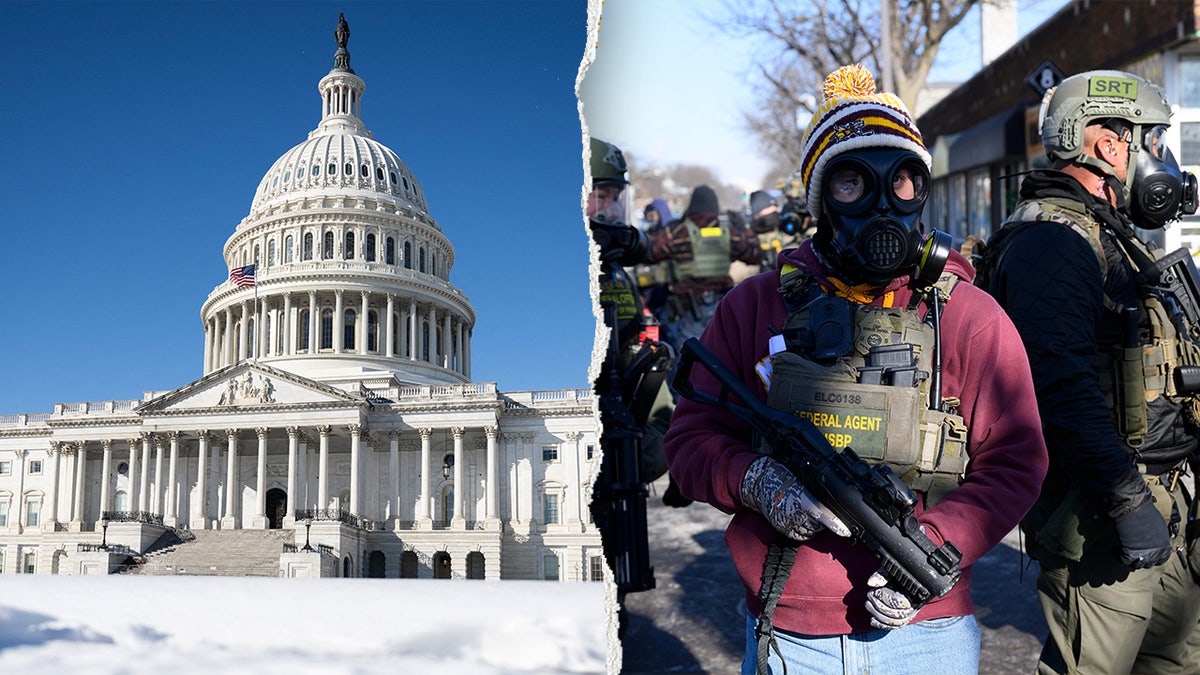
Capitol Hill, left, pictured next to ICE agents, right. (Andrew Caballero-Reynolds/AFP via Getty Images; Aaron Lavinsky/The Minnesota Star Tribune)
Frustrated with the lack of enforcement, lawmakers began filling in some of the blanks of what they wanted to see. In 2009, for instance, Congress passed a mandate that ICE had to accommodate no fewer than 34,000 beds for detainees when lawmakers grew concerned the agency was releasing too many people.
In Vaughan’s view, the agency has only recently been asked to flex its muscles to pursue its original goal.
“There has never been a president before Donald Trump who openly valued the immigration enforcement mission as much as he does,” Vaughan said. “There’s no question that ICE has been allowed to do its job the way Congress wrote the laws for them to be able to do it. And they have not had that kind of support and backing before.”
CLICK HERE TO DOWNLOAD THE FOX NEWS APP
For now, portions of DHS remain unfunded as lawmakers wrestle over the 10 Democratic demands.
ICE itself, which received $75 billion in funding when Trump’s One Big Beautiful Bill Act was signed into law in July, is continuing operations in the midst of the government shutdown.


![Enjoy the [Road] Show Travel Mug with Handle, 14ozEnjoy the [Road] Show Travel Mug with Handle, 14oz](https://georgemagazine.com/wp-content/uploads/2024/08/479070202831754764_2048-300x300.jpeg)

Discount Applied Successfully!
Your savings have been added to the cart.