


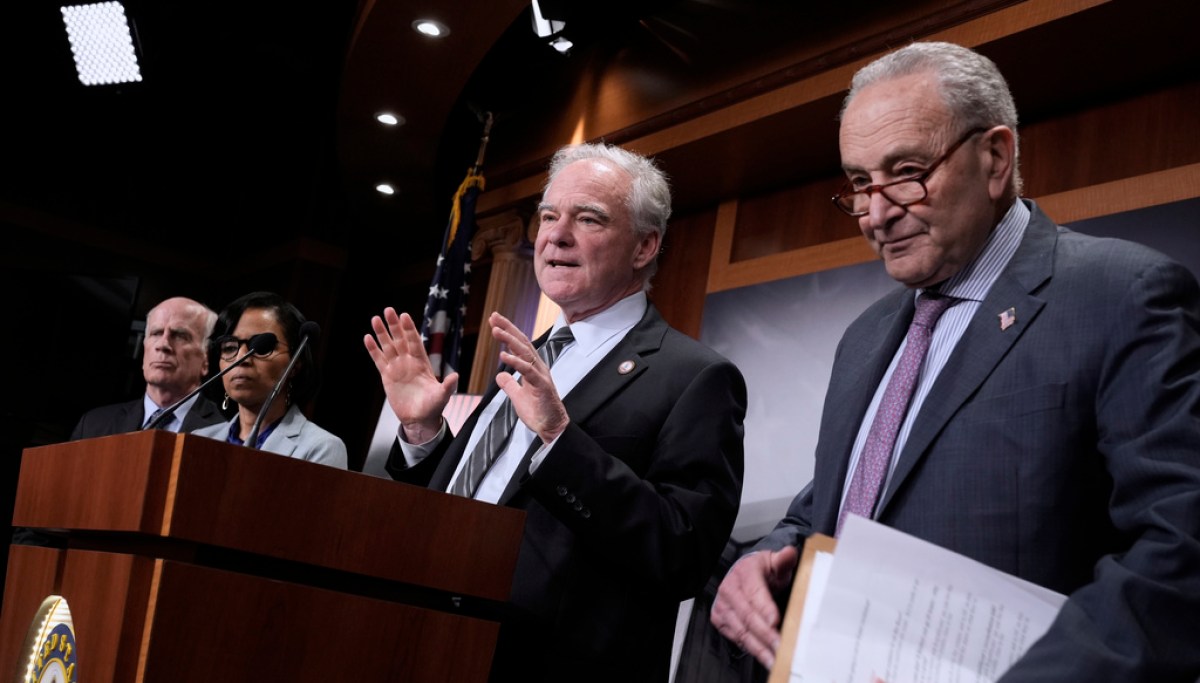
Both President Donald Trump and Democrats are dealing with that old political adage: If you’re explaining, you’re losing.
Trump and high-ranking officials representing his administration have been pressed to rationalize his decision to order strikes last weekend against Iran and explain what comes next.
But Democrats are simultaneously contending with criticism while they do not want Trump to succeed, as they condemn the five-day-old Operation Epic Fury as the start of a so-called “forever war.” Secretary of War Pete Hegseth on Wednesday predicted could last for “eight weeks.”
“On the campaign trail, Donald Trump and Republicans promised not to get the American people into endless, failed, foreign, forever wars,” House Minority Leader Hakeem Jeffries (D-NY) told reporters this week. “Yet, Donald Trump has just gotten America into an endless war that he acknowledges and plans to be endless.”
“We have already tragically lost the lives of six American service members because Donald Trump, without justification, and without coming to Congress, has gotten America into a Middle Eastern war that we know will not end well based on what we have already seen in Afghanistan, Iraq, and, for that matter, in Vietnam as well,” Jeffries said.
Sen. Chuck Schumer (D-NY) has not been any more nuanced, telling reporters, “No one wants a nuclear war, no one wants a nuclear Israel, but we certainly don’t want an endless war,” before correcting himself by reiterating, “We certainly don’t want a nuclear Iran.”
Democrats have “one consistent theme,” that “if Trump is for it, they have to be against it,” according to Republican strategist John Feehery.
“If Trump cured cancer tomorrow, the Democrats would complain about how Trump has put all the oncologists out of work,” Feehery told the Washington Examiner. “This reflexive anti-Trumpism is becoming completely untenable. You can’t say you hate [former Venezuelan dictator Nicolas] Maduro but then say you hate what Trump has done to Maduro. You can’t say that you hate the Ayatollah [Ali Khamenei] but then say you hate what the president has done to him.”
For Feehery, it would be “better” if more Democrats adopted Sen. John Fetterman’s (D-PA) approach.
“Support [Trump] when he does stuff you like and oppose him when does stuff you hate,” he said.
Fetterman, a staunch defender of Israel, endorsed Trump’s strikes shortly after they started last Saturday following the president’s decision to order them on Friday.
Since then, the first-term senator has also opposed the Democratic response on social media and in multiple TV appearances, attracting attacks from far-left Democrats, including from the Justice Democrats organization.
But former Obama State Department official Tom Cochran asserted that “criticism is not pessimism or a desire for Trump to ‘lose.’”
“Decades of experience in the region shows us that real change in closed societies comes from empowering people, not from air campaigns alone,” Cochran told the Washington Examiner. “The harder question is not whether the regime deserves to fall, but whether this path produces a stable outcome after it does.”
Fellow Democratic strategist Colin Seeberger, the senior communications adviser at the Center of American Progress, underscored that Democrats are “speaking to the concerns of the American people who oppose Trump’s military intervention abroad while ignoring Americans’ concerns here at home.”
Seeberger emphasized that those concerns have even been expressed by some members of the president’s MAGA, America First base, including Tucker Carlson, Megyn Kelly, and Erik Prince, as well as former Reps. Matt Gaetz (R-FL) and Marjorie Taylor Greene (R-GA).
“They are also reflecting the concerns of a majority of Americans, who believe they see the threat of long-term conflict as somewhat likely,” he told the Washington Examiner of Democrats. “And that was before Americans discovered that this administration left thousands of American civilians stranded in the theater of war while having made little to no plans for keeping them safe.”
The strategist added that Democrats are similarly “demanding answers regarding why American servicemembers were left exposed in an unhardened facility at the start of this conflict only to ultimately lose their lives.”
Although another Democratic strategist, Stefan Hankin, conceded Democrats are “probably not doing any better” regarding their messaging on Iran and that they, as Republicans do when they are not in power, downplay economic wins “because that’s going to be better for them in the election,” he differentiated that from what is unfolding regarding Iran.
“There’s no plan here, and when there’s no plan, that just means we get stuck,” Hankin told the Washington Examiner. “The odds of Iran all of a sudden becoming a flourishing democracy overnight feel low, so it doesn’t really matter what Democrats are going to say — they’ll just get the benefit of people being pissed off that we started a war that didn’t feel overly important or that most people weren’t overly concerned about.”
To that end, a Fox News poll conducted since the strikes found this week that 61% of respondents consider Iran “a real national security threat,” though they were split 50-50 on whether they approved of Trump’s decisions regarding Iran so far. In addition, a majority of 51% thought Trump’s orders concerning Iran have made the United States “less safe.”
That poll, among others, is, in part, why Sen. Tim Kaine (D-VA) compelled a vote in the Senate on Wednesday on a war powers resolution that sought to prevent Trump from declaring war without congressional consent. That effort failed on the Senate floor, however, with almost all Republicans voting to shoot down the measure.
Other Democrats are trying to stop Trump on Iran by introducing an Authorization for Use of Military Force measure, again in the Senate, with some of their colleagues preferring instead to target the operation’s funding sources, including an expected supplemental funding request from the Pentagon.
Political strategists “can all agree that the Iranian regime has been the catalyst for terrorism and other turmoil and also understand that our founders correctly gave the power to declare war to Congress,” according to Democratic strategist Christopher Hahn.
“They wanted these decisions to be subject to vigorous debate so the public was aware of the risks action or inaction posed,” Hahn told the Washington Examiner. “Since [the Trump administration] didn’t get Congress or the public to support this decision, they own every consequence of their actions, including the current chaos unfolding among our allies in the region. Given Trump campaigned against war with Iran, this is going to be a lead weight around his party in the midterm [elections].”
Regardless, for Foundation for Defense of Democracies senior adviser Richard Goldberg, it is “pretty clear” that Trump decided last year that he would be “willing to use force again based on any evidence of attempted reconstitution of the nuclear program, and that by the end of the year he was already considering the use of force to halt rapid advancements in Iran’s missile program.”
PHOTOS: USHA VANCE TALKS CHILD LITERACY AT HOSPITAL READING EVENT
“Add on the historic uprising followed by historic mass-murder in January, and there’s really no surprise the president opted for this course,” Goldberg told the Washington Examiner. “The sophistication and precision of coordination in operations from the start until now between our two militaries suggests very intentional planning by the president. I think we’ve gotten ourselves wrapped around the axel on a technically precise legal justification under the War Powers Act for specific timing of an action, which distracts us from the bigger point that this is President Trump driving the train – always has been, always will be.”


![[GOOD PRESS] ON[GOOD PRESS] ON](https://georgemagazine.com/wp-content/uploads/2024/08/16389056566437433941_2048-300x300.jpeg)

Discount Applied Successfully!
Your savings have been added to the cart.