


A federal judge on Tuesday temporarily blocked the Trump administration from moving forward with construction of a nearly $400 million White House ballroom, siding with challengers who argued the project exceeded executive authority.
The ruling by U.S. District Judge Richard Leon, an appointee of former President George W. Bush, marks an early legal setback for the project, pausing development as the court weighs challenges to the administration’s authority to carry out the overhaul.

“The President of the United States is the steward of the White House for future generations of First Families,” Leon wrote. “He is not, however, the owner!”
Adding to his sharply worded ruling, the judge said the administration cannot proceed without Congress explicitly signing off on the plan, stressing that the Constitution gives lawmakers — not the executive branch — authority over federal property and spending.
“Unless and until Congress blesses this project through statutory authorization, construction has to stop,” the judge wrote. “And the American people will benefit from the branches of Government exercising their constitutionally prescribed roles. Not a bad outcome, that!”
President Donald Trump reacted with shock to the ruling, saying the decision was unjustified given that California under Gov. Gavin Newsom (D) has not been stalled in court over its “RAILROAD TO NOWHERE,” referring to the long-delayed and over-budget California High-Speed Rail. That project began with an estimate of around $33 billion to $45 billion in 2008 and has since jumped to upwards of $135 billion, according to recent estimates.
“So, the White House Ballroom, and The Trump Kennedy Center, which are under budget, ahead of schedule, and will be among the most magnificent Buildings of their kind anywhere in the World, gets sued by a group that was cut off by Government years ago, but all of the many DISASTERS in our Country are left alone to die,” Trump wrote on Truth Social.
The lawsuit was brought by the National Trust for Historic Preservation, which sought to halt the demolition of the East Wing until the White House followed federal law and rules, including obtaining congressional approval and going through multiple independent reviews and a public comment period.
Demolition of the East Wing began in late October 2025, rendering any effort to preserve the original structure pointless. The administration is expected to appeal the decision.
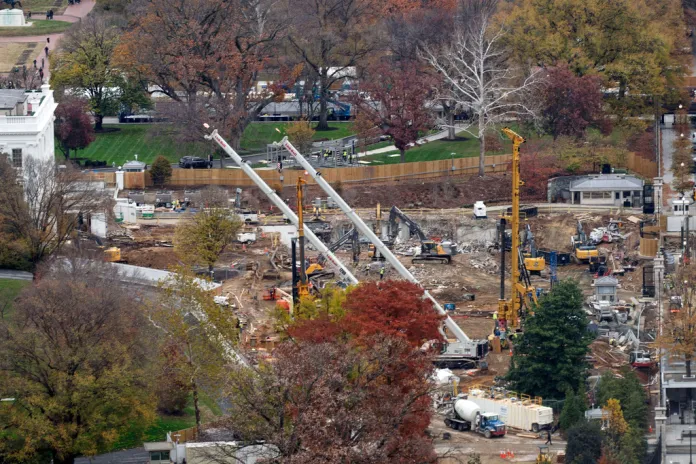
The construction of the new White House ballroom, a project whose estimated cost has ballooned from $200 million to $400 million, is being funded through a mix of private donations and Trump’s personal funds.
Leon added that Trump “may at any time go to Congress to obtain express authority to construct a ballroom and to do so with private funds,” noting “Congress may even choose to appropriate funds for the ballroom, or at least decide that some other funding scheme is acceptable.”
WHITE HOUSE BALLROOM WILL INCLUDE MILITARY BUNKER, TRUMP SAYS
The administration has argued the project would come at “zero cost to the American taxpayer,” although that unconventional funding structure has fueled legal and ethical concerns at the center of the case.
Leon previously found that NTHP had standing to sue and, in February, ruled against claims that the group had wrongly invoked the Administrative Procedures Act in its lawsuit, allowing for an amendment to the complaint.


Subscribe to George Magazine and unlock exclusive bonuses. Your subscription now includes a free crypto essentials guide and three premium downloadable images. These images are perfect for personal use as desktop or mobile backgrounds, with thumbnail previews shown below.




Discount Applied Successfully!
Your savings have been added to the cart.