


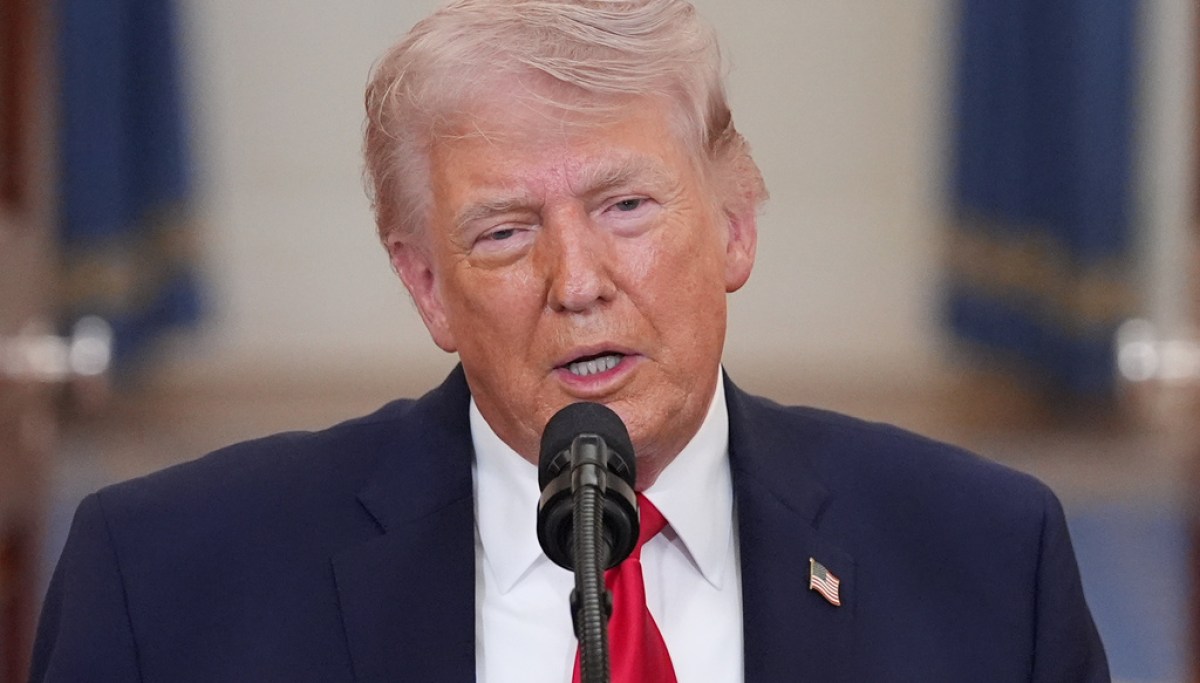
President Donald Trump downplayed the bipartisan housing legislation that many congressional allies hope will ease the affordability worries plaguing voters, saying instead in an exclusive Washington Examiner interview that housing is “all about interest rates.”
Trump said on a phone call Thursday morning that he was focused on more important priorities than the legislation, which the Senate passed last month and faces an unclear future in the House. It would be the second most significant economic policy bill to pass Congress in his second term, after the One Big Beautiful Bill Act that he signed last summer.
Trump said he is pushing for the housing bill but that “we have other things we’re pushing that are bigger, and right now, more important.”
He also took a shot at Federal Reserve Chairman Jerome Powell, whom he has pressured for months to lower interest rates.
“I’m looking at other things very strongly,” Trump said. “Housing to me is all about interest rates, and we’re driving the interest rates down. Other than we have a very, very dumb head of the Federal Reserve, we’re driving the interest rates down.”
Interest rates have risen, though, since the beginning of the war with Iran. Mortgage rates have risen as well, despite falling earlier this year after Trump announced that the government would buy $200 billion in mortgage bonds to lower rates.
Before the war, mortgage rates fell below 6% for the first time since 2022, according to Freddie Mac, which tracks rates weekly.
As of Thursday, the average rate on a 30-year fixed-rate mortgage has risen to 6.45%, according to Mortgage News Daily, which tracks rates daily.
Trump seemed confident that rates would fall once the war with Iran ends.
“I think as soon as that’s over, I think you’re going to see many, many good things happen,” Trump said.
When asked if he thinks rates will go down after the war, Trump acknowledged how mortgage rates were falling before the United States entered the war.
“I think so,” Trump said on the call. “Yeah, I do. They were headed in that direction.”
The housing legislation is designed to boost supply and would not have any bearing on mortgage rates. It is designed to lessen government regulations on housing and incentivize state and local governments to ease land-use regulations.
The bill, the 21st Century ROAD to Housing Act, is a combination of the Senate’s ROAD to Housing Act and the House’s Housing for the 21st Century Act. The Senate version was written by Senate Banking, Housing, and Urban Affairs Committee Chairman Tim Scott (R-SC), along with the panel’s top Democrat, Sen. Elizabeth Warren (D-MA). House Financial Services Committee Chairman French Hill (R-AR) wrote the lower chamber’s version.
The Washington Examiner reached out to Scott and Hill for comment.
Normally, legislation of this magnitude, carefully negotiated to attract support from both sides of the aisle, would require support from the president to make it to final passage.
But Trump has sent conflicting signals about the underlying purpose of the legislation, which is to lower home prices and make them affordable for more families.
For instance, while he has at times said housing affordability is a goal, he has also indicated that he does not want to see housing prices fall because it would hurt homeowners’ wealth.
“People that own their homes, we’re going to keep them wealthy,” Trump said in January. “We’re going to keep those prices up. We’re not going to destroy the value of their homes so that somebody that didn’t work very hard can buy a home.”
While the bill has passed the Senate, it has a trickier path in the House.
There are several provisions that have faced resistance on the House side.
One is a ban on institutional investors such as Blackstone from purchasing single-family homes. That measure was included at the insistence of Trump, who touted it in his State of the Union address.
Such a restriction would be hard for free-market Republicans to accept, regardless of its specific details. But one provision is causing particular resistance from traditional conservatives and the industry. Namely, the bill contains language that would require investors in build-to-rent homes to sell those houses within seven years. Housing experts argue it would decrease the housing stock.
Industry groups have come out hard against the proposal.
MORTGAGE RATES RISE IN DEFIANCE OF TRUMP’S $200 BILLION PUSH, HURTING GOP ON AFFORDABILITY
The National Association of Home Builders, long a supporter of the bipartisan legislation, threatened to withdraw support for the bill over its language. The group is now urging a conference between the House and the Senate over the legislation.
Also, in a recent open letter, a group of prominent housing experts and economists told lawmakers that it would make investing in housing uneconomical and amount to a soft ban. They also said it would directly lead to fewer homes being built.




Discount Applied Successfully!
Your savings have been added to the cart.