


When President Donald Trump was a real estate mogul, he was known for his lavish architectural designs for residential and commercial buildings, hotels, casinos, golf courses, and more. His flagship construction projects often employed what could be described as an in-your-face approach. Trump’s buildings and complexes were large and impossible to miss. Traditional and modern architecture were seamlessly blended together. Materials such as gold, silver, and marble were commonplace, along with plenty of glass and multiple light fixtures. And, in keeping with his personal brand, the vast majority adorned his last name.
There’s nothing wrong with Trump’s approach to real estate. It worked out quite nicely for him and his family. But when he started musing about building a ballroom in the White House, some shuddered at the thought of Trump coming to Washington and altering the design of the people’s house.
The Trump administration announced last summer that a new event space, a state ballroom, was going to be built in the White House’s East Wing. It would be “approximately 90,000 total square feet of ornately designed and carefully crafted space with a seated capacity of 650 people,” according to the July 31, 2025, release, a “significant increase” from the “200-person seated capacity.” The White House State Ballroom would also be “substantially separated from the main building of the White House, but at the same time, it’s theme and architectural heritage will be almost identical.”
Most importantly, the ballroom would be privately financed. “President Trump, and other patriot donors, have generously committed to donating the funds necessary to build this approximately $200 million dollar structure,” according to the briefing. Although the costs of construction have roughly doubled according to some estimates, it still won’t cost the taxpayer a penny.
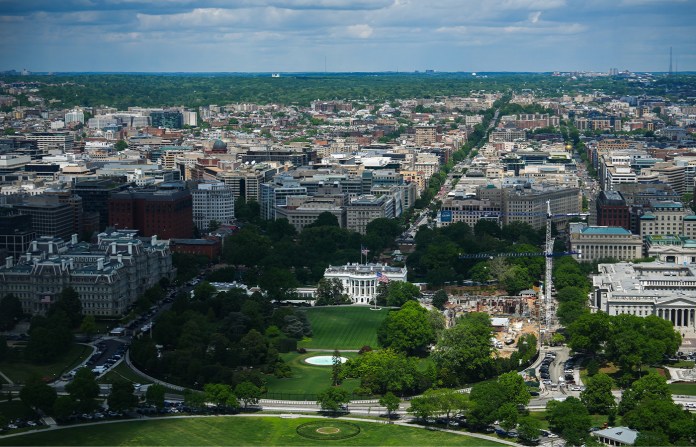
Construction began mostly unnoticed in September 2025. This was unsurprising for several reasons. The East Wing was built in 1902 and, as the Trump administration correctly noted, “has been renovated and changed many times.” As an example, a second story was added in 1942 to house the Presidential Emergency Operations Center, a “top-secret” underground bunker built during President Franklin Roosevelt’s administration to protect him against possible aerial attacks during World War II. In other words, the East Wing didn’t have the same historical significance as other rooms in the White House. There were also more pressing concerns at the time, including the 43-day government shutdown. The development of a privately financed state ballroom in the White House was obviously small potatoes compared to the financial turmoil in Washington.
That changed when photos of the partially demolished East Wing circulated in late October. The National Trust for Historic Preservation worried that the ballroom’s design could “overwhelm” the White House and suggested there should be a freeze in construction. Some of Trump’s political opponents and old foes screamed bloody murder, too. “It’s not his house. It’s your house. And he’s destroying it,” former Democratic presidential nominee Hillary Clinton notably posted on X on Oct. 21.
The reason for this pushback, as Politico noted the same day, was that “Trump previously said construction of the ballroom wouldn’t affect the existing White House.” Indeed, the president had said during the summer that the construction “won’t interfere with the current building. It’ll be near it but not touching it — and pays total respect to the existing building, which I’m the biggest fan of.” Because the ballroom’s design had apparently increased from 650 to “as many as” 999 people for gatherings, there should have been some acknowledgment by either Trump or the White House of this change in plans.
Was it a fate worse than death? Hardly. “I believe there’s a lot of fake outrage right now because nearly every single president who has lived in this beautiful White House behind me has made modernizations and renovations of their own,” White House press secretary Karoline Leavitt said during an Oct. 22 Fox News interview. “Construction is a process. At the end, the East Wing, which is an entirely separate structure from the executive mansion you see behind me, will be more modern and beautiful than ever.”
She’s right. Many presidents have added their own personal touches to the White House. Some construction projects have been quite costly, too. Social media users were reminded about former President Barack Obama’s massive $376 million renovation of the White House when a clip of a 2010 CNN report was circulated on Oct. 22, 2025. The Right Angle News Network noted on X that Obama’s renovation was “fully funded by taxpayers,” unlike Trump’s ballroom, which “he’s paying for himself.” Democratic voices, who were mostly silent in 2010, were unfazed once more.
Until Trump recently showed off some new designs for a grand total of five minutes, that is. The New York Times experienced a complete meltdown and published an interactive page on March 29. The Old Gray Lady suggested the ballroom design had “barely been scrutinized” and “rushed toward construction, with little time for public review of this major addition to the White House.” The Washington Post followed suit on March 30, noting “the new renderings revealed some changes to the ballroom’s design, including removal of stairs on its south side that some observers had criticized as extraneous.”
Then came U.S. District Judge Richard Leon’s decision to grant the National Trust for Historic Preservation’s request for a preliminary injunction on March 31. While this has stopped construction for the time being, it’s hard to fathom that it will have any long-lasting effects. Not only is the East Wing gone, but seeking congressional approval to continue the construction of a state ballroom financed with private money almost seems like a foregone conclusion for Republican lawmakers. Defending a giant hole in the ground on the White House lawn seems like an ill-advised Democratic strategy close to the midterm elections.
The White House Correspondents’ Association dinner shooting at the Washington Hilton on April 25 helped intensify this debate, too. Several White House staffers have suggested the state ballroom would create a safer and more secure environment for these types of large events. Trump made similar arguments during his 60 Minutes interview and on Truth Social.
“What happened last night is exactly the reason that our great Military, Secret Service, Law Enforcement and, for different reasons, every President for the last 150 years, have been DEMANDING that a large, safe, and secure Ballroom be built ON THE GROUNDS OF THE WHITE HOUSE,” he wrote in an April 26 post for the latter. “This event would never have happened with the Militarily Top Secret Ballroom currently under construction at the White House. It cannot be built fast enough!”
This liberal tizzy has been nothing more than making a mountain out of a molehill. When I first wrote about the state ballroom brouhaha in a Nov. 11, 2025, Troy Media syndicated column, I mentioned two historical proposals that would have changed the White House’s structure and appearance beyond our wildest dreams. They would have cost taxpayers a pretty penny, too.
Caroline Harrison, wife of President Benjamin Harrison, proposed a massive extension in 1891 that would have made Trump’s ballroom, Obama’s renovation nightmare, and every other construction project pale by comparison. The White House Historical Association wrote on Feb. 5, 2015, that Harrison’s “most ambitious conception,” created by architect Frederick Dale Owen and housed in the Library of Congress, “would have extended the original house southward by adding a historical art wing facing the Treasury Department to the east, and an official wing facing the State, War and Navy Building to the west.” There would have also been “glass-enclosed palm gardens, plant conservatories and a lily pond” to complete the quadrangle’s southern portion, “which would be linked by two-story connectors, colonnaded cross halls and large glass domes to enclose a private inner courtyard.”
Congress unsurprisingly rejected Harrison’s grandiose vision. If given half the chance, it would have surely done the same thing with another monolithic proposal, the Bingham Plan.
Devised in 1900 by Col. Theodore Bingham, his vision was to replace “the crowded working spaces with new offices, public and entertaining spaces and press rooms by constructing massive, flanking two-story cylindrical wings with domes and lanterns patterned after those at the Library of Congress.” President William McKinley was suitably impressed with Bingham’s proposal, however. A model was soon set up in the East Room and he confidently rose to present “a history of the White House that evolved into a sales pitch for the expansion.” Many architects spoke out against the gargantuan and costly redesign. The project stalled and collapsed after McKinley’s assassination in September 1901.
LAUREN BOEBERT UNVEILS BILL TO GET TRUMP’S WHITE HOUSE BALLROOM ‘OVER THE FINISH LINE’
Then-Vice President Theodore Roosevelt, who was sworn in as president, ultimately approved a remodelled White House in 1902 along the lines of what we largely see today. His sensible restoration project “transformed it from a crazy quilt of alterations over time into a cohesive statement of modern times,” in the wise words of author and historian William Seale. Nevertheless, the White House Historical Association noted that while Harrison’s proposed extension “never came to be realized, the plan anticipates President Theodore Roosevelt’s construction of the East and West Wings in 1902.” One would assume that Bingham’s vision served as a form of inspiration, too.
Fifty-six percent of people are reportedly opposed to Trump’s privately financed state ballroom, according to a Washington Post-ABC News-Ipsos poll conducted in October, with only 28% in support of it. Could this change once it has been completed, the partisan fighting and judicial interference have concluded, and taxpayers realize they’re not footing the bill? It’s possible, but they’ll surely dance around the subject for years to come.
Michael Taube, a columnist for the National Post, Troy Media, and Loonie Politics, was a speechwriter for former Canadian Prime Minister Stephen Harper.
![Enjoy the [Road] Show Travel Mug with Handle, 14ozEnjoy the [Road] Show Travel Mug with Handle, 14oz](https://georgemagazine.com/wp-content/uploads/2024/08/479070202831754764_2048-300x300.jpeg)



Discount Applied Successfully!
Your savings have been added to the cart.