THE DISTRIBUTOR MODEL
Bitcoin Depot did not build its network alone. The company recruited experienced payment industry operators: ATM distributors and credit card processing ISOs who already had merchant relationships, understood terminal hardware, and knew how to manage location-based revenue streams. These were not door-to-door salespeople learning on the job. They were industry veterans with existing books of business and merchant trust built over years.
Bitcoin Depot’s pitch was simple. Find locations, place machines, earn a monthly commission. The rest would take care of itself.
The agreements were detailed. Rates were fixed. Bitcoin Depot paid host merchants a flat monthly fee for the floor space. The higher that fee, the lower the distributor’s commission. A location where Bitcoin Depot paid the merchant $200 per month earned the distributor $105. A location where the merchant received $275 earned the distributor $75. Place machines. Earn commissions. Keep earning as long as the locations stayed active.
The contracts did not include a modification clause for many of the operators who signed early. The rates were fixed. The deal was the deal.
For years, it held together. Distributors built out territories. Some placed a handful of machines. Others built fleets of dozens across multiple states. They drove to convenience stores in Texas heat and Florida rain. They pitched skeptical store owners. They explained Bitcoin to merchants who had never heard of a blockchain. Some opened entirely untapped markets, placing machines in regions where no competitor had gone. They built the network that made Bitcoin Depot worth half a billion dollars at its Nasdaq debut.
Then the emails started.
THE SERVICE CALL PROBLEM
The original pitch was set it and forget it. Find locations, earn commissions, let the technology handle the rest. The machines needed servicing. Merchants needed managing. Ownership of stores changed hands. Machines went offline.
When any of that happened, Bitcoin Depot did not send a technician. The company sent an email to the distributor, the same person who had been told the job was finding locations, not maintaining hardware. Handle this, or we handle it ourselves. The implication was clear: if Bitcoin Depot handled it, the location disappeared from the distributor’s commission stream.
The messages arrived with urgency. A machine was down. A new owner had taken over. The merchant was threatening to unplug the kiosk. Could the distributor take care of it? There was no compensation attached. No acknowledgment that any of this fell outside the original scope. Just the work, and the unspoken understanding of what happened if the distributor said no.
Distributors did the work. What started as occasional calls became a drumbeat. Then a full-time job. They drove to stores at all hours. They mediated disputes between Bitcoin Depot and merchants who had grown frustrated with the machines. They fixed electrical issues. They talked down owners who wanted the kiosk removed. They managed relationships, resolved complaints, and kept machines running. None of it was in their contracts. None of it was compensated. Nobody warned them this was becoming their primary responsibility. Nobody gave them time to make other plans. The machines kept running. Bitcoin Depot kept collecting transaction fees.
Over years, this added up to hundreds of hours of uncompensated labor per distributor. Nobody in that original pitch said anything about service calls. Nobody mentioned that refusing meant losing the account. They found out the way you find out about most things at Bitcoin Depot, when it was already too late.
Distributors allege they were pressured to perform this work under the implicit threat of losing their accounts if they refused. They believed the original pitch. They fell for it. And the records that would document the full extent of that uncompensated labor, every call, every location, every date going back to the beginning, exist inside Bitcoin Depot’s systems. These records remain inaccessible within the bankrupt company.
Every distributor tells the same story: account managers routing problems their way, no money changing hands, the threat of losing the location keeping everyone in line. Now, as distributors try to file accurate claims through the court-appointed claims agent, they have asked Bitcoin Depot directly for those service call logs. Without them, a distributor cannot calculate the fair market value of years of uncompensated labor. The claim is materially incomplete without that data. Bitcoin Depot has responded to every request by redirecting distributors to the same claims agent they are trying to file with. The claims agent cannot produce records only the company holds.
Across the United States, numerous states have enacted Sales Representative Acts giving independent contractors the legal right to access commission records, contracts, and supporting documentation. These are not courtesy requests. They are statutory obligations that exist outside any bankruptcy proceeding and cannot be handed off to a claims agent. Bitcoin Depot has redirected every request anyway. It circles back on itself: file your claim, but do not expect the documents that would make it accurate. At minimum, this is the practical effect of preventing accurate claims from being filed in a federal bankruptcy proceeding.
Bankruptcy law requires debtors to cooperate with creditors. Whether redirecting every records request to a claims agent that cannot fulfill them satisfies that requirement is something Judge Lopez will have to decide.
The core of the distributors’ complaint is that they were pressured into uncontracted labor under the threat of account termination, that Bitcoin Depot benefited from that labor for years, and that the only record of its full extent is now locked inside a company where the records remain inaccessible.
If you are a Bitcoin Depot distributor, every hour of uncompensated service work you performed is part of what you are owed. Without your service call log, that number cannot be accurately calculated. Bitcoin Depot has that log. You are legally entitled to it. Request it in writing from [email protected] and [email protected], citing your state’s sales representative statute. Then file your claim through the Kroll claims agent at restructuring.ra.kroll.com/bitcoindepot. Both steps matter. Neither step requires an attorney to start.
THE EXPLOITATION OF HIGH PERFORMERS
The worst treatment was often reserved for the distributors who performed best. One opened an entirely untapped market, placing machines across an underserved region that no competitor had reached, only to be told afterward that his monthly commission would be $100 less per location than his contract specified. No negotiation. No amendment. A retroactive reduction applied to every location he had spent months placing.
Others brought in major franchise deals, national chains and high-volume retail groups, and watched Bitcoin Depot corporate step in, absorb the accounts directly, and cut the originating distributor out entirely. The people who found the best locations and closed the biggest deals were, in some cases, the ones who lost the most.
Bitcoin Depot built its network on the merchant trust and operational skill of experienced industry veterans. Then it used that network as a source of free labor and, when useful, a pipeline of accounts to bring in-house. The distributors who delivered the most value carried the most risk.
THE FEBRUARY PROMISE
By early 2026, Bitcoin Depot was falling apart. Its distributors had no idea. Revenue had fallen 49.2 percent year over year in the first quarter of 2026, a drop of $80.7 million. Gross profit had collapsed 85.5 percent, from $31.2 million to $4.5 million. The stock had fallen nearly 80 percent in the six months before the filing. Cash had dropped from $65.6 million in December 2025 to $44 million by March.
The company’s own leadership was walking out the door. On February 13, 2026, both the Chief Legal Officer and the Chief Compliance Officer resigned on the same day, explicitly citing concerns about the company’s compliance practices. The Chief Operating Officer resigned March 11 with no reason stated. The CEO resigned March 23. Four executives gone in 38 days.
Goodwin Procter was brought in to investigate internal compliance practices. The firm delivered its findings to the board in April. Those findings were never released. On May 12, the company filed a formal notification with the SEC that it could not submit its quarterly report on time, and attached a going concern warning, management’s own admission that it had doubts about the company’s ability to survive the next twelve months. The bankruptcy filing came six days later.
Bitcoin Depot’s distributors were told none of it. In that same February, a Bitcoin Depot Partner Program Manager sent a written message to at least one distributor confirming that existing accounts would not be affected by any rate changes. New deals only, she wrote. Existing accounts were protected.
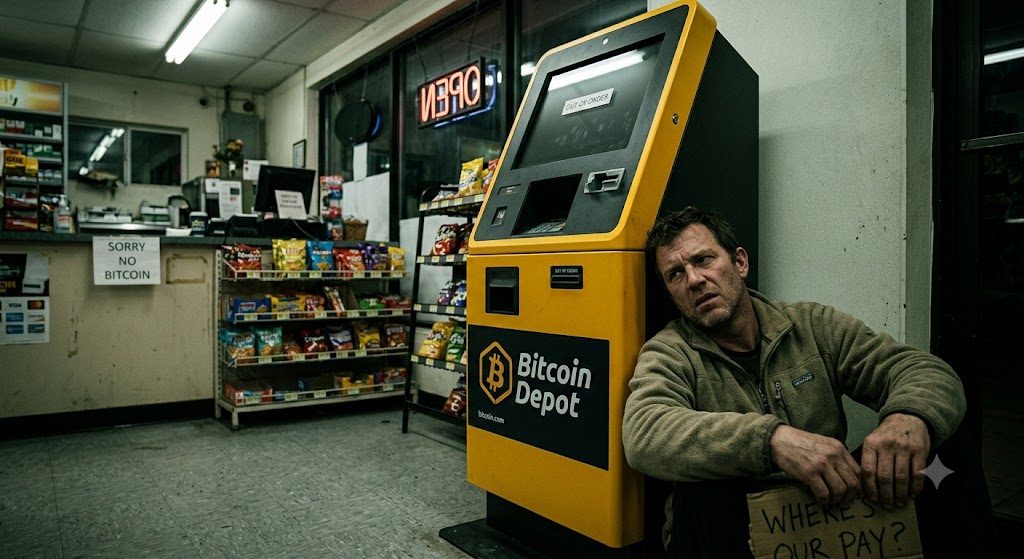
Sixty-four days later, on April 29, 2026, Bitcoin Depot sent a mass notification to its entire distributor network announcing immediate rate cuts. For many distributors, the reduction exceeded 80 percent. The people who had built Bitcoin Depot’s network location by location, who had serviced its machines for free under the implicit threat of losing their accounts, who had set aside other careers because this had become their full-time livelihood…they were told their new monthly commission was $13.71 per location.
Not a mistake. Not a typo. $13.71. Barely enough to cover gas for the service call Bitcoin Depot would expect them to make that same week. The cuts arrived nineteen days before the company filed for bankruptcy.
One distributor’s account captures what that looked like up close. For months before the collapse, his Bitcoin Depot contact had been reassuring. Rates were stable. Existing accounts were protected. Growth was continuing. He kept working, placing locations, servicing machines, managing merchants, on the basis of those assurances. He has the messages. Written, dated, specific. A company representative telling him his existing accounts would not be affected by any changes made to new deals.
Then April 29 arrived. The commission on locations he had spent years building dropped by more than 80 percent overnight, with no explanation, no negotiation, and no contractual basis anyone has been able to identify. He rejected the modification in writing. He rejected a second modification in writing. Bitcoin Depot pushed the rate modifications to the entire distributor network regardless. The company filed for bankruptcy nineteen days later.
Bitcoin Depot did not respond to requests for comment. Brandon Mintz’s representatives did not respond to requests for comment.
Look at the math, because $13.71 was not just an insult. It was a calculation. Unsecured creditors file claims based on what they are owed at the time of filing. A distributor earning $170 per month files a $170 per month claim. A distributor earning $13.71 files a $13.71 claim. By cutting the commissions of the people who built the network to $13.71 nineteen days before filing, Bitcoin Depot reduced the dollar value of every distributor claim before a single one was ever submitted. Lower commissions, lower reported liabilities, less owed on paper to the people owed the most.
The network was deactivated May 17, one day before the filing, so no further commissions would accrue under the original rates. The filing came the next morning. Whether intentional or not, the sequence had a precise financial effect on the people least able to absorb it. The timing speaks for itself.
THE REGULATORY WALL CLOSES IN
While distributors were absorbing rate cuts, regulators across the country had already been building cases for years. The FTC called Bitcoin ATMs a payment portal for scammers back in September 2024. By 2025, the FBI had logged nearly 13,500 complaints and $389 million in losses tied to crypto ATM use, a 58 percent increase over the prior year. More than half the complaints came from people over 50.
Two states have now independently initiated enforcement actions naming Brandon Taylor Mintz personally. The Connecticut Department of Banking published a charging document in 2026 establishing that Bitcoin Depot Operating LLC was 93.3 percent owned by Mintz personally, and seeking to revoke the company’s money transmitter license, ban both the company and Mintz from money transmission for ten years, and impose a $1.5 million personal fine.
On June 15, 2026, the Washington State Department of Financial Institutions filed a separate enforcement action seeking the same: revocation, a ten-year ban, and another $1.5 million personal fine against Mintz. Washington’s charges include allegations that Bitcoin Depot charged fees up to 42 percent above prevailing market rates and failed to provide legally required disclosures in more than 30,000 transactions. These are not actions against the company alone. Two states, independently, have named the founder personally.
Connecticut’s document identifies specific consumers who lost thousands at Bitcoin Depot kiosks: scammers posing as Norton customer service, Apple Support, and FBI agents. People depositing $15,000, $10,500, and $28,800 in cash into machines while on the phone with criminals. Connecticut’s document also references prior state actions. Iowa alleged the company hid the true cost of using the kiosks and misled consumers about refund policies. Maine denied Bitcoin Depot a money transmitter license entirely in April 2025, citing a lack of commercially reasonable fraud safeguards, before settling for $1.9 million. Florida issued a Final Order in July 2025. Minnesota imposed a $20,000 civil penalty in June 2025.
An investigation by ICIJ and CNN found at least $1.5 million in scam transactions through Bitcoin Depot machines installed in Circle K locations alone. The Massachusetts Attorney General alleged that nearly 60 percent of Bitcoin Depot’s Massachusetts revenue was scam-derived and that the company knowingly facilitated more than $10 million in consumer harm. Iowa documented at least $7.2 million in confirmed scam transactions through the company’s kiosks in that state alone. High-volume customers spending $10,000 or more were, according to Massachusetts, overwhelmingly engaged in scam activity.
Indiana banned crypto kiosks entirely in March 2026. Tennessee followed in April, making it a criminal offense to operate or even host one. Minnesota signed its own ban in May 2026, effective August 1. A proposed class-action framework currently being organized by distributors alleges the company actively profited from scam activity targeting elderly and vulnerable consumers, and that it continued operating regardless.
Two of the company’s top compliance officers resigned within 90 days of each other, both citing concerns. An outside law firm investigated. The findings were never released. Six weeks later the company filed for bankruptcy.
The regulatory actions are administrative proceedings. But the conduct they describe, a founder who controlled 93.3 percent of a company that allegedly extracted years of free labor from independent contractors, cut their compensation to $13.71 nineteen days before filing bankruptcy, and whose records remain inaccessible to those trying to file accurate claims, is the same conduct that gives rise to civil claims. Whether those claims are pursued, and by whom, is a question that will be answered in the months ahead.
THE MONEY TRAIL
Even as revenue was collapsing, the company was acquiring competitors. Bitcoin Depot bought Pelicoin in June 2025, National Bitcoin ATM in October 2025, and Instant Coin Bank in January 2026, adding more than 500 kiosks while the business was deteriorating. In February 2026, eleven weeks before the bankruptcy, it acquired Kutt Inc., a social betting startup, and ReadyBucks, a merchant cash advance business, for a combined $4.5 million. The company that would declare $11.3 million in assets against $26.9 million in liabilities was still spending on acquisitions three months before the filing. The sellers and the disposition of those assets in the bankruptcy have not been publicly disclosed.
Brandon Mintz, Bitcoin Depot’s founder, sold more than $8.5 million in company stock throughout 2025, through a pre-scheduled trading plan authorized to sell up to eight million shares. The sales ran in waves across February, September, and October. The plan was set to expire May 31, 2026, thirteen days after the bankruptcy filing. The company separately disclosed in a quarterly filing that it had failed to properly disclose the trading plan on time.
When the bankruptcy was announced, Mintz did not exit. He was expected to remain as a non-executive board advisor, described as providing strategic continuity and institutional knowledge. Mintz’s personal holding company, Mintz Assets Inc., is listed among the 17 debtor entities that filed alongside Bitcoin Depot. The founder filed his own personal asset vehicle into the estate. Nobody knows what’s in it. Not yet. The Schedules of Assets and Liabilities were due June 30, 2026. As of publication they had not been publicly released.
Weeks before the May 18 filing, Chief Financial Officer David Gray and General Counsel Christopher Ryan each received lump-sum retention bonuses, $600,000 and $550,000 respectively, accelerated from agreements that had originally stretched the payments over twelve months. The bonuses were paid May 8, ten days before the filing. Both executives are statutory insiders under bankruptcy law, which extends the lookback period for potential clawbacks. The board authorization documents for those payments have not been made public.
On March 23, 2026, the company disclosed to the SEC that an unauthorized party had stolen approximately 50.9 Bitcoin, valued at roughly $3.7 million, from company wallets. The theft was discovered the same day the CEO resigned. It has not been publicly resolved.
Cash fell from $65.6 million in December 2025 to $22.6 million at filing, more than $43 million in five months. Two CEOs in 90 days. The company’s own board formed an Investigation Subcommittee with authority to pursue claims against current and former officers, directors, and insiders. A litigation trust will be established if findings warrant it. Investigations by the board are typically reserved for significant corporate concerns.
WHAT HAPPENS NEXT
The asset auction closed June 23, 2026. The sale is the largest liquidation of crypto ATM assets in bankruptcy since Cash Cloud Inc., which sold 4,800 kiosks for just $5.7 million in 2023. That sale did not end well: the buyer’s principal was later linked to an alleged Ponzi-like scheme. Bitcoin Depot’s most valuable remaining assets may not be the kiosks at all. Analysts note that Kutt Inc. and ReadyBucks, the two businesses acquired in the final weeks before the filing, could attract more buyer interest than the machines themselves.
The sale hearing is July 2, before Judge Christopher Lopez in Houston. After that, the secured lender gets paid first. Then the lawyers. Then whatever’s left gets split among hundreds of unsecured creditors fighting for fractions of a dollar.
The distributors are in that line.
This is not how it was supposed to go. The distributors were not passive investors or anonymous shareholders. They were small business operators, the kind of people the crypto industry spent years holding up as proof that blockchain technology could democratize wealth and create opportunity outside the traditional financial system. They believed it. They built territories from nothing, drove to strip malls and corner stores, shook hands with merchants, and put their own time and reputations on the line.
They did everything the pitch promised would be rewarded. They were told their role was finding locations. They ended up doing full-time field service work for free. And when the company they built was done with them, it did not simply close. It cut their pay to $13.71, waited nineteen days, and filed for bankruptcy, leaving them to navigate a federal claims process without the documents they need to prove what they are owed.
The crypto industry marketed itself as the antidote to Wall Street greed. Bitcoin Depot’s final move looks a lot like the thing it claimed to replace.
A group of distributors is fighting back. ATM operators and payment processing professionals from across the country, each with the same story told in different accents. Commission cuts without notice. Unpaid service calls. Accounts taken. Written promises broken. Some of them spent years building these territories, setting aside other opportunities because Bitcoin Depot had become their full-time business. They were given no warning and no time to make other plans. They are not waiting quietly now.
They have documentation, and each other. Now someone is finally paying attention. When the bankruptcy concludes, they will collect pennies on the dollar. Not on what they were originally owed. On the reduced commissions Bitcoin Depot imposed nineteen days before filing. The claims they cannot fully document, because the company holds the records, will pay out a fraction of numbers that were already cut by more than 80 percent before anyone filed anything.
Brandon Mintz sold more than $8.5 million in stock in the year before the filing. His trading plan expired thirteen days after the company filed. Connecticut and Washington State are each independently seeking a $1.5 million personal fine and a ten-year ban from money transmission. His personal holding company sits inside the same bankruptcy. The Schedules that would show what it holds and what it claims it is owed are due next week. Two states want $1.5 million from him personally. His own board is investigating the people who ran the company.
The distributors have attorneys. The operators who built his network, serviced his machines without pay, and lost their accounts before they even knew the company was failing are waiting for a Kroll portal to tell them how little they get back.
Mintz is waiting for the Schedules.
EDITOR’S NOTE: The author of this piece is a former Bitcoin Depot distributor whose identity has been withheld by request. The author is currently pursuing claims against the company in the ongoing bankruptcy proceedings. The Schedules of Assets and Liabilities for all 17 debtor entities, including Mintz Assets Inc., are due June 30, 2026. Those schedules should show for the first time what Mintz Assets Inc. holds, what it claims it is owed, and how its finances may relate to the broader estate.
The bankruptcy of Bitcoin Depot Inc. (Case No. 26-90528) is ongoing in the U.S. Bankruptcy Court, Southern District of Texas, before Judge Christopher Lopez. Sale hearing scheduled July 2, 2026. The Connecticut Department of Banking charging document is publicly available at portal.ct.gov. The Washington State Department of Financial Institutions charging document is publicly available at dfi.wa.gov. Facts in this article are claimed by the author to be drawn from public court filings, SEC disclosures, state regulatory actions, documented communications, and accounts provided by Bitcoin Depot distributors. Allegations referenced herein reflect unfiled complaints and active disputes discussed in public organizational proceedings among the affected distributors and have not been adjudicated.






ponzi