

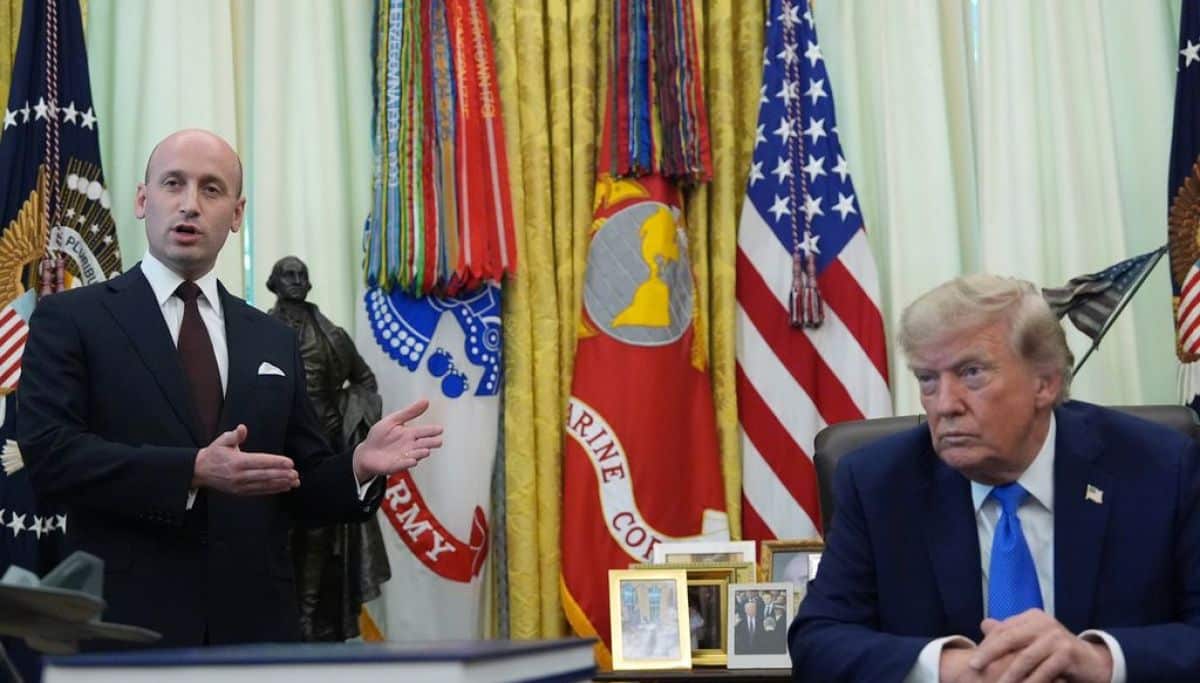
Stephen Miller thinks President Donald Trump’s second bid to curb birthright citizenship can survive where the first failed, he said Thursday from the Oval Office alongside the president at an executive order signing.
Trump’s two new executive orders do not revive his previous broad effort to deny citizenship to children of illegal immigrants and temporary visitors. Instead, they target categories the administration says fall within narrow historical exceptions the Supreme Court left unresolved.
Miller described the orders as an attempt to use the Supreme Court’s ruling in Trump v. Barbara to “expand the definition of people who are ineligible for birthright citizenship.”
“That includes, for example, alien enemies,” Miller said.
Trump’s first birthright citizenship order would have denied automatic citizenship to children born in the United States to parents who were either in the country illegally or present only temporarily. In June, the Supreme Court held that the 14th Amendment extends citizenship to children born to those parents.
Chief Justice John Roberts rooted that ruling in the citizenship clause’s “broad reach and narrow exceptions.” He wrote that the clause begins with territory, requiring a person to be “born … in the United States,” and ends with sovereign power, requiring that person to be “subject to the jurisdiction” of the U.S.
The chief justice said a child born in the U.S. and subject to U.S. law “was made an American citizen.” The established exceptions, he said, were “carefully defined,” covering children of foreign ministers and members of 19th-century Indian tribes over whom the U.S. had ceded part of its territorial jurisdiction.
Trump’s new citizenship order attempts to operate in those narrower areas. It directs agencies to deny citizenship to children born to certain foreign government officials, employees of international organizations with immunity, individuals designated as “alien enemies,” and parents who used commercial arrangements to travel to the U.S. to give birth.
South Texas College of Law professor Josh Blackman said Trump is trying to identify questions that Barbara did not conclusively answer.
“I think he’s trying to find vulnerabilities in the chief’s opinion,” Blackman told the Washington Examiner.
One provision of the orders specifically highlights people born in a U.S. territory or territorial waters where citizenship is not conferred by federal statute. Blackman said that language appears to point to American Samoa and could give the administration a distinct test case that has little to do with the broad rule settled in Barbara.
People born in American Samoa are generally U.S. nationals rather than U.S. citizens at birth, unlike people born in Puerto Rico, Guam, the U.S. Virgin Islands, and the Northern Mariana Islands. Blackman said American Samoa appears to be the only current example contemplated by Trump’s provision.
“It’s an issue not from Barbara, but something called the Insular Cases,” Blackman said, “Which is that people in these various territories are not citizens by birth. … So he’s testing the Insular Cases there as well.”
The executive order could face litigation on that point more readily than other provisions, Blackman said. A pregnant woman from American Samoa could have a direct injury and standing to sue, although her case would not necessarily answer the separate questions involving foreign officials, alleged birth tourists, or designated alien enemies.
Blackman said the administration may otherwise confront more difficult standing problems. States could argue that denying citizenship to people born within their borders would reduce federal funding tied to population, but the Supreme Court did not resolve that theory in Barbara because the earlier litigation involved individual plaintiffs.
Blackman said Trump’s strategy is to force lower courts and, eventually, the Supreme Court to address each category separately rather than reconsider the broad question decided in Barbara.
The alien enemy provision is one example. The majority’s historical account noted the common-law understanding that children born after enemies “possess” a U.S. “castle or fort” were not born under U.S. allegiance. Trump’s order seeks to apply that principle to people designated as alien enemies under federal law, including members of certain foreign terrorist organizations.
“Barbara didn’t decide the status of alien enemies, so that’s not controlled,” Blackman said.
Finding an individual challenger to that provision could prove difficult because few people would likely come forward to identify themselves in court as members of a designated terrorist group. A business that arranges birth tourism travel could also attempt to sue, Blackman said, although its standing would present its own questions.
The provision involving children of ambassadors and other foreign officials rests on a more established footing, Blackman said. Roberts explained that foreign ministers are treated differently because of a legal “fiction of extraterritoriality,” under which diplomats remain, in some respects, under their home country’s sovereignty.
“The children of ambassadors, I think Barbara said they’re not citizens,” Blackman said, although he added that defining which other foreign government employees qualify may be more difficult.
Roberts also drew a sharp contrast between diplomats and ordinary foreign visitors. Citing an early Supreme Court case, he wrote that private foreign nationals who enter the country for “business or caprice” are “amenable to the jurisdiction of the country.” The majority found no similar foreign sovereignty concern for parents who are in the U.S. illegally or temporarily.
“[What] Trump’s doing is basically forcing the Supreme Court to look at each item separately, not just writ large and entire orders,” Blackman said.
The order’s treatment of birth tourism may pose the most difficult constitutional question, and by all considerations appears to be an area where options to crack down are more limited.
Miller explained that the administration sees birth tourism as a form of visa fraud rather than ordinary travel by a pregnant woman. “Birth tourism is, by definition, a fraud on the American system,” he said.
“If you’re telling a consular officer you’re here as a tourist, but your true purpose and intent is to go to a baby mill, give birth, and try to mint an American citizen while you’re here, then you’re committing a fraud against the American government,” Miller said. “And by definition that visa can, and should, and will now be denied.”
Trump’s separate order targeting birth tourism directs the State Department and Department of Homeland Security to develop regulations and guidance aimed at preventing foreign visitors from using temporary visas to give birth in the U.S.
Former acting Immigration and Customs Enforcement Director Jonathan Fahey said the visa-focused component could have practical effects even if the broader citizenship restrictions face litigation.
“If you’re already pregnant and your purpose is to have a child, to have it become a citizen, that would become visa fraud if you lied about that,” Fahey said Friday on Fox News’s Varney & Co. He also argued that stricter enforcement could deter organizations that profit from arranging birth-tourism travel because prospective clients may no longer expect citizenship for their children.
“I think that’s going to be really effective on the deterrence aspect,” Fahey said. “Overall, this is going to be very effective, even if it doesn’t end up being upheld in the courts.”
But Blackman said the administration’s attempt to deny citizenship to children of birth tourists is “the hardest one” legally because “there’s no obvious historical reason why they’re excluded.”
The White House appears to be arguing that fraud used to obtain entry into the U.S. creates an “extraterritorial fiction” that places those children outside the birthright citizenship rule, Blackman said. Yet Roberts’s opinion is a potential obstacle, because it said “temporary visitors remained subject” to U.S. jurisdiction while here and that their children are citizens at birth.
More legal analysts critical of the orders say they stretch limited exceptions under the current law beyond recognition. Tianna Mays, legal director at Democracy Defenders Action, told NBC News that the administration lost “the central constitutional argument” in Barbara and is now trying to stretch narrow exceptions “until it swallows the whole 14th Amendment.”
TRUMP SIGNS EXECUTIVE ORDERS TO CURB BIRTHRIGHT CITIZENSHIP AND ‘BIRTH TOURISM’
Lucas Guttentag, a law professor at Stanford and Yale, told the outlet that the birth tourism directive largely restates powers the government already has under immigration law.
Trump’s new orders are narrower than the policy the court rejected, but they are also designed to test a subset of legal boundaries that Roberts described in his ruling without clearly defining himself.
![[GOOD PRESS] ON[GOOD PRESS] ON](https://georgemagazine.com/wp-content/uploads/2024/08/16389056566437433941_2048-300x300.jpeg)


Discount Applied Successfully!
Your savings have been added to the cart.