

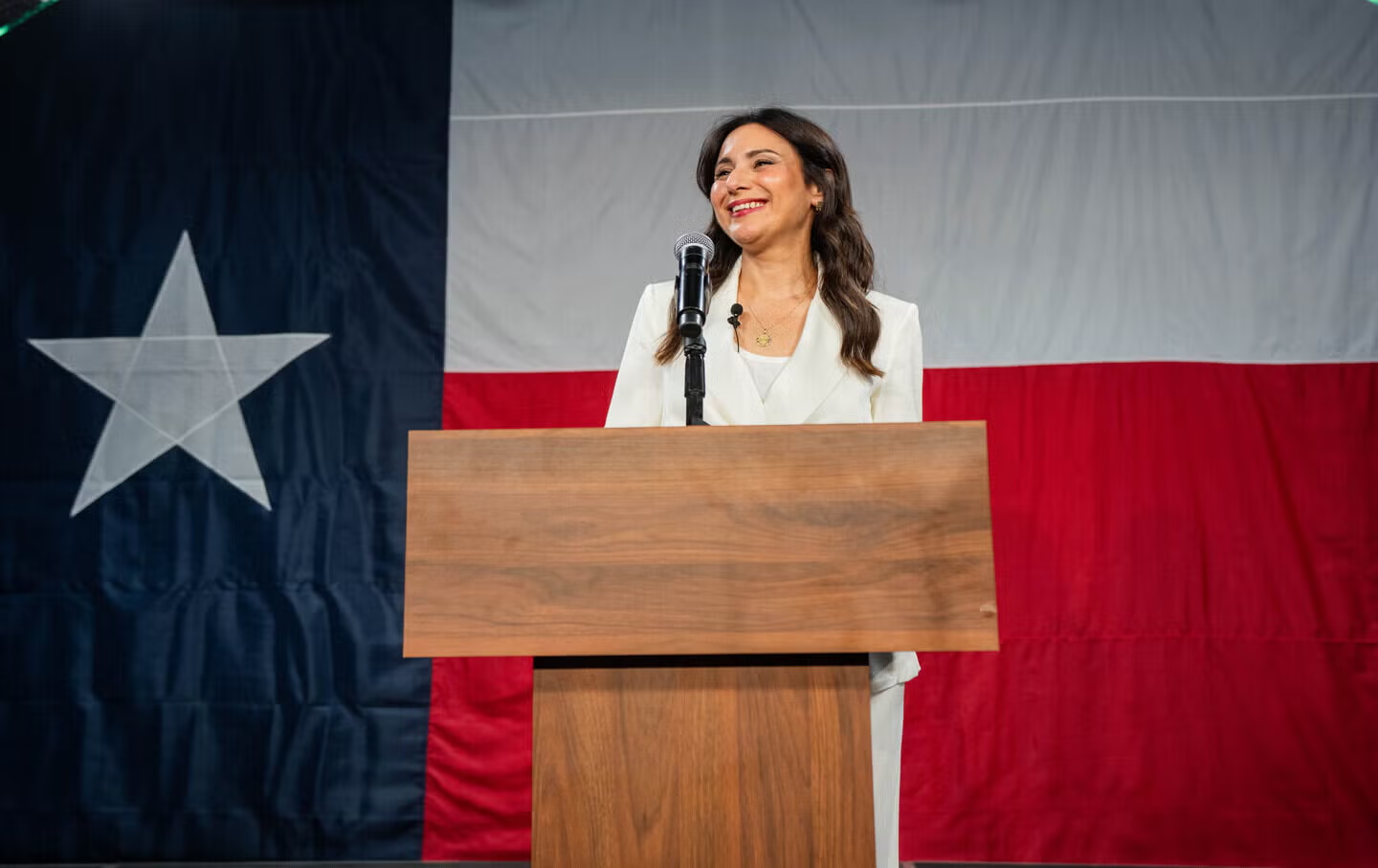
Jon Wiener: From The Nation magazine, this is Start Making Sense. I’m Jon Wiener. Later in the show: how socialism can work in the real world: Bhaskar Sunkara will explain. His new co-authored book is The Blueprint. But first: The Texas earthquake: Steve Phillips will comment – in a minute.
[BREAK]
The most significant single race of the year turned out to be the one nobody predicted: the election of Gina Hinojosa as the governor of Texas. For comment and analysis, we turn to Steve Phillips. He wrote the bestseller Brown is the New White: How the Demographic Revolution has Created a New American Majority. He hosts the podcast ‘Democracy in Color.’ He writes for The Guardian, The Washington Post and The Nation. And his new book has the wonderful title Are White Men Smarter than Everybody Else? It’s a USA Today bestseller. Steve Phillips, welcome back.
Steve Philips: Thanks for having me.
JW: Our best political forecasters did not think Gina Hinojosa would win. Nate Silver didn’t. Neither did the Cook Teport. Neither did any of the best pollsters at The New York Times and The Washington Post. But Gina Hinojosa beat Greg Abbott, 53 to 46%. It wasn’t close. You say that victory is not just the biggest surprise; it’s “more consequential for the future of American politics” than any of the other amazing victories that we had last week. Why is it “more consequential”?
SP: For two reasons. Well, maybe even three. But one is, and we should not skip over that, there’s now millions of people in Texas whose lives will be better and will not have to deal with constant oppression and suppression, hostility and attacks. They’ve eliminated many, if not most of the higher ed programs for anybody who’s not a straight white man, eliminated all the diversity programs and programs for women and people of color. And so, just the quality of life has been very, very difficult. We shouldn’t skip over that in terms of what that will mean in terms of having both Gina and the Texas State House being Democratic. So, you take that as one piece. Then another reason in terms of the national significance, and this is what I wrote about for The Nation back in 2021, after Georgia flipped after the work of Stacey Abrams over a decade to register voters there and sent Ossoff and Warnock to the US Senate in 2021 and flipped the entire United States Senate balance of power. And so, then everything was able to happen from that standpoint. Remember, Stacey called me in 2021. I was like, “so you took that first money we helped you raise in 20– ten years ago, and you’ve turned it into $2 trillion for the American people.” She says, “I like to provide return on investment.” Obviously, the Biden record is mixed, but everything positive that happened in those years would not have happened had Georgia not flipped and had that work not taking place.
Texas is both larger and more racially diverse than Georgia. Texas is – 51% of its eligible voters are people of color. There are more Latinos in Texas than whites. So, the popular conception is that Texas is white men in cowboy boots, and they are there. But that’s not the majority of the people. And so, the significance is both in terms of the federal balance of power, in terms of the US Senate seats and the composition of the House of Representatives. And then looking at the presidential, that Texas has been reliably Republican in terms of its voting, if it’s a partisan skew. But if you take that out of the Electoral College equation for the Republicans, they almost have nowhere to go in terms of 2028 and beyond. And so that’s what was so significant. And then it shows the path that Democrats are losing Latino voters, they moved over to Trump and whatnot. I was watching Rachel Maddow election night, and they were smart enough to send a Latino reporter to his victory party. The joy of the young Latina women there when the race was called for her. It was like transcendent. And that’s the kind of depth of allegiance and partnership and connection that’s generational. And so, if she’s locking in young Latinos and Latinas as seeing the Democratic Party, as looking like them and being for them, the long-term implications of that for politics in this country are enormous.
JW: I want to take a step back to two years ago, when Trump won a majority of the popular vote nationally. Terrible day. A huge number of pundits declared Trump’s victory in 2024, even though it was only one and a half percentage pointing that that represented a fundamental realignment in American politics. And they said it was led by Latinos switching from the Democrats to the Republicans, especially in Texas, especially in the Rio Grande Valley, which for years before Joe Biden had won those counties by 15 points. Trump for the first time carried all of them in 2024. Now, this year, the shift from Republican to Democratic votes in the midterm nationwide is, what, 14 or 15 points? How much did the governor’s race shift in Texas towards the Democrats compared to 2024?
SP: It was a 20-, 21-point shift in terms of the partisan lean, in terms of where things actually went from the prior election to what we actually saw in 2026, which is enormous.
JW: One conclusion some people might draw is that Texas Latinos are very volatile group. They flipped from 2024 to 2026. Maybe they’ll flip back again in 2028. What do you think of that possibility?
SP: That’s why Gina’s race in particular is so strategically significant. If it were just the situation of Latinos repudiating this Trump administration and all of its hostility and all of its attacks, frankly, on Latinos, and all these other communities, and they voted in favor of a white guy such as Talarico. You could say, well, maybe it would switch back, etc.. I mean, there’s an underlying issue here around Democrats not being willing to be seen as fighting for Latino issues. And so, they are not embedded in the psyche and the culture as the champions of Latinos. They’ve been more concerned about alienating whites who might be mad that they’re too close to Latinos. So, this has been a fundamental dynamic. So yes, it could go back and forth. It has somewhat gone back and forth, certainly from 2020, 2022, when it was Democratic, and then 2024 when there was more of a move to Trump and then back here to 2026. But this is why Gina is so significant, because this is not just an issue around this set of issues or inflation or even the ICE crackdowns and whatnot. This is somebody people can identify with and who can personify the community. She comes from the Rio Grande Valley. She is a progressive Latina who has worked in the civil rights law area. And so, she connects culturally as well as politically. And that’s the kind of deeper psychological, cultural, social connection that’s far more enduring and less likely to switch from election to election.
JW: We’re told the number one issue for white voters everywhere was the cost of living. Do you think Latinos care more about high prices than white people? Is that why the turnout was so gigantic or was there another issue why Latinos switched from Trump?
SP: Affordability is real, but I think it’s limited. And so if you look at Latinos, African Americans, actual women, we have a lot of people saying, “let’s talk about kitchen table issues.” There is a gargantuan racial wealth gap in this country between whites and Latinos, between whites and African Americans. There’s a very sizable gender pay gap. Those are kitchen table issues, but there are a lot of Democrats who don’t want to lean into them. So, I say that to say that affordability has always been an issue for the Latino community. It really has to do with the hostility and the hatred that is core, has been core, to Trump’s rise, his hatred and hostility and demonization of Mexican Americans in particular. “They’re rapists.” “They’re murderers” – in his very first presidential speech in 2015. And then you take Stephen Miller and people coming in power, and then what they’ve done with ICE and unleashing that on communities and breaking up families. That’s just been really a bridge too far in terms of assaulting this community and what it is all about. So, I think those issues are actually much more core and fundamental on top of the underlying affordability piece.
JW: And as far as 2028 goes, if Trump had learned to moderate his policies regarding Mexican Americans, it’s conceivable he might have made some progress. But appointing Stephen Miller, as you say, this is doubling down. So, it’s likely to get worse and more frightening. To be perfectly frank about it, for Latinos everywhere in the United States and especially in Texas.
SP: Yes. And but now there’s been so much progress at the state and local level. So, if you’re just looking at the different newspapers and the different counties that the leadership in Harris County and Houston and Austin, they are now directing their local police to not cooperate with ICE. And so, they had to before because of Abbott and the really repressive state leadership, Harris County, where Houston is, is larger than 25 states. And so, it’s enormous. And so, if you can really make some progress there, improve people’s lives, back off the repression, it’s quite consequential both there and statewide.
JW: And you say in your article in The Nation. Latinos were the cornerstone of Hinojosa’s win, but they were not alone. Please tell us about that.
SP: Texas has actually one of the largest concentrations of African Americans in this country, just in terms of the raw numbers of people there, it’s a very big state. And so, the Black community, the Black voters, went very large. And again, as always happens, Black women are the single most progressive, certainly the most Democratic voting bloc, as well as different, as well as Black men following behind them. So, she did quite well there. And so that and there was a larger turnout of Black voters as well, through groups like Texas Organizing Project and efforts like that. That was another part of the cornerstone. So, the Latino piece – and then you had the African American part, which has always been solidly Democratic but got bigger in this election. So that made it even more possible.
JW: I just want to spend one more minute on the fact that Gina Hinojosa is not just Hispanic. She’s also a woman.
SP: Oh, exactly. Which is something people haven’t. And I’ve actually kind of wondered about, not wondered about, worried about. And there’s much too little discussion of what people say that oftentimes the clearest, most simple answer is the right answer. Donald Trump has run for president three times, twice against a woman, once against a man. And the only time he lost was against the man. And so, if we believe and I certainly do, that sexism transcends the different demographic groups that had to come into play as a factor in 2024 with Kamala. And so, it raises the question around, well, what is the potential? What are the challenges that we face, the additional challenges in terms of trying to get the electorate to embrace a woman leader? And so, the fact that Gina actually prevailed and did that is very, very encouraging on multiple different levels. And it is interesting that the prior Democratic governor was also a woman, Ann Richards, back in 1994 and whatnot. So, there is something to be said there.
JW: One more factor. I asked Claude AI, how many voters of color in Texas did not vote in 2026, and they came up with an estimate of something like 5 million or 6 million. I wonder if you agree with that number. And I wonder what you conclude from that number.
SP: So yes, I do agree with that number. I cited similar numbers looking at 2024 and 2022 from the census data — they put out voting statistics. And it’s been around that number. It was probably a little bit smaller because turnout was higher. So we’re in the realm of 5 million people of color who did not vote. And so that is an enormous upside. And it’s an important lesson too, because right now, next week, maybe these moderate Democrats gather and talk about ‘where do we go from here?’ Because there are all these efforts to continue to try to woo more of the moderate, and if there are such a thing. But the whites who are not with us, whereas the upside is enormous. And so, one of the like there’s a group in Texas for all that’s done working at a precinct captain program to be able to get as many people out to vote. That’s the future in terms of locking this down solidly, is having every single precinct in the state have a precinct captain, so we can get those 5 million more voters out. And that also will help flip the state Senate, which will then make Texas a blue trifecta state, which will be enormous as well.
JW: Five million more voters of color to be turned out at the polls next time around. Steve Phillips – you can read his latest piece “Gina Hinojosa’s Win Was the Most Important of the Entire Midterms” at thenation.com. Steve, thanks for all your work – and thanks for talking with us today.
SP: Thanks for having me.
[BREAK]
Jon Wiener: Now it’s time to talk about socialism with Bhaskar Sunkara. Of course, he’s president of The Nation magazine, founding editor of Jacobin, a columnist for The Guardian and coauthor of the new book, The Blueprint: How Socialism Can Work in the Real World. Bhaskar, Welcome back.
Bhaskar Sunkara: Thanks for having me, Jon.
JW: First, can we talk briefly about the election? A few facts: In addition to gaining control of both Houses of Congress, Democrats gained six governorships. Now Democrats will lead nine of the ten most populous states, and will govern states representing 75% of Americans. Democrats also won six new state government trifectas: Pennsylvania, Wisconsin, Michigan, Minnesota, and out West, Nevada and Arizona. Nearly every group of voters moved towards Democrats. The biggest shifts came among Latinos, Asians, young people, and rural voters. So, what do Democrats need to do now?
BS: I think for one, we should just obviously be excited about what’s happened. I mean, the victory in Mississippi, especially — it looks like it’s headed toward a victory. There is one of the biggest triumphs of the broad left in the US since Reconstruction. It’s a symbol obviously. We know that the economic part of the revolution needs to be finished. But the long battle against Jim Crow, the long battle to have people see each other as equals in society, the long struggle for racial justice — it is a real victory in that regard. And I think a lot of the left has grown up in this more pessimistic environment where we’ve been unable to say, yes, the election of Barack Obama and him winning a state like Indiana in 2008 actually means something as far as a barometer of our success. You know, this victory, especially Mississippi, does matter. And broadly the victories in Texas do matter.
Where I put sort of some caution in the mix is just simply that the environment was so favorable for Democrats. Not because of the seats that were contesting–they had a pretty rough map in the Senate–but simply because of how unpopular Trump is – approval ratings by some measures in the low 30s, really unpopular. Iran war spiking diesel prices, which matters a lot in these rural areas, gas prices, the general sense that he’s not delivering on his promises. This yielded a really favorable terrain for any opposition party.
And I think more work needs to be done to make sure the Democratic Party gains stick, particularly in rural and semi-rural areas where Democrats were used to losing 30-70. And this election is sort of proof that if you lose 40-60, you could be competitive statewide. And a lot of these places, and this isn’t even me making a radical socialist point. This is saying, let’s look back to the Howard Dean fifty-state strategy. Let’s look to the people, wherever they were in the spectrum that decided to invest in Mississippi, who thought it was winnable. People who cared about races in Kentucky, which would have been winnable; in Tennessee, which would have been winnable if there was more investment. I don’t care where they are in the spectrum. I think those are the voices to sort of elevate, and where the focus of the party should be going forward/ But obviously it’s very exciting. It’s now easier to see the map to get to 58, 59 solid Democrats in the Senate in the next cycle. And maybe you could poach some sort of grand compromise that labor could make with the Josh Hawley’s of the world and others. Not that I generally support working with those people, but if you get something like the Pro Act passed, I think it could really change the game as far as the organized workers movement in this country. So, it’s very exciting. I’m much more optimistic about the direction this country can go in than I was a month ago.
JW: Your book, The Blueprint How Socialism Can Work in the Real World, starts with the fact that capitalism is not working for most people. That’s pretty obvious. But the big question, of course, is ‘what is to be done?’ And there’s one preliminary objection to the whole project of a blueprint for socialism. It goes all the way back to Marx. He never wrote anything like The Blueprint. His view was that the workers themselves should decide what they needed and wanted, and it would be a mistake, it would be wrong, it would be undemocratic for leaders and intellectuals to tell workers what they needed. Why do you disagree with that? Why do you think socialists owe people a concrete model?
BS: The whole idea of a blueprint today is to tell people that, in fact, despite the past failures of different models of socialism, the barriers to constructing a better world are political, not technical. And that’s a great start of a conversation. If you’re a socialist.
JW: It’s easy enough to see what the minimum program of socialism is: a robust public system of social support. We all know it: Medicare for all. Free childcare. Free public college, strong unions, higher minimum wages. Decent housing, clean water and air. Basically, what the social democracies of Denmark, Norway and Sweden achieved at their peak. You call them “the most livable societies that human beings ever built.” But there’s one huge thing missing, even from Scandinavian socialism. from the viewpoint of socialists. Tell us about that.
BS: Ultimately, it left huge chunks of the economy in private hands. So, there should be a couple objections come to this. In the socialist perspective, we as socialists don’t believe in the sort of division of society between those who own and those who have to work for them. We think that in those conditions, even entering into a free contract as a laborer is sort of a contract made under duress, a sort of worker-starved bargain. Furthermore, we believe that there’s tons of capacity that ordinary workers have to make decisions about production, to participate in the democratic governance of a firm. So, we favor, instead of private capitalist ownership, a labor-managed firm, purely on that normative basis.
Now, there’s a lot of people who say, ‘well, my objection to capitalism is mostly distributional, and it’s mostly about the outcomes of poverty, of neglect, of women not being able to be truly free’ because they don’t have access to childcare, for instance, and that shaping their outlook in life and their opportunities afforded to them, or someone being perpetually unemployed and not being able to fully participate in civil society because they’re always worried about underemployment and not having the money to participate in civil society. For those people, I would say, well, I perfectly agree with all those social democratic objections to capitalism. But even if you just want a robust welfare state that expands and continues to expand to meet people’s needs. And as we have more productivity gains, we plow more of that, those gains into the welfare state– well, you’re still allowing a class of people who have a vested interest in keeping people insecure enough to accept unacceptable bargains at work.
So, in my view, the socialist project is about voice in the workplace, voice in civil society, the democratic voice aspect. But it’s also about giving people exit options. And under capitalism, those exit options are limited. And by simply the fact that ordinary people have to work for a living and are dependent on jobs created disproportionately by private capitalists. We can have a true democracy.
JW: So, ‘voice’: democracy in the workplace, worker control. That’s really the heart of the socialist idea. The first problem there is the conflict between what consumers want: Now we’re calling it ‘affordability’ — and what workers want: Basically, higher wages. What’s your proposal about how that should be decided?
BS: Simply, the market mechanism does in fact resolve this. People are given choice as consumers to look for items on the basis of quality and also cost, and to pick between an array of choices. I think that’s something that actually works quite well in capitalism. The problem with this consumer choice in capitalism is obviously our grossly unequal distribution of income, which a socialist society could resolve through taxes and transfers, and to guaranteeing a right to work and all sorts of things. But the actual choice, and also the fact that these choices are private, does matter.
But workers simply would compete with other firms, other labor managed firms for market share. They would find their market niche, they would grow and expand and become more efficient, or they will contract and fail. And I think this is the market mechanism actually works well and serves egalitarian outcomes.
JW: You also propose investment banks that are public institutions that would decide which worker-controlled firms would be allowed to borrow money to expand or upgrade. But those decisions require economic expertise that ordinary workers, ordinary people, don’t have. So how would that be democratic?
BS: Today, the expansion of existing firms or the creation of new firms is entirely dependent on the – not entirely, mostly dependent – on the entrepreneurial risk of capitalists and also their ability to secure capital. Sometimes they secure capital by starting a new venture and seeking equity partners. Debt for their raising their capital in that regard. Other times they’re getting debt from a private bank, they’re taking out loans. So, if we accept the capitalists aren’t entirely parasites and they’re performing this useful function, we have to find a way to socialize this function in a socialist system.
We do this by turning private banks into public banks. These public banks and these bankers would simply, like existing capitalist bankers, be trying to give out loans and maximize returns within a given risk profile. There would also be state run development banks, which exist in the world today that would serve longer term social objectives. Let’s say we want to invest in this region because this region is lagging behind. We want to lower unemployment here.
We have this big infrastructure project, that those are sort of long-term profitable things, but short term might not be profitable. So, there would still be that function.
The actual decision of a banker or of a bank to give additional funds to a firm to allow it to expand or reject its business plan is not a democratic decision. That decision is sort of a technocratic decision. The recourse that these worker managed firms would have is that they could seek different banks to be their partners with any given project.
But the democratic part comes in simply from us socializing the function as a whole. And again, this might sound sort of wonky, but a major project of the left over the past 200 plus years has been this reconciliation of democratic equality and technical expertise. So, this is a battle, we’ll continue to have to figure out what should be within the sphere of one person, one vote, democratic decision making. And what should be a technocratic function.
JW: One of the deepest criticisms of your project here is your reliance on markets. Some of our friends say markets, by definition, push people to be selfish and competitive, to make fear and greed central to life; basically, to make people like capitalists. Isn’t the market the enemy of community and equality?
BS: I would say that markets, certainly competitive markets, are by definition competitive. It does push the firms towards competition. I think that’s a virtue in certain respects. I believe in reclaiming efficiency as a socialist value. If you’re at a firm that can produce ten widgets with four hours of time and use less natural resources doing it. Wouldn’t you want that firm to succeed and expand, compared to the firm that wastes ten hours of people’s time and more resources to produce the same ten widgets? I think this efficiency is of value.
And then after that, it’s up to society what to do with the surplus that comes from our competition and our efficiency. I do think the social value is the firms are democratic. The firms aren’t owned by private capitalists. That’s one socialist value.
But two, within these firms, making them efficient and producing more social surplus might allow us to make decisions like saying, you know what? This sphere of work is still going to be not great. You’re still going to have to deal with working hard and trying to get results when you’re in the office. But maybe everyone should only be in the office from 9 to 2 every day to allow more time to pick our kids up from school and spend time with their families and in our communities. In this case, you really see how efficiency and competition can actually be married to this wider social goal of making a collective decision, saying, now in this more productive society, we don’t necessarily need more output. We actually would rather value our leisure time. And because there’s still competition, we’re going to make sure that these are actually rules. So even if I would rather work 60-hour weeks, I actually have to work less hours than if I still have lots of energy. I could volunteer, I could do other stuff outside production, but I won’t be undercutting other people who live in the society with certain labor norms.
JW: Can we talk about DSA? DSA, Democratic Socialists of America, is the actually existing socialist organization we have: 130,000 members, the largest socialist organization in American history. You’ve been a member since you were a teenager. Mamdani is a member. AOC is a member. Bernie is not a member. Of course, DSA has factions and fights. Tell us about your view of DSA.
BS: I think it’s a messy democratic organization, and its primary problem is just the fact that it has a weak social base. Even where DSA has a lot of members, like in New York City, with thousands and thousands of members, these members cut across all sorts of – they’re Black, white, Hispanic, Asian, come from all backgrounds, men and women, people from different income groups and whatever else. But it’s primarily like a youth movement. It feels mass in the youth sense. It doesn’t have older people, particularly older workers. Obviously, there’s some old lefties in the organization and so on. I know I’m going to get a message from at least one of them for the way I painted the organization.
But I think about someone like my godmother, she’s a nurse in her 60s at this point, she’s Jamaican. She was kind of a Manleyite. She comes from that tradition. She considers herself a socialist. It’s like a very particular populist tradition. I would love her to come to a meeting. I feel like she–not because anyone’s racist or has any sort of biases towards people–I just feel like it would be hard for her to get inculcated in the culture and run for a democratic position in DSA. And it sometimes has the feeling of a youth organization in that way. Which gives it cultural relevance as part of its power. But I feel like it’s very different.
And when people diagnose the problem, they sometimes say it’s like a lack of diversity or a lack of welcoming. I don’t think that’s actually it. I think it’s a lack of class rootedness. What does it mean to be an organization that doesn’t recruit people in ones and twos, but recruits people in mass? Because it’s like really powerful in an industrial or even service sector when it’s involved with a strike. Then you’re getting dozens of people like my godmother, Yvonne, to join the organization. I feel like that’s the big challenge and that’s more broadly a challenge for left and center left candidates around the country. Like, can you root yourself in the language and practice of ordinary working-class people, which isn’t necessarily more conservative? But it is, I think a little bit different than some of the rhetoric and debates we have in the organization. I think that’s our challenge. And that honestly should be a challenge for the Democratic Party as a whole: how do you restore the association of the left in all its forms with working-class people?
JW: One last word about the election and its significance. All our lives we’ve been told politics is the art of the possible. And that was always a reason why we couldn’t get what we wanted, why we had to give up our most important goals. But this year’s election really transformed the idea of ‘the possible.’ We never thought it would be possible, as you said, to have a Black senator from Mississippi, or a Democratic senator from South Carolina, or a Latina governor of Texas. What do you think is possible right now?
BS: Yeah, I think there’s clearly–in my mind, at least–a social Democratic majority in the U.S. that exists today, a narrow majority, but a majority. The question is really how we activate that majority. I think it actually gets a bit complex in that I don’t think we have a majority for the type of tax and transfer policies. I think we need to create a really egalitarian society. I do think we have a majority for certain guarantees, even if they’re policy-wise more complicated and actually more invasive than taxes and transfers. I think we have a majority for a jobs guarantee, and we could have a majority for national insurance, but we don’t have a majority for the taxes to fund those programs. So, I think it’s complicated.
I think it’s also complicated because people see in their bosses and in the rich the sources of prosperity, not just oppression and theft. And this is obviously some of the story. I would love to talk at some point with you about the California campaign and the billionaire wealth tax. And I think in that case, people, it seems like it’s going forward to rejection. I know there’s still votes to be to be counted, but I think people saw in billionaires, not just people who siphon their labor, but saw in them job creation and wealth opportunities.
And I think we need to make sure that our version of transformation that we’re offering to people is not just about redistribution, but also dignity and wealth creation, which is another can of worms. But I really do think that the American people have shown themselves to, one, be not nearly as racist and xenophobic as Trump, a low bar, but I think an important one. And also, willing to listen to people who have something to offer for them. That’s why, again, I go back to Colom, I go back to Mississippi, and I say that this is a sign of the America that we want to live in.
After November 2024, I personally had a more pessimistic view of the direction things were going to go in. And we did see a bit of it. We saw more racism or xenophobia, more just general meanness and bullying. And I think now we have the chance to really offer a positive alternative in which we look at one another through solidarity, as people who are in a community together, not like burdens to one another.
JW: ‘The America we want to live in’: Bhaskar Sunkara – his new coauthored book is The Blueprint: How Socialism Can Work in the Real World. And he and his coauthors have a new piece at thenation.com, “Do Socialists Even Believe in Socialism Anymore?” Bhaskar, thanks for talking with us today.
BS: Thanks for having me.




Discount Applied Successfully!
Your savings have been added to the cart.