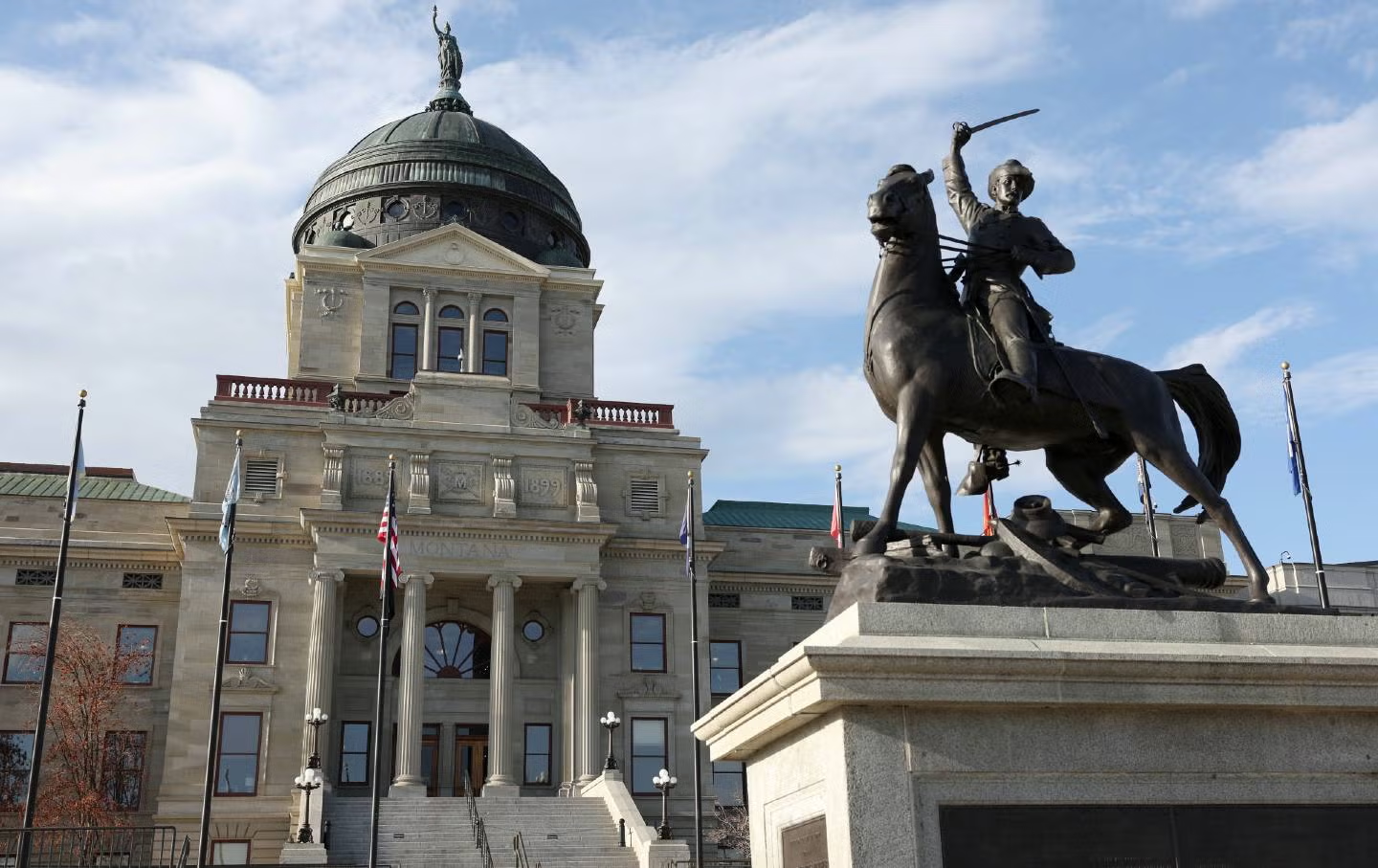
On November 3, two-thirds of Montana voters approved a measure that strips corporations of the power to spend money on elections, striking a blow against corporate political cash in a state that went for Donald Trump by 20 points in 2024.
Initiative 194, known as the “Montana Plan,” is a first-of-its-kind ballot measure that rewrites state law so that “artificial persons”—such as corporations, nonprofits, unions, and trade associations—are no longer allowed to spend on candidates, PACs, or ballot measures. Advocates hail the plan as a novel legal strategy to bar corporate and dark money from influencing elections, and say that versions are being pursued in more than 30 states.
The measure passed by 66 to 34 percent, making Montana the second state, after Hawaii, to use its power over corporate charters to sidestep the US Supreme Court’s 2010 decision in Citizens United v. FEC. The ruling, which held that the First Amendment prohibits the government from restricting independent political spending by corporations and unions, relied on the claim that spending not coordinated with a candidate cannot corrupt; now candidates are permitted by the Federal Election Commission to raise money for their allied super PACs, and in practice frequently coordinate with them. Over 465,000 Montana voters voted on the initiative, which was greeted with a lawsuit from the Montana Republican Party and conservative groups on election night, before the race was called.
The initiative’s approval came as the 2026 elections smashed spending records. AdImpact tallied $11.9 billion in media spending nationwide, making this the most expensive election on record for political advertising. Outside spending on federal races, by groups like super PACs that pay for things like ads and mailers, was projected by OpenSecrets to reach $3.9 billion, a record for a midterm. The nonprofit also calculated that dark money flowing into federal races surpassed $1.5 billion, more than in the 2024 presidential cycle.
Voters this year noticed. An AP poll of midterm voters found that government corruption was the factor most mentioned in the survey as “crucial” in their choice for Congress, followed by the cost of living. More than half of midterm voters pointed to corruption as a main concern in the poll, conducted by the nonpartisan SSRS.
The Montana Plan redefines the powers the state grants to artificial persons, like corporations and nonprofits, to no longer include spending in elections—harnessing the legal distinction between constitutional rights and charter powers that are issued by states. Rather than restricting corporate speech rights, which Citizens United protects, the statutory Initiative 194 changes Montana’s code so that the state no longer grants artificial persons the power to spend on politics. Corporations and covered entities would no longer be allowed to contribute to any candidate, political party, or political committee in an election in Montana, including state and local ballot initiatives. Backers say that corporations remain free to advocate for candidates without giving money.
The measure applies to companies chartered in the state as well as out-of-state companies and nonprofits, so a Delaware corporation or a Washington, DC, nonprofit will be barred from unloading cash in a Montana election. Political committees, including super PACs, can still spend in the state, and individuals can still give to them—but corporations, nonprofits, and other artificial persons can no longer contribute to those committees. The new law does not apply to individuals, government bodies, or the distribution of news or commentary, unless the outlet is controlled by a party, PAC, or candidate.
A company, nonprofit, union, or other group found to be in violation would forfeit its charter privileges, including limited liability, and would be required to pay back its spending, regardless of whether it won or lost in the contest. The legal theory behind the plan, dubbed the Corporate Power Reset, was developed by Tom Moore, senior fellow at the Center for American Progress, who compiled a tracker of ballot initiatives and state bills introduced or being considered. Montana supporters say that once the law is in effect, disclosures listing the donors behind spending groups in the state will be names of real people, not corporations or dark-money groups.
The law is set to take effect on January 1, 2027, and legal challenges are underway that could be bound for the US Supreme Court, where the case would pit long-standing legal precedent for states’ authority to define corporate powers against the ruling in Citizens United. The Montana lawsuit, filed by the Institute for Free Speech on behalf of the state GOP and conservative groups, argues that the law violates the First Amendment by barring them from spending to communicate about candidates and ballot measures.
The nonprofit behind the initiative, the Transparent Election Initiative (TEI), says it anticipated the legal challenge and is prepared to defend the plan while helping other states advance their own versions.
“What I’ve been saying to folks for two years now is, there is a solution,” said Jeff Mangan, a former state legislator and Montana commissioner of political practices who is TEI’s founder and president, of the flood of corporate and dark money in elections.
“I started at the beginning of 2025, doing a listening session across the state, just asking folks about how they felt about money in politics, and if they’re ready for a change,” Mangan said. “I always led with the same question: Do you believe there’s too much money in politics? Everyone said yes.”
Since Citizens United, he said, people had been told that “there’s nothing you can do unless you have an amendment to the Constitution or the Supreme Court overturns it.” When he outlined the plan building on the state’s authority over corporations “to change the way corporations spend in elections, which will affect dark money and the amount of money going into our politics,” he said, “people got excited about it and wanted to collect signatures.”
TEI’s all-volunteer signature drive collected more than 50,000 signatures from all 56 Montana counties, above the 30,121 valid signatures required, with more than 600 volunteers helping the initiative qualify for the ballot. Mangan said TEI aimed to show the measure could make the ballot without the paid signature gatherers that have become commonplace for campaigns.
He pointed to the surge of corporate money this cycle. “The amount of money this year alone is staggering,” he said. Public Citizen recently found that 40 percent of the $1.8 billion that corporations have spent since the Citizens United ruling came in the 2026 midterms. The scale of the spending was inescapable, Mangan said, in recent Montana races like the 2024 Senate contest between Democrat Jon Tester and now-Senator Tim Sheehy, which set a national record for per-voter spending. He points out that billionaires are free to form PACs, just with their names attached. “They choose to spend anonymously through C4s or keep it dark for a reason,” he said, referring to 501(c)4 nonprofits.
A 2018 documentary about secret spending in Montana politics, Dark Money, was a regular feature of the signature drive. TEI showed the movie about a dozen times around the state, Mangan said, including a screening in Helena with remarks from the filmmaker, Kimberly Reed, who is from there.
Volunteers from other groups joined to put the Montana Plan in front of voters. The League of Women Voters of Montana’s members gathered signatures and hosted voter education events around the state, said Bonnie Lorenzen, the group’s president.
“The League of Women Voters of Montana chose early on to endorse the Montana Plan because it aligned perfectly with the League’s goal to ensure that our government serves the people, not wealthy special interests,” Lorenzen told The Nation. “We believe this is best attained by promoting transparency in government and eliminating dark money, which is what the Montana Plan aims to do.”
“Our elected officials need to be responsive to their constituents who elect them, not to corporate entities financing their campaigns,” Lorenzen said.
Former Republican governor Marc Racicot endorsed the Montana Plan, calling it “a brilliant idea,” along with Tester and Gary Buchanan, a former independent candidate for Congress. Groups applauding the plan included the cross-partisan Issue One, Free Speech for People, and Craig Holman, government affairs lobbyist for Public Citizen. Opposition to the ballot initiative came from groups including the Montana Chamber of Commerce, the Montana Mining Association, and the Montana Petroleum Association, as well as the state GOP. In April, the Montana Supreme Court unanimously dismissed a challenge from business groups that would have barred I-194 from the ballot, ruling that citizens have a right to go through the initiative process.
In May, Hawaii became the first state to enact a law based on the Corporate Power Reset framework, when Act 11, passed with near-unanimous support in the state House and Senate, was signed by Governor Josh Green. The law takes effect July 1, 2027, though it faces two federal lawsuits: one from the free-market think tank Grassroot Institute of Hawaii, and a second from the massive dark-money lobby the US Chamber of Commerce.
Bills based on the Corporate Power Reset were introduced in nearly 20 states this year, after New York was the first to introduce the legislation in late 2025. The New York Assembly bill was sponsored by Assemblyman Micah Lasher, now a US representative-elect, and the Senate bill by Senator Kristen Gonzalez; both bills were left in committee.
“We’ve always said it has to be a local solution, it has to be a state-by-state solution,” Mangan said of others seeking to pass the plan, whether through ballot initiatives or state legislatures. The measure’s spread across the map, he said, shows it has been “embraced by folks across the political spectrum.” After the plan’s resounding passage in Montana, he sees people thinking, “Oh, we can actually do something, rather than just saying we can do something.”


Discount Applied Successfully!
Your savings have been added to the cart.