

China is building nuclear weapons at a “hot and heavy” pace and could catch up to the United States in the next decade, President Donald Trump said Nov. 20, a day after meeting with Chinese leader Xi Jinping and Russian President Vladimir Putin in China.
“China’s way behind, but they’ll catch us within 10 years,” Trump told reporters at a press conference. “But they have a lot.”
The president estimated China had 600 nuclear weapons. The United States has over 3,700 nuclear warheads in its stockpile, according to the Energy Department.
Russia has 4,400 warheads, according to the Stockholm International Peace Research Institute.
The New Strategic Arms Reduction Treaty (START) expired in February, which capped deployed U.S. and Russian strategic nuclear arms.
Trump is seeking a new treaty with a vision of making the world safer from nuclear weapons, which he considers the “single greatest threat to the world,” Under Secretary for Arms Control and International Security Thomas DiNanno said Feb. 6 in Geneva.
Related Stories


China is on track to have over 1,000 nuclear warheads by 2030, and Russia is helping China develop the weapons-grade fissile material needed for the expansion, DiNanno said.
Trump said Xi and Putin agreed to the idea of limiting nuclear weapons in the first-ever trilateral meeting among the nuclear powers.
The relationship was “fantastic,” Trump said.
The countries control 92 percent of global nuclear weapons, but the level of destruction represented was much greater than conventional weapons or war machines, the president added.
“It’s unacceptable,” Trump said. “This is a different level. We’re not going to let it destroy the world because there can be no winners.”
The leaders spoke about the need to cooperate to stop the spread of nuclear weapons, fissile material, and weapons-related technology to countries and other nonstate entities, Trump said.

Chinese leader Xi Jinping (2nd L), U.S. President Donald Trump (R), and Russia’s President Vladimir Putin take part in a trilateral meeting at Kylin Villa on the sidelines of the Asia-Pacific Economic Cooperation Summit in Shenzhen, China, on Nov. 19, 2026. Mandel Ngan/AFP via Getty Images
They also spoke “extensively” about ensuring Iran will never have a nuclear weapon—the main reason Trump started the conflict with the Middle Eastern country in February.
“Iran will never have a nuclear weapon ever,” Trump said.
The leaders also pledged to dialogue on reducing nuclear risks and preventing the further spread of nuclear weapons.
Secretary of State Marco Rubio said it helped the leaders to engage in agreements by having good relationships.

A Yars intercontinental ballistic missile is test-fired from the Plesetsk launchpad in northwestern Russia on Oct. 29, 2024. Russian Defense Ministry Press Service/AP
“These three countries … possess the overwhelming majority of nuclear weapons on this planet,” Rubio said. “The better these three leaders get along, the easier and more conducive the environment will be to actually agree to things that are concrete down the road.”
The talks come at a time when the threat of nuclear warfare has reached outer space, according to an October report by the Defense Intelligence Agency detailing current space-related national security threats.
“Russia is developing a satellite designed to carry a nuclear weapon despite its obligation to comply with the 1967 Outer Space Treaty, which prohibits the placement of any objects carrying nuclear weapons or any other kinds of weapons of mass destruction into orbit around Earth,” the agency reported.
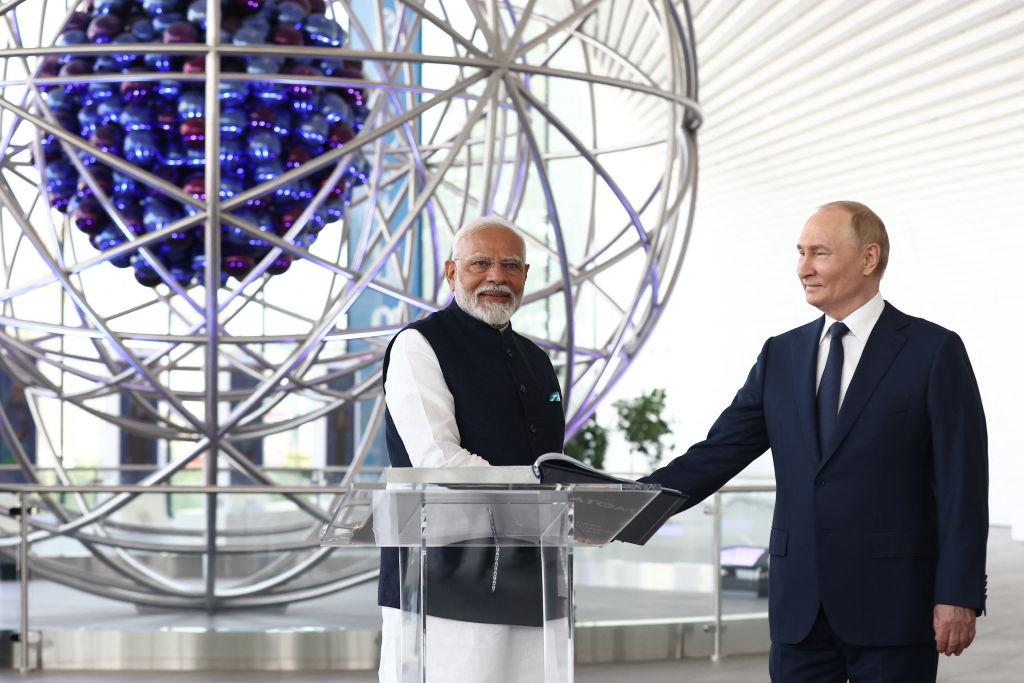
Russian President Vladimir Putin and Indian Prime Minister Narendra Modi tour an exhibit showing Russia’s achievements in the nuclear power industry at the All-Russia Exhibition Center in Moscow on July 9, 2024. Artem Geodakyan/Pool/AFP
In February 2022, Russia launched Cosmos 2553, a satellite that Moscow claimed was testing the effects of space radiation on electronic systems, but it was launched into an “unusual and isolated orbit not used by any other spacecraft,” the Defense Intelligence Agency reported.
China, Russia, Iran, and North Korea are developing, testing, deploying, and using space capabilities in a way that threatens the security of all space systems and their associated benefits, the agency said.
Iran has also launched satellites into lower orbit for civil and military use, according to the report.
There is no indication that China plans to actively test or develop a nuclear anti-satellite weapon for space, the report said.




Discount Applied Successfully!
Your savings have been added to the cart.