

You see the promise on airline booking screens, shipping boxes, electronics and grocery aisles: “Carbon neutral.” “Net zero.” “Climate pledge friendly.” Those labels rest on the comforting premise that even when companies and countries keep burning fossil fuels, the resulting pollution can be canceled out by simply capturing the carbon and locking it away.
Recently, along with my colleagues at ProPublica and Drilled, I investigated how the world came to rely so heavily on this premise, particularly in the technology known as carbon capture and storage. CCS aims to trap carbon dioxide that would otherwise be warming the atmosphere and pump it thousands of feet below Earth’s surface, where, ideally, it stays put. The oil industry has long favored the idea.
At the industry’s prodding, the United Nations has effectively endorsed the idea that the technology can work at a massive scale.
Over the last two weeks, world leaders and negotiators met in Antalya, Turkey, for the U.N.’s annual flagship climate summit, where nations hash out global commitments to curb warming. A central foundation of these negotiations — and many of those carbon-neutrality labels and climate pledges — is the expectation that we can bury billions of tons of CO2 a year, an operation that would rival today’s entire global oil industry within just a couple of decades.
Yet our reporting found that expectation rests on thin evidence. After three decades of development, only 12 large-scale geologic storage projects have ever been built, and at least seven have underperformed or failed. Last year, the world buried less CO2 underground than a single large power plant emits annually.
Why do world leaders keep staking climate policy on a technology that remains unproven?
Because the models they all rely on to guide their approach have already presumed that it will work.
I spoke to more than 100 experts for this series, including several members of the wildly powerful group of people who build and run those models. Their simulations of the economy and environment map out how specific choices, like retiring coal plants or electrifying vehicles, could prevent warming catastrophic enough to submerge cities like Miami. Which means that if they’re wrong, Miami could pay the price.
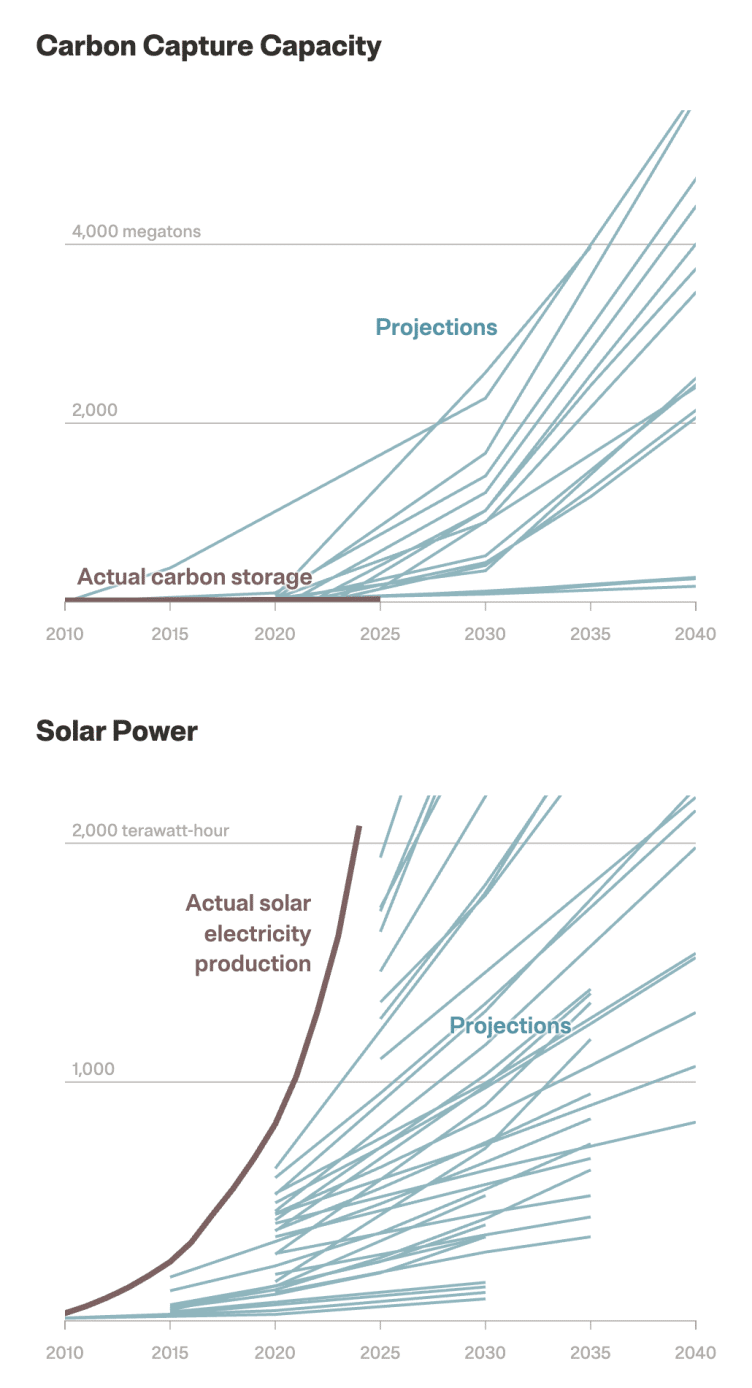
One chart laid bare to me exactly how wrong they’ve been about CCS. It compares one prominent model’s projections for CCS with their projections for solar power, a technology so abundantly tested and proven that you can likely spot a panel out the nearest window:
Meanwhile, solar electricity production has grown rapidly, far outpacing projections.
I wanted to understand what could possibly account for such a disparity. But the problem is the models are opaque: Unlike most scientists, who trade in public, peer-reviewed studies, modelers aren’t required to document every assumption they build into their influential simulations.
So I tracked down the leaders of the world’s three most influential climate models — one based in the Netherlands, another in Germany and a third in Austria — and asked. Here’s what I learned:
Public data is hard to come by, but several analyses have found the real capture rates are far lower than the industry has promised. Yet the models calculate as much as a 92% success rate. When I pointed out this discrepancy to Keywan Riahi, who leads the Austrian model, he insisted that capturing concentrated CO2 from industrial emissions “is not high-tech, this is very easy to do.” Riahi told me the models assume a high rate of capture because they factor in incentives such as payouts from carbon taxes and large government subsidies. Add those incentives, he argues, and the capture rates would increase.
In project after project, operators have struggled to inject as much carbon into the earth as they say they can. For instance, at Chevron’s Gorgon natural gas processing plant in Australia, billed as the largest CCS operation on Earth, clogged wells and pressure spikes have forced operators to release most of their CO2 straight into the air. As it stands, only the German model, led by Jessica Strefler, assumed there’d be any limit to how much CO2 operators could inject underground at once. But, she told me, there is no good data to work from, and she pegged the limit based on “expert interviews” with people in the industry.
Modelers took that cue from a rosy 2005 U.N. report, which I’d learned had been written at the behest of Saudi Arabia and allied petrostates, that portrayed underground storage space as practically limitless. (The U.N.’s climate science body has said it stands by the report. Scientists who contributed to the report also defended their work. Authors and editors from Saudi Aramco, Chevron and Shell joined scientists in writing it; the companies did not respond to requests for comment.) Yet just last year, a paper in the journal Nature warned that the earth’s capacity to absorb CCS could be far more limited once you rule out pumping the gas beneath cities, into earthquake zones and under the deepest parts of the oceans. If CCS ever worked at the scale modelers imagine, the paper found, the Earth could run out of room as soon as early next century. Riahi, himself a co-author on that paper, conceded that although his model presumes the earth’s capacity for carbon storage is literally infinite, the real potential may be “smaller.”
Scientists warn that even tiny annual leak rates over longtime horizons could undermine a storage site’s climate benefit. Our investigation found two large-scale sites that have leaked, one all the way to the surface. Surely the models all factor in this risk? I asked Detlef van Vuuren, leader of the Dutch model, if his did so. His one-word answer: “Nope.”
When I asked Strefler if it makes sense to assume our children and grandchildren will pay big bucks to suck CO2 out of the air, even though today governments won’t spend pennies to avoid emitting that pollution, she said: “If a country is not willing to do that, I don’t see how they would be willing to” pay for CO2 removal.
In short, the modelers overlooked decades of underperformance, inflated capture rates, evidence of leaks and finite underground storage, all while assuming future generations will willingly bankroll an increasingly expensive industry. They pointed to a mix of legitimate studies to support those assertions. They also pointed to unreviewed white papers, casual chats with industry insiders and the 2005 U.N. report — of which van Vuuren was an author. Van Vuuren said his team is working to revise some of its assumptions, but he generally sees no technical reason why CCS cannot work, or should be excluded from the possibilities his model considers. He said it is a policy decision whether countries wish to invest the dollars and effort to make it happen.
One way to look at the model projections is as recipes for the future. Seen this way, the modelers’ argument is that their job is to assemble a cookbook, not tell us how each recipe tastes. In other words, the models merely show that if CCS works and is used at an extraordinary scale, it is possible to hit climate targets. And the modelers told ProPublica and Drilled that the delay in climate action has left few other tools to do so — and so they include CCS.
A good recipe, though, cannot rely on imaginary ingredients. If we’re making unrealistic assumptions, why not include the possibility that aliens will appear and hand us a solution to climate change, I asked Riahi, half joking.
“You can quote me that I think carbon dioxide removal is more likely than an alien,” Riahi said.
The post Why Is the World Still Counting on Unproven Carbon Capture Technology? appeared first on ProPublica.




Discount Applied Successfully!
Your savings have been added to the cart.