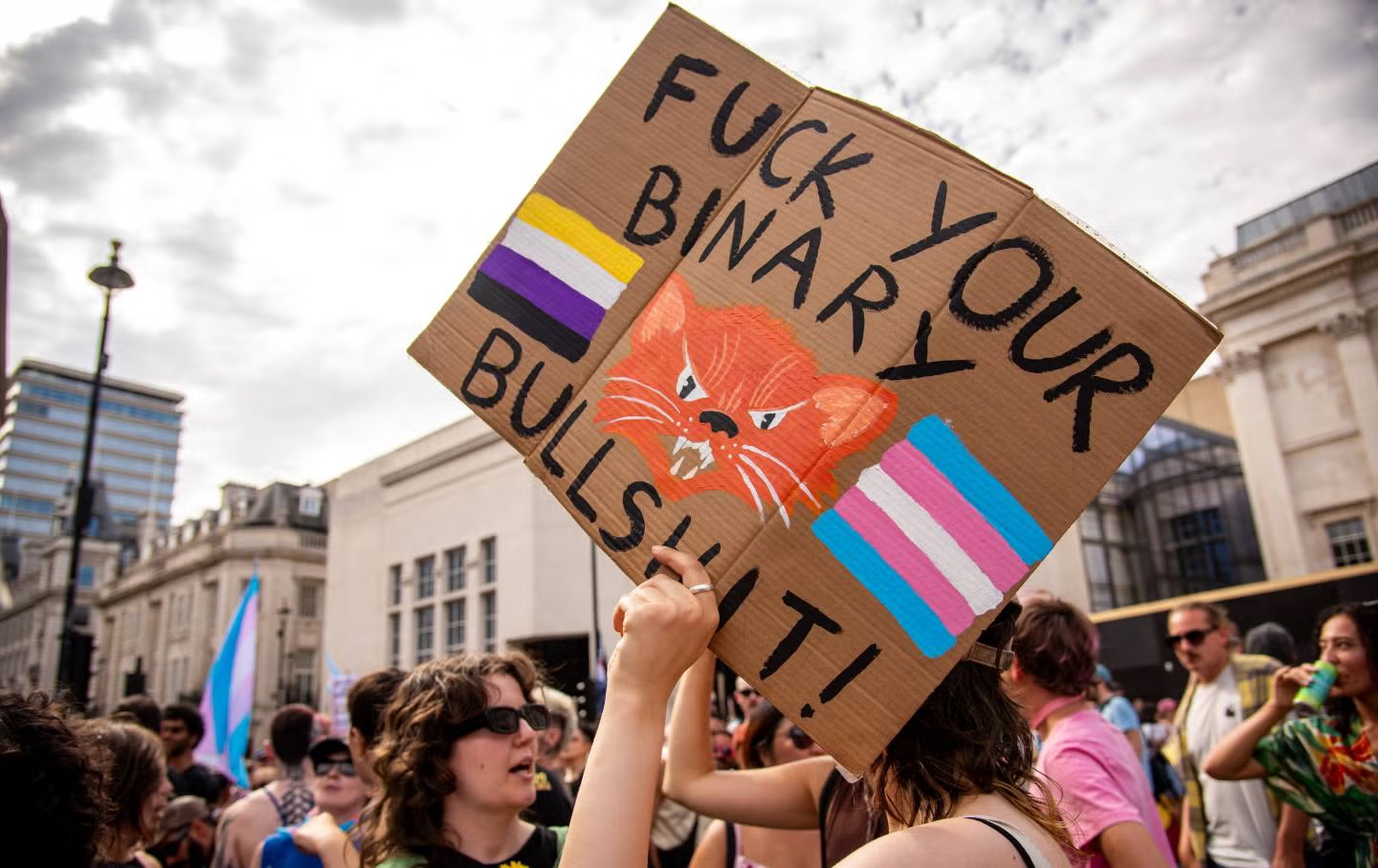
A protester holds a placard during the London Trans+ Pride 2026 Parade. New Equality and Human Rights Commission (EHRC) rules limiting single-sex spaces to biological sex created a “bleak” backdrop for this year’s London Trans+ Pride march.
(Loredana Sangiuliano / SOPA Images/LightRocket via Getty Images)
In 2022, my partner, Wes, and I deposited three embryos in a fertility clinic freezer, where they sat for the duration of the pandemic. We wondered if we would ever see them again. It doesn’t matter where the embryos came from, or whether Wes and I are genetically linked to them. What matters is that we’ve wanted this for a long time, and our plan is bound to make people uncomfortable.
Physically speaking, neither of us can carry a child. In 2024, we started looking for a gestational surrogate—someone to carry our implanted embryo—which is different from a traditional surrogate, who contributes a portion of the genetic material. Surrogacy is altruistic in Canada where we live, meaning that surrogates do it simply because they want to help. Although they can be reimbursed for pregnancy-related expenses, it’s illegal for them to be paid for their services. That doesn’t mean it’s free: Laboratory, legal, notarial, and agency costs guarantee a five-figure project.
Because of this altruism, surrogates are relatively scarce in Canada: chimeras who mustn’t be scared off. It’s considered poor form to reach out to potential surrogates directly, so the best hope Wes and I had was to cast our line in private Facebook groups where intended parents can match with surrogates and… wait for a bite. We had decided on an independent search instead of the more costly method of using an agency.
We posted shy photos of ourselves in the salt flats of Bolivia’s Uyuni desert and explained what kind of parents we would be: loving, somewhat equipped, and interested in taking a little one to the strangest places on earth. We didn’t have to wait long. A reply came the next day, while we were watching the Opening Ceremony of the 2024 Paris Olympics, just before the mechanical horse glided across the Seine. A few calls later, Em had volunteered to carry our baby. A gift of that magnitude is incomprehensible. What if we hadn’t posted that day, or if horses didn’t tread water?
Roadblocks came up as soon as we started the process. Wes is nonbinary, yet most of the forms required for surrogacy offer only binary options. A notary got our names wrong on the surrogacy agreement. Our lab results were contaminated four times somewhere between our home province of Quebec and Arizona, which delayed our family planning by several months. Quebec fertility laws changed when we were mid-process and our lawyer had to scramble to figure out the differences. Our first embryo transfer didn’t work out. But we forgot many of these troubles the minute we got news of the positive pregnancy test earlier this year.
This was Em’s second time being a surrogate, so they coached us through the steps. If at first the journey felt slow, soon we could hardly keep up. Our life became a diorama of midwife appointments, prenatal classes, and yes, even phone calls to prospective daycares, because with a baby, the future is always on your heels. I got a PhD in how to clean an umbilical stump with a cotton swab—theoretical knowledge, of course, until I could put it into practice in the real world on a real baby. There would be no time to read all our parenting books; babies operate on their own schedules.
Em became a friend, and we can never thank them enough for making this journey possible. Our baby crew is extensive, from casual supporters online to the professionals involved in drafting Quebec’s fertility laws. For expert opinions on the legislation, the province consulted our lawyer, as well as the community support group where we attended our very first workshop on becoming parents through surrogacy. Several queer folks in our orbit are waiting for us to make them aunts and uncles and ancles. I’m in a polyamorous relationship with two partners; Mark, my other partner, has agreed to be the child’s legal guardian in case anything happens to Wes and I. We have support from most within our circles, many of whom feel indignant that families like ours face so many hurdles to having a child.
Many on the right view surrogacy as a violation of natural law and a way to exploit vulnerable women who in the United States are paid for carrying children that aren’t theirs. The theocracy has never wanted women to have bodily sovereignty, much like they don’t want queers to have kids. (If they only knew that our surrogate is a self-described witch.) Wes and I aren’t in touch with many conservative religionists, but we have still received pushback online and in person from people we know when discussing our plan to have a kid—not in the form of outright objection, but rather as questions that reveal their true feelings: Who could give up a baby that way? What do you mean your kid will have no mother?
Just as likely to anger those on the right is our plan not to gender our baby. Growing up with an assigned gender, my nonbinary partner felt that it was a kind of violation of their informed consent. I’m a cis guy, have always used “he,” and am fine with the pronoun. To both of us, it’s crazy to squint at a blurry ultrasound photo to determine the presence or absence of an appendage, then use that observation to lay out the rest of someone’s life. It feels like astrology, which is to say, limiting. Biological essentialism is a dangerous ideology for how reductive it is. The vast range of human experience can never be encapsulated in the binary of pink versus blue.
When someone asks about the gender of our baby, we reply: “We’ll tell you when the kid tells us.” Good news: We found out that we’re able to request a birth certificate with an X marker in the sex category. Our kid will have a mix of given names, some gender-neutral and some that skew more masculine or feminine. Later in life, they can order those names in whatever way feels best to them, in the same way that many people choose to go by their middle name. Our kid can identify their gender when they’re ready, and it’ll be the most beautiful moment, more meaningful than a thousand infant gender reveals.
At the same time, we also understand how our baby plan can be alienating for some fellow queer people. Having and raising children is usually something straight people do, so it’s easy to read parenting as heterocentric, no matter the circumstances. There’s also so much privilege embedded in who gets to have a baby by surrogacy, including who can afford it, so it’s unsurprising that some of my friends might feel resentful. They’re right that the way some queer parents have children reinforces the primacy of biological ties, when those same ties have often failed the queer community. For many people, a chosen family can be a better way to live—one of the great lessons that queer people have gifted the world.
The beauty of having a baby is that we’ve learned how much doing so, as with forming a chosen family, can organize adults in meaningful ways. Suddenly, our friends and family are all providing materially, spiritually, and artistically for the babies in their lives. They’re also buying material objects at a level I’m not exactly comfortable with. But when Wes brings home a onesie that reads, “My daddy is an author” I weep for a week. If having spawn forces us into heteronormative models, we find ways to queer the process. We fight against what remains exclusionary, like government forms that assume there must always be a mother in the equation. Changing these norms can only start with people like us.
We surprised our surrogate, and perhaps even ourselves, when during the second trimester anatomy scan, we expressed openness to seeing our child’s genitalia on an ultrasound. To us, it didn’t make sense to avoid seeing any part of our baby during a scan designed to check on health and development just because of where the part was. Delaying the moment seemed to place even more emphasis on whether it was important if they had a vulva or a penis. We wanted to see the entirety of our child’s body as soon as possible because it’s not a big deal. I’ll never get over the debasement of people asking me, “What are you having?” What am I having? A baby. Let’s make a deal: Don’t reduce my child to a single body part, and we’ll teach them not to do the same to you.
Like we plan to reject the tradition of gendering a child, we plan to zap the gender out of parenting, too. We’ll both caretake, cook, discipline, and provide financially. Both of us will take the little one snowboarding and teach them to catch snowflakes on their tongue. Both of us will bottle feed. Neither of us will delegate teaching them how to pee in the toilet, because it won’t matter what genitals they pee with. They’ll grow up always knowing how to use the singular they. We have support for this, but there’s a lot more education to do. The parenting-industrial complex is hinged on a binary gender worldview, so we’re preparing for battle. Making sure all their personal documents match their gender identity, or lack thereof, is an agon unto itself.
Understanding any of this means acknowledging the existence of trans people and their rights. At London Trans+ Pride this summer, I marched in a crowd of 150,000 carrying homemade signs with all manner of provocative messages on them. I bought a posterboard from a stationary store, wrote a note about transphobia and fascism on it, and made sure to show passengers on every passing double-decker. Among the legendary slogans that day were “It’s raining them,” “Imagine making bathrooms your entire personality,” and “Throat goats, not scapegoats.” Special mentions go to the “I’m so fucking angry” cape, and “Human rights terrorist” beside a photo of J.K. Rowling.
We headed south down Regent Street, thrusting our fists, flags, and flowers into the bright July sky. The butch dykes in the crowd reminded us that trans rights aren’t an erasure of women or gay public life. The kids reminded us that the future we want is worth fighting for, even (especially?) if it means horrifying the tourists clustered at Trafalgar Square. There’s no greater statement than 10,000 trans people swarming the National Gallery looking for a place to pee. Except, of course, the staff at His Majesty’s Theatre waving to us from the windows, proof that the Phantom himself is onboard.
With the latest wave of anti-trans legislation in the UK, it’s a time for protest signs to be blunt. It’s also a time to provoke from within, because some of the gays just aren’t getting it. This year—during pride month, no less—multiple papers of record in the US published op eds calling for gay assimilation at the expense of queer and trans people. “My sexuality doesn’t require me to reject all that’s ‘normal’ and ‘legitimate’,” writes Ben Appel in “I’m Gay, but That Doesn’t Make Me Queer.” What Appel forgets is that basic gays like him aren’t safe; legitimacy is defined by the straight world, which can delegitimize you whenever it likes. (And “I’m gay” should never be followed by a “but.”)
The odds are that my kid will turn out cis and straight, but that’s beside the point. In every sense, having this baby with Wes is a way to remake the world. It’s a chance for me to discard whatever elements of gender performance are broken for us and for society and to replace them with something better. Our plan will always be too traditional for some and too progressive for others. That won’t stop us. Wes and I will do it with the help of those we love.
One day, we want our kid to research their genesis, starting with an Excel spreadsheet I made that documents the five years it took to bring them about. Their own personal creation myth. We want them to see how we navigated transphobia and queerphobia to make space for them to exist. How we rebounded after every setback. How their no-gender-assumed-at-birth existence explodes the universe into a million possibilities.
We got the call on a Monday morning that Em had gone into labor. We sped through farmlands in a car share to get to the birthing center in time, low on gas but high on adrenaline. In the final stretch, as we crossed a bridge over the Saint Lawrence river, I got visions of the horse on the Seine: all waterways somehow leading us to our child.
The baby was born in a clawfoot bathtub 15 minutes before we arrived, but it didn’t feel like we’d missed anything, because suddenly we were warming them on our bare chests, and everything that led to this moment melted away. We synchronized our breathing and counted our luck. They gradually opened their eyes and looked right through us, and their first name came to us in a shiver of insight. Love-drunk and sleepless, we inscribed it on a form so maladapted to our situation that we had to write outside the boxes. A problem to sort out another day.



Discount Applied Successfully!
Your savings have been added to the cart.