

Transportation Secretary Sean Duffy has requested $50.1 billion from Congress to overhaul America’s antiquated air traffic control infrastructure after the longest nationwide ground stop in 25 years on Nov. 13.
One day before the ground stop, Duffy and Office of Management and Budget Director Russell Vought had formally requested $30.1 billion from Congress to “complete the modernization of our national airspace.”
That request increased by $20 billion in a letter on Nov. 17, with Duffy, Vought, and Federal Aviation Administration (FAA) chief Bryan Bedford requesting more funds to “deliver a truly world-class air traffic control network.”
But many lawmakers have pushed back, noting the billions in unspent funds from the $12.5 billion down payment for aviation infrastructure upgrades in last year’s One Big Beautiful Bill Act.
Some are also asking why the FAA needs the additional money for modernization efforts, particularly since many have already been underway since last year.
Related Stories

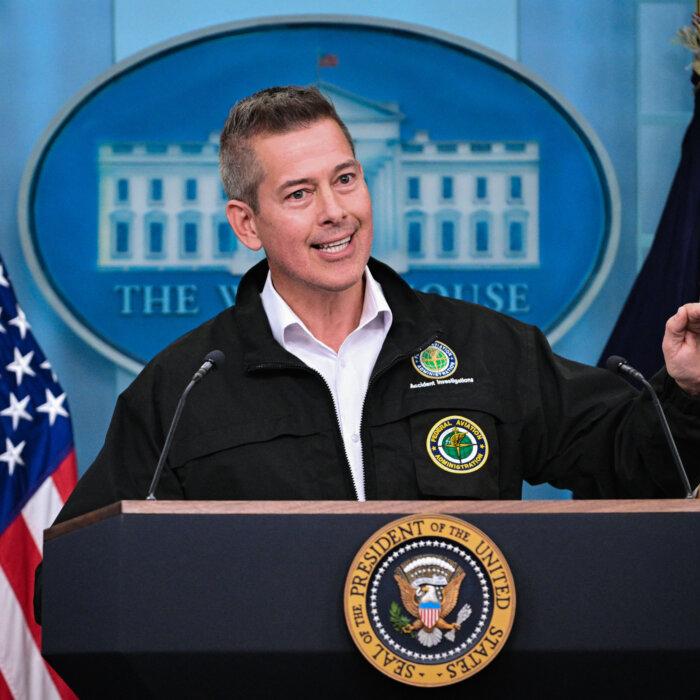
On Nov. 12, one day before the nearly five-hour ground stop, Duffy and Vought outlined their request for additional funds after last year’s sweeping spending and tax cut bill provided $12.5 billion for aviation infrastructure upgrades.
The letter said the FAA had completed 68 percent of its transition from copper to fiber-optic telecommunications lines, along with other modernization efforts, including converting 457 radio sites to modern digital systems and deploying other new technology.
Duffy and Vought asked for an additional $30.1 billion to complete the modernization, to deliver a “resilient telecommunications backbone for air traffic controllers, modern hardware and software, state-of-the-art control towers, and world-class airport infrastructure.”
They requested $10.1 billion for air traffic control modernization alone.
This included $7.2 billion for automation platforms and controller workstations, $2 billion for “cloud computing and national airspace system telecommunications,” $600 million for “strategic air traffic flow management” technology, and $300 million for consolidating terminal air traffic control facilities.
The request also contained $10 billion for towers and airport infrastructure, as well as $10 billion for upgrading and modernizing aging terminals at “high-impact transitional hub airports.”
The second funding request increased the ask by $20 billion and kept most of the allocations listed above, with two new categories and separating airport and tower infrastructure.
Duffy, Vought, and Bedford are now asking for an additional $10 billion for the “design, site selection, land acquisition, and construction” of up to five new air route traffic control centers, which manage aircraft while they’re in the “en route” flight phase across much of the U.S. airspace.
There’s also a line asking for $10 billion for building, replacing, or improving up to 140 of the FAA’s air traffic control towers.
During an interview with NBC on Nov. 15, Duffy said part of the reason he was asking for $50.1 billion was that last year’s spending bill didn’t provide money for telecom upgrades or for new software.
“We’re going to spend that 12-and-a-half billion by the end of 2028, but I need the rest of the money for software and a new telecom architecture that will be way more resilient. I need that money so I can start that build so this all can be done by the end of 2028, start of 2029,” Duffy said.
Among the full $12.5 billion, that legislation gave the FAA $4.75 billion for “telecommunications infrastructure modernization and systems upgrades.”
It’s not clear how much of this money has been spent thus far.
The Transportation Department did not respond to a request for comment by publication time.
A day after Duffy’s interview with NBC, Sen. Mike Rounds (R-S.D.) told reporters that the secretary will need to share with Congress where the FAA’s shortfalls are, their progress with spending the money Congress has provided so far, and why more money is needed while some funds are still unspent.
Several different figures have been presented for how much the FAA might still have in unspent funds from last year’s spending and tax cut bill.
Democrats on the House Appropriations Committee said on Nov. 15 that the FAA should still have $9.1 billion on hand after receiving $14.4 billion in total from Congress, including an additional $1.9 billion they say the agency received in February to modernize air traffic control systems.
It’s not clear where this figure comes from. The 2026 Consolidated Appropriations Act passed in February includes additional funding for the Department of Transportation, but The Epoch Times could not find direct line items that would bring the total FAA funding to $14.4 billion.
A press contact for the House Appropriations Democrats did not respond to a request for comment by publication time.
The $9.1 billion in potentially unspent funds is close to what the FAA likely still has on hand from last year’s spending bill, according to Treasury Department data.
Not including the money obligated for fiscal year 2025, the FAA had roughly $12.3 billion in total budgetary resources for fiscal year 2026 from last year’s reconciliation funding. The agency had committed roughly $3.9 billion in budgetary obligations for fiscal year 2026, as of Sept. 30.
This would suggest that of the money Congress has given the FAA for aviation and air traffic control infrastructure upgrades and modernization, the agency still had not committed around $8.4 billion by the end of September.
“I support adequate investments in technologies and systems that increase safety and efficiency in the National Airspace System, but it cannot and must not be at the expense of public transparency and accountability. Recent events are not the result of a lack of funding or support from this Congress,” Rep. Jim Clyburn (D-S.C.) said in a statement.
Sen. Rick Scott (R-Fla.) said he agreed with Duffy that the United States needs to update its air traffic control system, but said it would only “cost about $10 billion,” adding that the airlines should also contribute.
Some lawmakers have also questioned Duffy’s leadership amid the fallout from the Nov. 13 ground stop.
“I think there’s a lot of questions we have to ask about how we could possibly get to the fact that this one incident could bring down the entire system,” Sen. Gary Peters (D-Mich.) told The Epoch Times.
Among the issues facing the FAA, “there’s the larger issue on infrastructure,” but leadership’s communication to the public is also a problem, said the top Democrat on the Senate Committee on Commerce, Science, and Transportation.
“I’m now bringing up the fact that the public deserves to know when something’s going on, and they need to have people to communicate to, not sleep on the floor of an airport for a couple of days trying to figure out what’s next,” Sen. Maria Cantwell (D-Wash.) told reporters on Nov. 20.
Sen. Jack Reed (D-R.I.) said lawmakers are still waiting for “all the details, not just the overview.”
“And more importantly, what are they going to do to prevent it from happening in the future?” he told The Epoch Times.




Discount Applied Successfully!
Your savings have been added to the cart.