

NEWYou can now listen to Fox News articles!
There is a new golden rule of combat: The side that controls the data pipeline controls the war.
Picture a soldier on the battlefield. They spot an enemy target, analyze. Think through a plan, and its ramifications. Then, they react. Those crucial few minutes of human cognitive process — the power over life and death — are being dramatically reduced from hours to seconds, day by day. When that cycle runs faster than a human adversary can think, we stop making decisions. Combat on autopilot.
We see that cycle with Iran, and what has been happening in Ukraine for the past four years. We are watching a fundamental restructuring of how military power works, and most of the institutions responsible for governing it are still thinking in the previous century. And this is all due to how AI is rapidly changing warfare.
For decades, military strategists have understood war through a succinct lens: observe, orient, decide, act. This routine was elegant and ruthless. The side that moves through that cycle faster forces its adversary into a permanent reactive posture. For most of the 20th century, the bottleneck in that cycle was human cognition. How fast could analysts process intelligence? How quickly could commanders coordinate a response? Those limits defined the pace of conflict.
SEN TOM COTTON URGES DOJ TO PROBE CHINESE BID TO ‘KNEECAP’ AMERICAN AI
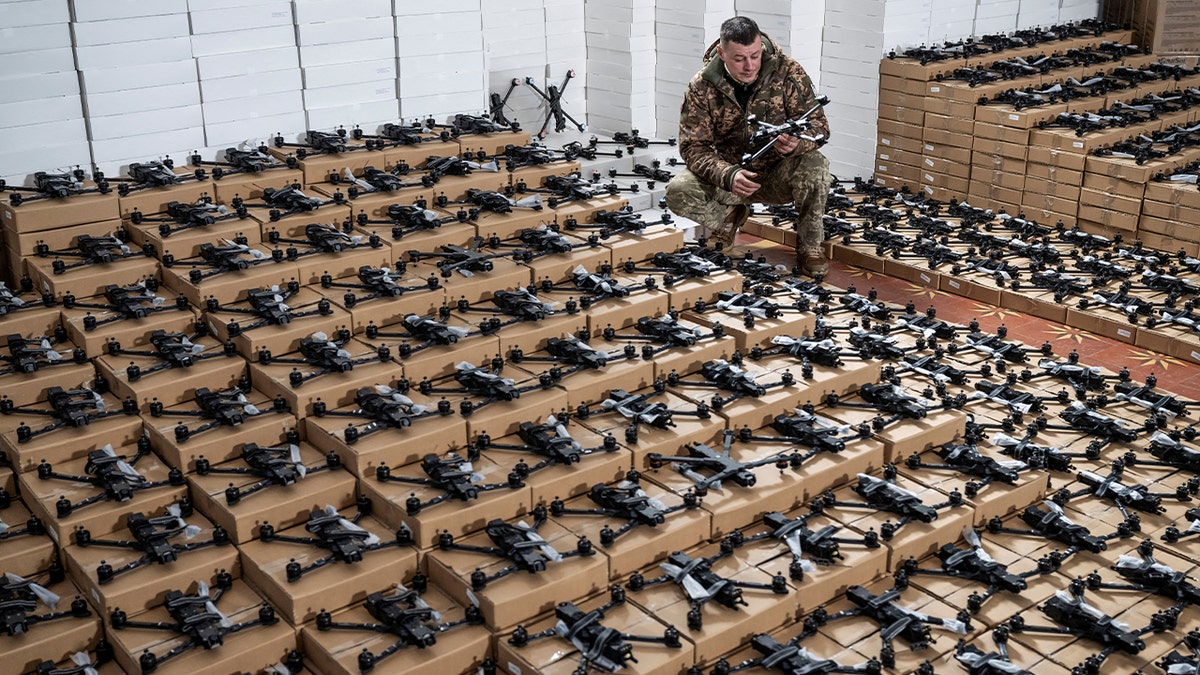
A Ukrainian serviceman inspects a first person view (FPV) drone provided by the Come Back Alive foundation to one of Ukrainian Airborne Brigades, amid Russia’s attack on Ukraine, in Kyiv, Ukraine, Feb. 14, 2024. (Viacheslav Ratynskyi/Reuters/File photo)
AI has removed that bottleneck entirely. What’s left is a speed advantage that no human institution, legal framework or command structure was designed to handle.
Ukraine was the first large-scale example. It built its own data advantage from the ground up. One Ukrainian nonprofit collected over 2 million hours of battlefield drone footage since 2022, storing five to six terabytes of new data daily from active fighting.
That data was used to retrain AI targeting models on real-world conditions. By March 2026, drones accounted for 96% of Russia’s battlefield casualties in a single month, with Ukrainian drones killing or seriously injuring more than 240,000 Russian soldiers in 2025 alone.
‘A NEW KIND OF WAR’: INSIDE UKRAINE’S HIDDEN FACTORIES MASS-PRODUCING COMBAT DRONES
This is what the defense community calls decision dominance: the ability to analyze and act on vast, messy sensor streams faster and more reliably than an adversary can. The side that achieves it fights better, of course, but, moreover, it also sets the terms of the fight entirely.
Data pipelines are the real competition, the real arms race of our time. Platforms are visible. Training datasets are not. Who has collected more real-world conflict data? Who has labeled it correctly? Who has continuously retrained models on evolving battlefield conditions? These questions are the ones that will determine military outcomes in the next decade.
China understands this. Russia has been learning it the hard way in Ukraine. The United States has institutional advantages in AI infrastructure but faces a structural problem: its data acquisition and model development cycles still largely operate within procurement timelines designed for hardware rather than software. That mismatch will compound in the years to come.
FEDERAL APPEALS COURT REJECTS ANTHROPIC BID TO BLOCK PENTAGON BLACKLIST IN AI DISPUTE
Speed, however, is not comparable to wisdom. This is a crucial distinction. When decision cycles compress to machine speed, the legal and moral architecture of warfare faces a structural stress it was never designed to absorb. A system optimized to compress time will, under operational stress, compress human judgment along with it.
What’s more concerning too, is that the international community knows what it’s watching. It just doesn’t yet know what to do about it. That ambivalence is dangerous. The absence of clear governance means accountability collapses under pressure. Whether any specific account is verified or not is beside the point. The underlying structural risk is real, and it is going to recur in every future conflict where these systems are deployed at scale.
CLICK HERE FOR MORE FOX NEWS OPINION
This is what the defense community calls decision dominance: the ability to analyze and act on vast, messy sensor streams faster and more reliably than an adversary can. The side that achieves it fights better, of course, but moreover it also sets the terms of the fight entirely.
The next military power to take on a battlefield will be the one that assumes its institutional experience and physical prowess are sufficient substitutes for data infrastructure. This advantage is invisible until it suddenly, and decisively, isn’t.
The states and institutions that understand this, not as a procurement challenge but as a fundamental rethinking of how information, decision-making and accountability interact, will be the ones that shape what comes next.
CLICK HERE TO DOWNLOAD THE FOX NEWS APP
States should be investing in data infrastructure with the same urgency as weapons development. Building governance frameworks before the next conflict, not during it. We must also acknowledge honestly that once decision cycles reach machine speed, the chain between intelligence, action and accountability will collapse under strain, and that we need brave and proactive governance to address it.
The ones that don’t grasp this will find themselves, perpetually, a decision cycle behind. At machine speed, that is not a recoverable position.




Discount Applied Successfully!
Your savings have been added to the cart.