-
×
 “Time’s Up” – Enhanced Poster
1 × $174.47
“Time’s Up” – Enhanced Poster
1 × $174.47 -
×
Zeppelins Over Washington
1 × $36.90
Subtotal: $211.37


 “Time’s Up” – Enhanced Poster
1 × $174.47
“Time’s Up” – Enhanced Poster
1 × $174.47  Zeppelins Over Washington
1 × $36.90
Zeppelins Over Washington
1 × $36.90 Subtotal: $211.37
By Jordan M. Clarke
Apparently, applause equals authority nowadays. When did entertainment cross the line into politics? When did we as a society allow what was once strictly for entertainment purposes to start swaying our opinions, and why did we let them? Do you remember a time when actors were just actors and singers were just singers and didn’t give their two cents on things they aren’t experts in? It’s gotten to the point now that if a celebrity doesn’t acknowledge some world disaster that has absolutely nothing to do with who they are as an entertainer and public figure, we cancel them. Today’s A-listers are practically politicians with all their advocacy for YOU to pay towards a cause.
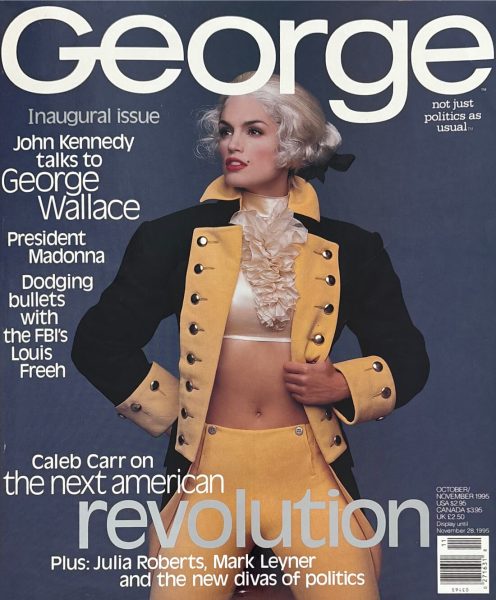
When George Magazine started, it was to blend the world of politics and pop culture. Did it all start here? Is the foundation of this magazine what encouraged this awful sense of entitlement? Maybe it all started with a glossy cover that dressed politics up as entertainment. Now, democracy doesn’t look like a system—it looks like a fan club with better lighting. What was meant to serve as a convenience for looking at all interesting news in both celebrities and politics became the turning point for whom we look to for (unsolicited) political advice.
In November 1995, George Magazine put the spotlight on Krist Novoselic, the bassist and co-founder of Nirvana. In The P.A.C. that Punk Built, Charles Peterson focused on the role Novoselic gave himself when he started overstepping his role as a rocker and founded the Joint Artists’ and Music Promotions Political Action Committee. As someone who identifies with no political party, he started JAMPAC as a way to protect against Seattle’s powerful Christian coalition. “We’re trying to sell the music industry—show the politicians what resources they have here,” Novoselic tells Peterson.
George Magazine blended politics and pop culture, but without demanding every celebrity be an expert—or every reader pick a side. Influence should be intentional, not obligatory. Maybe that’s the lesson George was quietly teaching all along: know your platform, use it wisely, and let the work itself speak louder than the headlines.
Fast forward about 30 years, and Darrin Williams discusses Hollywood’s impact on Americans in his article, The Good, The Bad, and the Ugly, in George Magazine’s 30th issue. Williams points out that celebrities used to be hired to sell cars, food, and clothes. Now? They’re not just selling products—they’re selling opinions and shaping political outcomes too. And while celebrities are selling you products, consumers think they are actually buying their lifestyle—making our original lives and homes and things all look sub-par.
Unless you’ve been living under a rock the last few years, you would know that Hollywood definitely favors the Democrats. Hollywood’s been nudging the political needle for decades, but it didn’t start out so blatant. At first, it was subtle—slipping messages into scripts, weaving ideals into storylines, and casting “acceptable” heroes and villains. But over time, it got louder. Actors stopped just playing roles and started playing pundits. Somewhere along the way, we stopped noticing the shift. Popcorn was optional, and the politics came free with admission.
Oprah’s Book Club is proof you don’t need to tweet your opinion on every world disaster to be influential. She picks a book, and suddenly everyone is reading it, talking about it, and buying it like it’s some cultural law. That’s power. That’s influence without the drama, the hot takes, or the performative outrage.
Rivers Cuomo hasn’t exactly waved a Democratic flag, and that’s kind of the point. The Weezer frontman focuses on music and lyrics and doesn’t post hot takes on every world crisis. Cuomo proves you don’t need to pledge allegiance to a party to make an impact. He influences without lecturing, without performative outrage, and without turning every guitar pick into a political podium. That’s the kind of influence that actually earns respect.
Novoselic, still known for his political activism, has been involved in electoral reform by serving as a chair for the FairVote board and published his book, Of Grunge & Government: Let’s Fix this Broken Democracy, in 2004. While he believes the American 2-party voting system is broken, he thinks citizens should have more control over the governing of their communities. “We need a system that rewards cooperation and consensus, not division and distinction,” he explained in a FairVote address.
Today, the pressure to “speak up” on tragedies will make or break someone. Influencer culture has only fueled this by normalizing the idea that every public figure needs to weigh in, whether or not they have any real expertise. Kim Kardashian suddenly sits in the White House talking prison reform. Hayley Williams blasts policies on stage and on X. Meanwhile, Adam Sandler just tells jokes, and Dolly Parton stays out of politics altogether because she’d rather unite than divide. Some trade applause for authority. The rest know silence sells just fine. But since when did silence stop being an option?
Chappell Roan is another example of a rising star who got pulled into the political spotlight whether she wanted to or not. She posted on TikTok about a current political issue, and suddenly her followers weren’t just talking about her music—they were dissecting her opinions, her intentions, and even her morals. Like so many young influencers today, she learned fast that every post carries a weight it didn’t used to. It’s a reminder that in this era, talent alone isn’t enough; if you have a platform, people expect you to turn it into a pulpit. Some handle it with grace, some get burned, and some just choose to stay out of it entirely—and maybe that’s the smartest move of all.
Maybe that’s the takeaway: influence isn’t about volume; it’s about intention. You don’t need to scream your opinions from a podium or turn every platform into a political stage. You don’t need to trade respect for retweets. George Magazine showed us that culture and politics can coexist without forcing a choice, and artists like Novoselic, Cuomo, or even Oprah prove that real impact comes from action, creativity, and authenticity—not performative outrage.
The next time the world expects you (or your favorite celebrity) to weigh in on everything, remember: sometimes the smartest move is knowing when to speak, when to create, and when to just let your work do the talking. Influence isn’t a microphone; it’s a message. And you decide how loud it gets.
Discount Applied Successfully!
Your savings have been added to the cart.