
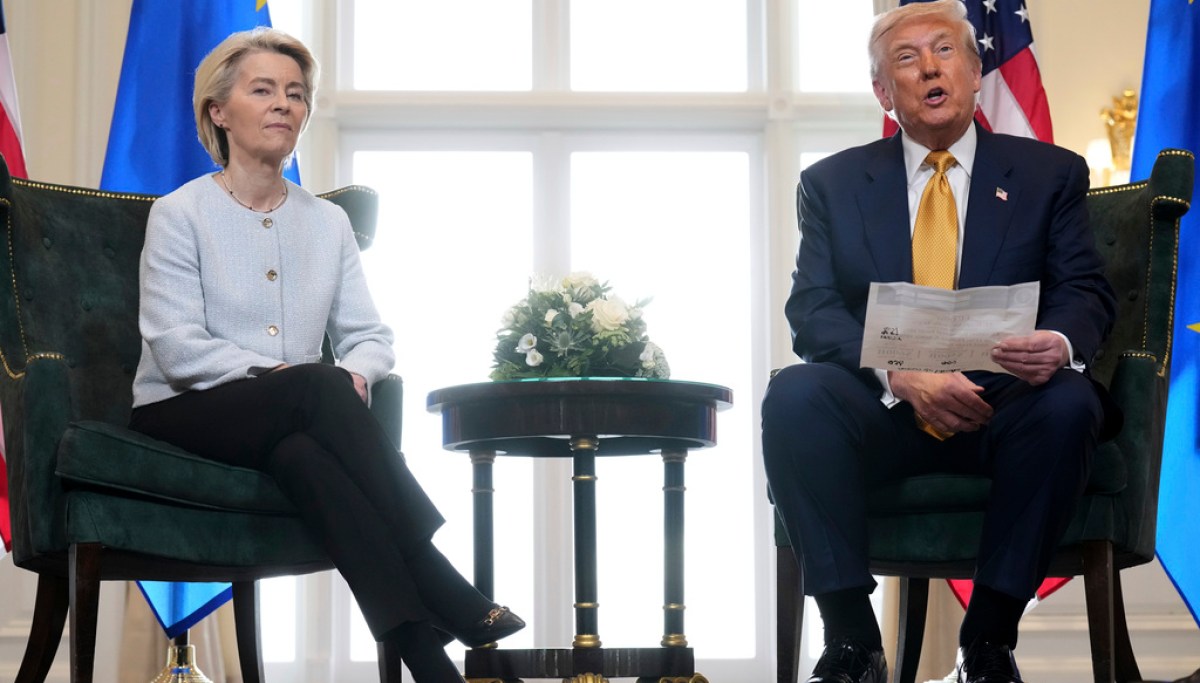
As foreign countries aggressively imposed digital fines and regulations on American technology companies this year, President Donald Trump fought back by leveraging his trade powers through the threatened use of tariffs and other means.
The European Union and South Korea were two of the most blatant offenders in this regard. Here are all the relevant details to know about the pushback they faced from Trump on tech regulations:
Central to the dispute between the United States and the EU are the latter’s Digital Services Act and Digital Markets Act. Both laws enforce hefty fines, but they operate in different ways.
The Digital Services Act primarily moderates the content on online platforms to prioritize user safety, while the Digital Markets Act aims to prevent Big Tech companies from abusing their market dominance.
Apple, one of the tech firms classified as a “gatekeeper” under the Digital Markets Act, was fined over $585 million in April for allegedly restricting app developers from directing users to alternative offers outside Apple’s App Store. The practice violated the Digital Markets Act’s anti-steering obligation. Meta was similarly fined for violating a different Digital Markets Act rule.
By December, the 27-member bloc invoked the Digital Services Act for the first time by fining X over $140 million. The Trump administration has since ramped up pressure on the EU.
Two days before Christmas, Secretary of State Marco Rubio announced that his department placed U.S. visa bans on five individuals who he said were “agents of the global censorship-industrial complex.” One of the five people targeted was Thierry Breton, a former EU commissioner and architect of the DSA.
The U.S. action followed through on Rubio’s Dec. 5 warning that the “days of censoring Americans online are over” shortly after Elon Musk’s X was fined.
Other top administration officials have made statements pressuring the EU to drop its tech regulations.
U.S. Trade Representative Jamieson Greer recently warned that the U.S. may retaliate against European companies if the EU upholds its policies that disproportionately harm American companies operating in Europe. Sweden’s Spotify was one of the EU service providers that were threatened by the USTR.
Furthermore, Greer raised the possibility of a trade investigation under Section 301 of the Trade Act of 1974 that would scrutinize the Digital Services Act and the Digital Markets Act as unfair trade practices.
Commerce Secretary Howard Lutnick also pressed Brussels during his November visit to Belgium’s capital, where he pushed the EU to roll back its tech regulations if the bloc wants lower tariffs on steel and aluminum.
EUROPEAN LEADERS ERUPT OVER US TRAVEL BAN OF OFFICIALS INVOLVED IN DIGITAL SERVICES ACT
Writing on Truth Social in August, Trump threatened to impose “substantial additional” tariffs on countries that continue to discriminate against U.S. tech companies unfairly. While Trump did not name any one country engaging in such discrimination, his warning against the EU was all but understood.
The EU has made very little progress in changing its digital policies since then.
While South Korea is actively pursuing Digital Markets Act-like legislative proposals to regulate dominant online platforms, the U.S. is exerting increasing pressure on the key trade ally.
Following the president’s tariff warning concerning digital regulations, the trade deal between the U.S. and South Korea was left hanging in the balance. The deal was later finalized after negotiations made headway in late October when Trump personally met South Korean President Lee Jae Myung during the Asia-Pacific Economic Cooperation Summit.
A joint fact sheet on the Trump-Lee bilateral meeting says both countries acknowledge that “U.S. companies are not discriminated against and do not face unnecessary barriers in terms of laws and policies concerning digital services, including network usage fees and online platform regulations.”
However, recent reports suggest South Korea is proceeding with legislation on dominant platforms anyway. If South Korea is found in violation of the trade agreement, the Trump administration could take further action beyond tariffs.
Like the EU, South Korea is facing a possible Section 301 trade investigation if it does not stop discriminating against U.S. companies. Greer has not followed through on the threat yet.
Illustrating Greer’s uncompromising stance on the matter, the USTR recently canceled a planned meeting with South Korean officials precisely because of their digital proposals. The administration is framing these proposals as nontariff trade barriers.
Congress has also taken an interest in foreign tech regulations, with lawmakers urging the administration to apply pressure on Seoul to reverse course on the digital platform legislation.
The House Judiciary Subcommittee on the Administrative State, Regulatory Reform, and Antitrust held a Dec. 16 hearing on the matter, partially focusing its attention on Korean regulations.
Rep. Darrell Issa (R-CA), a member of the subcommittee, echoed the administration’s concerns about South Korea’s unfair discrimination against U.S. tech giants. In making his point about the Korean government’s problematic regulatory attitude, the congressman pointed to a quote from the Korea Fair Trade Commission head that showed his disdain for Americans and the U.S. more broadly.
As the country’s antitrust regulator, the KFTC is responsible for initiating unannounced raids at American firms over alleged unfair business practices. Coupang, a U.S. online retailer similar to Amazon that primarily operates in South Korea, is one such company facing this type of scrutiny.
US TECH FIRMS FACE GROWING SCRUTINY FROM SOUTH KOREAN ANTITRUST REGULATOR
Robert O’Brien, a former national security adviser during Trump’s first term, recently warned Seoul will face severe trade repercussions if Coupang remains a target of Korean investigations. The e-commerce company is dealing with the aftermath of a massive data breach involving 33.7 million users. The KFTC is considering suspending Coupang’s business operations, among other sanctions.
It remains to be seen what steps the Trump administration will take next, but action is surely guaranteed if South Korea proceeds with anti-American regulations in violation of its trade deal with the U.S.
![Enjoy the [Road] Show Travel Mug with Handle, 14ozEnjoy the [Road] Show Travel Mug with Handle, 14oz](https://georgemagazine.com/wp-content/uploads/2024/08/479070202831754764_2048-300x300.jpeg)
Discount Applied Successfully!
Your savings have been added to the cart.