

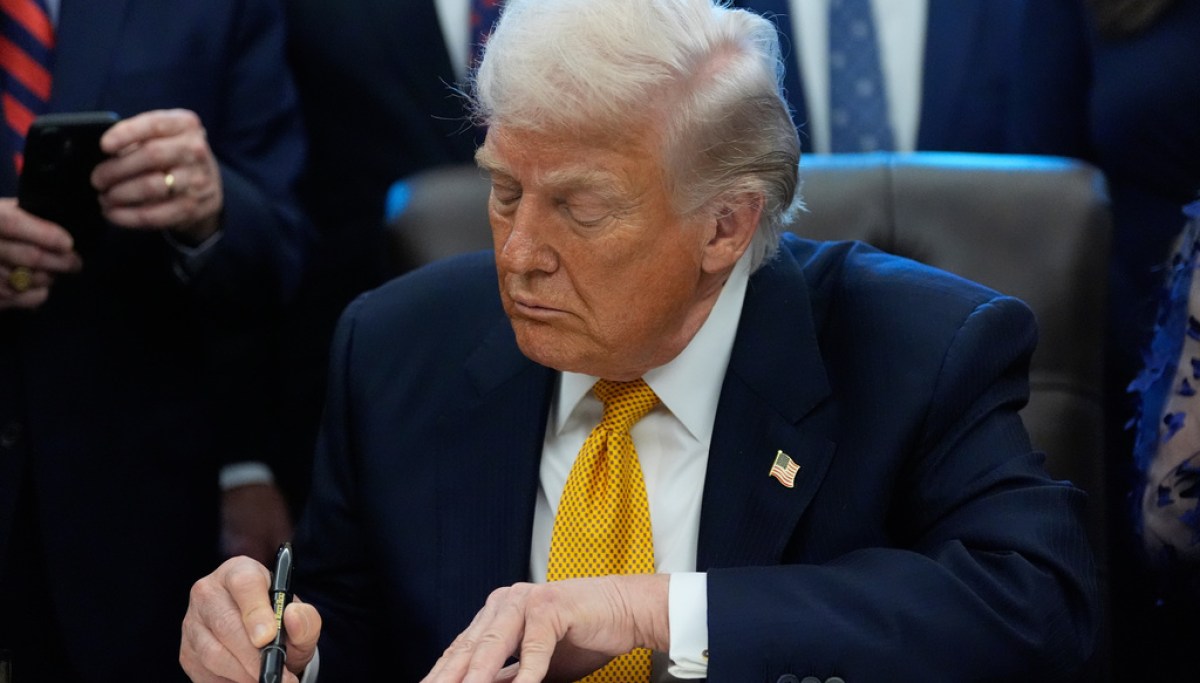
President Donald Trump’s recent economic proposals mark a notable shift further into populism and an embrace of policies typically espoused by left-leaning political figures.
In recent days, Trump has proposed capping credit card rates at 10% for one year, a proposal met with pushback from free-market advocates. He has also said he wants to ban institutional investors from buying single-family homes, another proposal that has been embraced by some on the Left.
TOP DEMOCRAT CHALLENGES TRUMP ON BAN OF BIG INVESTORS FROM SINGLE-FAMILY HOMES
The populist policy proposals have sparked backlash from fiscal conservatives, who say they mark a major departure from Republican orthodoxy.
“The president has been repeatedly advocating for government control of the economy, or at least his personal control of the economy,” former Sen. Pat Toomey (R-PA), a free-market conservative, told the Washington Examiner during an interview.
Toomey called the idea of capping credit card rates a “particularly egregious” proposal.
“Fundamentally, a cap on interest rates is a form of price control,” Toomey said. “Interest rates is the price of money. And when the government sets arbitrary caps on prices for things, and intentionally sets that cap at a level below what the market demands, then it always follows with shortages in supply of whatever is being capped.”
Free-market critics of the proposal argue that such a cap would result in lower- and middle-income individuals being cut out of the credit card market because credit card companies simply would not issue cards to people with lower credit scores.
Joel Griffith, a senior fellow at Advancing American Freedom, a group founded by former Vice President Mike Pence, said he was “particularly surprised” by Trump’s credit card proposal.
“This 10% cap has been proposed by some of the leading very far Left legislators in Congress, including AOC and Bernie Sanders,” Griffith told the Washington Examiner, using the acronym for Rep. Alexandria Ocasio-Cortez (D-NY).
Griffith said he thinks the proposal is an effort by the administration to show it is doing something to address affordability and cost-of-living issues that are weighing heavily on voters.
Polling has shown that cost of living, and the economy more generally, are the biggest concerns for voters right now. Republicans control both chambers of Congress and Democrats are hoping to seize on the discontent to win back one or both chambers during the November midterm elections.
“There’s just no way that that President Trump can ignore that reality, just as President Biden tried to ignore it publicly, but obviously it really weighed on families,” Griffith said. “So yes, I do think this is politics at play here, but we know that this idea economically would be disastrous to families that are most in need of temporary access to credit.”
The industry has also pushed back hard on the proposal.
The Electronic Payments Coalition, a group representing banks, credit unions, and payment networks, said in a report that up to 88% of open credit card accounts would essentially lose access to credit under a 10% cap like Trump has floated.
“A one-size-fits-all government price cap may sound appealing, but it wouldn’t help Americans — it would do the exact opposite, harming families, limiting opportunity, and weakening our economy,” said EPC Executive Chairman Richard Hunt.
“History is clear that government price controls don’t make costs disappear, they simply reduce access, push consumers out of safe, regulated credit, and leave the very people they claim to help with fewer options when they need them most,” Hunt added.
The credit card proposal comes alongside another plan Trump floated to ban institutional investors such as Blackstone from purchasing single-family homes. That idea has also courted skepticism from many in the industry and among free-market economists.
Proponents of banning firms such as Blackstone from buying single-family homes, many of whom are on the Left and populist Right, argue that those investors are crowding out the market for homebuyers. Others in the housing space, though, say that is not the case and that the policy could backfire by making housing more expensive for some.
“It won’t get to the root of the government-induced housing shortage, it will make things worse,” John Berlau, a senior fellow and director of finance policy at the libertarian Competitive Enterprise Institute, told the Washington Examiner.
Critics of the proposal make the points that these institutional investors only purchase a tiny percentage of the total housing stock and that they might make it easier for people to rent homes that they might not have been able to receive a mortgage to buy.
Still, assessing Trump’s plan is challenging because the administration has not provided any details as to how it would work, although it has said they are forthcoming.
Shortly after the announcement, Sen. Bernie Moreno (R-OH) said he would introduce legislation in the Senate that would codify the policy, and Sen. Josh Hawley (R-MO) suggested he might, too.
Free-market economists will also point out that institutional investors, those who own 100 or more homes, have purchased less than 2% of all homes.
Taken together with other government interventions into the private sector, some conservatives see the administration veering too far away from free-market principles.
LIST: UNUSUAL GOVERNMENT INTERVENTIONS INTO THE PRIVATE SECTOR UNDER TRUMP
“I mean, the populist Republicans are absolutely embracing liberal, left-wing, Democratic economic policies in a lot of ways,” Toomey said.
“In many ways, a significant segment of Republicans are like completely abandoning any commitment to free enterprise and a market economy,” Toomey said, “and this will come back to haunt them.”
![[GOOD PRESS] ON[GOOD PRESS] ON](https://georgemagazine.com/wp-content/uploads/2024/08/16389056566437433941_2048-300x300.jpeg)

![Enjoy the [Road] Show Travel Mug with Handle, 14ozEnjoy the [Road] Show Travel Mug with Handle, 14oz](https://georgemagazine.com/wp-content/uploads/2024/08/479070202831754764_2048-300x300.jpeg)
Discount Applied Successfully!
Your savings have been added to the cart.