
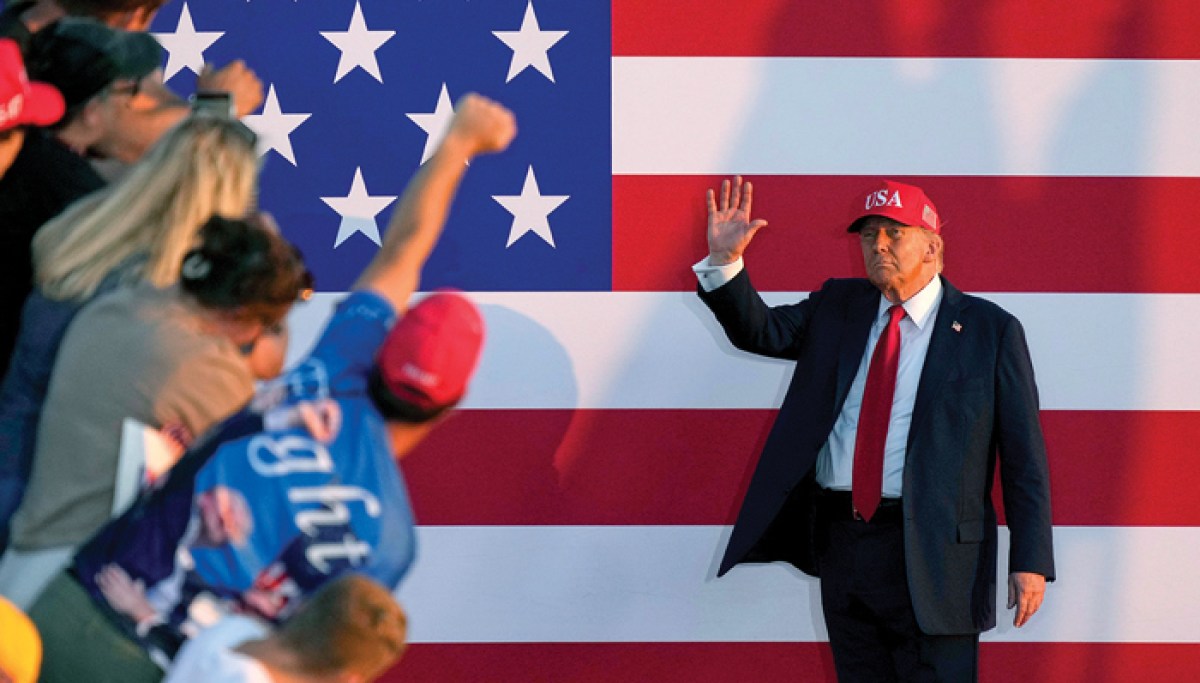
A mystery that haunted the Republican Party during the 2022 midterm elections, under President Joe Biden, was why the party failed to achieve the congressional surge its members craved. Then, last month, when Rep. Abigail Spanberger (D-VA) and Rep. Mikie Sherrill (D-NJ) won their respective states’ gubernatorial races, the pattern continued, and the same question remained.
Why do supporters of President Donald Trump fail to vote for Republicans in sufficient numbers when he is not on the ballot?
A year into Trump’s final term, it’s a problem Republicans need to solve, and an advantage Democrats hope to exploit again in the 2026 midterm elections. Retake the House and/or the Senate, and Democrats can effectively cripple the remainder of a lame-duck administration. Meanwhile, a weak 2026 show by the GOP would shake the party’s identity as it approaches the question of whether MAGA survives or loses significance and control without Trump in charge.
Thomas Whalen, Ph.D., professor of social sciences at Boston University, credited the phenomenon to the cult of personality. He questioned whether Trump voters are only and precisely that, and not necessarily surefire Republican supporters.
“Trump can draw crowds to his political brand, but the movement itself, MAGA, does not have any legs that it will survive Donald Trump,” Whalen said. “The Republicans hitched themselves to Trump’s political brand, but — without him — MAGA doesn’t resonate among American voters.”
Whalen laid some of the blame for the Republicans’ quandary at the White House door, accusing Trump of refusing to share the spotlight or promote candidates that might steal some of his star power.
“(Trump) more or less guaranteed the death warrant for the MAGA movement because you need to have other leaders or a second generation to carry on in your stead,” he said. “He doesn’t seem very interested in what hasn’t been overly invested in (the races the GOP lost recently).”
Whalen wondered whether MAGA’s off-year election struggles and Trump’s ego forecast a split between Trump’s brand and the GOP the moment he leaves the Oval Office.
“I would say MAGA so dominates the Republican Party now that there’s not much GOP left, at least the way we remember it,” he added. “But, what is MAGA without its lead actor? I think there is going to be a definite carryover effect with the GOP left without its identity if Trump separates MAGA for his own advantage after he leaves office. MAGA is always ‘Trump, Trump, Trump.’ That’s always been the weakness of the movement.”
Robert Hogan, Ph.D., is a professor of political science at Louisiana State University. He said he believes the biggest problem Republicans face is that Trump and MAGA have no real interest in aiding the GOP once the former steps away.
“Everything (Trump) has done is always, has always been, and always will be about Donald Trump,” Hogan said. “He enhances his brand and only promotes what he wants to do. He’s transformed the Republican Party into his party. Though he can’t run again, that doesn’t necessarily mean he doesn’t want to influence once he leaves office. But, I don’t think he’ll have the same sort of power he has now, and that could lead him to abandon (Republicans).”
Considering the president’s ego, Hogan suggested that Trump is wary of supporting some supposed MAGA candidates and risking standing with the possible losing side.
“At the same time, you have to ask, had he gotten in the [November] races, could he have affected the outcome?” he added. “Trump was not willing to make his case.”
If the GOP is to survive the 2026 midterm elections, Hogan insisted that Trump will need to do everything he can to boost Republican support.
“I think we will see him traveling around the country for key races, certainly in the Senate,” he said. “That’s especially true when you consider the counter-mobilization effect within the other party. Trump must recognize that he has to retain both houses of Congress. If not, it’s going to be two years of investigating Donald Trump. That’s what (Democrats) are going to do.”
Mark D. Weinstein, a public relations expert at Cedarville University in Ohio, in analyzing Republican losses without Trump’s coattails, pointed to the awareness and motivation of voter classes.
“A large portion of Americans don’t vote,” he said. “Another portion votes virtually all the time. These are not only committed voters, but often committed partisans. This group is much smaller, but they make up the core base of each party. They vote in primaries, off-year elections, mid-terms, and everything in between.”
Weinstein explained that it’s the group of people who show up only for “big” elections (for example, in presidential years) that are more fluid in their tendencies.
“Donald Trump does reasonably well with ‘big’ election voters, and he does well with (conservative or GOP) low propensity voters,” Weinstein explained. “Trump is a celebrity more than anything else. He is an image, someone easily recognized. He is also entertaining and sometimes crazy, but he is rarely dull or boring.”
Weinstein said he believes the November elections that dinged Republicans saw a small electorate of devoted partisans who cared enough to show up for an off-year election cycle, but few low-propensity or big election voters.
“Given the economic climate, the imagery of ICE raids and the feeling of instability that exists for many people, the degree to which somewhat marginal voters showed up, it should not surprise us that they voted for Democrats,” he said.
JUDGE BLOCKS TRUMP’S LA TROOPS DEPLOYMENT FOR THIRD TIME AFTER GETTING OVERRULED TWICE
Whalen suggested that the GOP could fend off some of the post-Trump era damage and perhaps survive the 2026 midterm elections if its messaging is more compelling than MAGA’s drumbeat of immigration or “America First.”
“The MAGA candidates aren’t that interesting, and the message they’re selling isn’t very compelling,” he said. “People are hurting. They want to see an answer to: ‘Why are my groceries so expensive? Why can’t I afford to send my kid to college? Why is it so difficult to put a roof over my head?’ They’re not getting answers from Republicans. But, the problem is they’re not getting them from the Democrats, either.”
John Scott Lewinski is a writer based in Milwaukee.




Discount Applied Successfully!
Your savings have been added to the cart.