
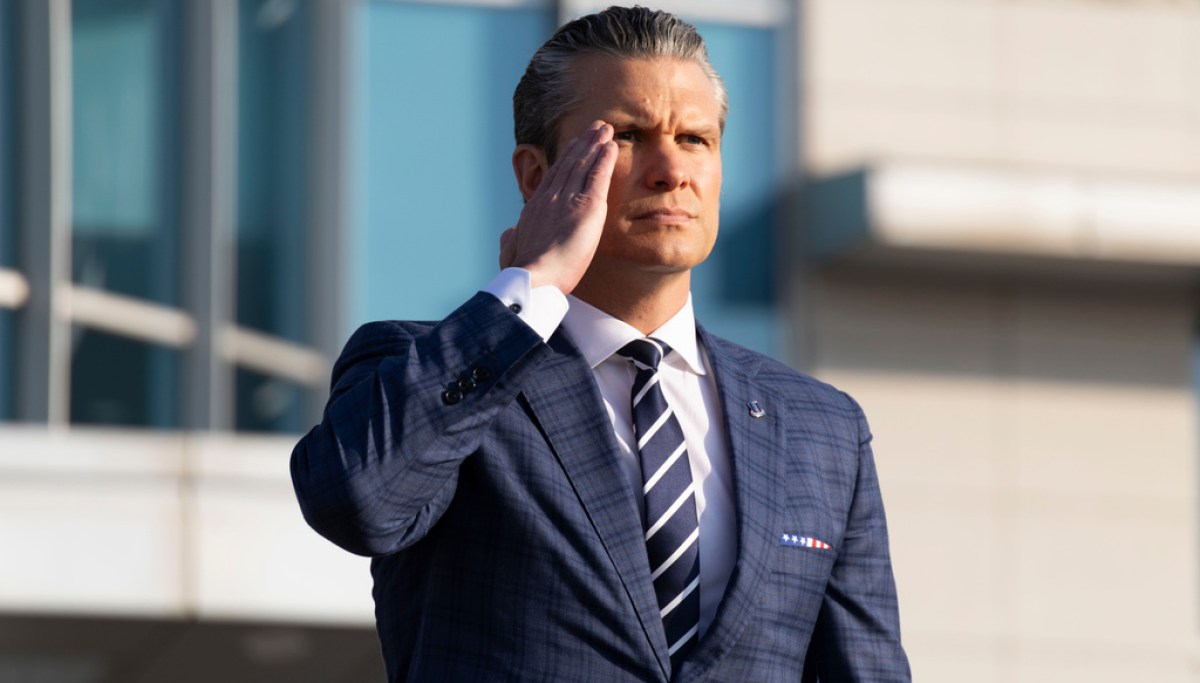
The White House said on Monday that the “double tap” hit targeting survivors of a U.S. strike on a purported drug smuggling vessel in September was legal.
White House press secretary Karoline Leavitt told reporters that Secretary of War Pete Hegseth authorized Adm. Frank M. “Mitch” Bradley to conduct the mission and that Bradley was the one, not Hegseth, who ordered a follow-up strike on a destroyed vessel that had already been targeted by U.S. forces after it became clear that there were two people who survived.
Last week, the Pentagon disputed reporting from the Washington Post that Bradley, the Special Operations commander overseeing the Sept. 2 attack, ordered service members to carry out a subsequent strike, or “double tap,” targeting survivors. That started the campaign to destroy alleged drug boats in the Caribbean Sea and the Pacific Ocean.
Leavitt said Hegseth did not order the military to kill everyone on board, contradicting reporting that Hegseth made the order to “kill everybody.”
“Admiral Bradley worked well within his authority in the law. He directed the engagement to ensure the boat was destroyed and the threat of narco-terrorists to the United States was completely eliminated,” she said.
The Trump administration is carrying out several actions designed to increase the pressure Venezuelan dictator Nicolas Maduro is facing, including the looming threat of U.S. military intervention, as President Donald Trump is set to convene senior Cabinet leaders later on Monday to discuss next steps in the campaign against the Venezuelan leader.
The targeting of two survivors of the Sept. 2 strike appears to demonstrate a change in policy, which Leavitt denied, given that U.S. forces rescued two survivors of a later attack and ultimately handed them back to their home countries of Ecuador and Colombia.
In response to a question about there being a second strike, Trump told reporters on Sunday night, “I wouldn’t have wanted that. Not a second strike. The first strike was very lethal. It was fine.”
The Republican chairs of the House and Senate Armed Services Committees released joint statements, along with their respective Democratic ranking members, calling for additional information from the Pentagon in light of the new reporting.
“The Committee is aware of recent news reports – and the Department of Defense’s initial response – regarding alleged follow-on strikes on suspected narcotics vessels in the SOUTHCOM area of responsibility. The Committee has directed inquiries to the Department, and we will be conducting vigorous oversight to determine the facts related to these circumstances,” SASC Chairman Roger Wicker (R-MS) and ranking member Jack Reed (D-RI) said.
Wicker and Reed sent two letters to Hegseth in late September and early October seeking information about the strikes and the written opinion from the Department of Justice’s Office of Legal Counsel regarding the domestic and international legal basis for these operations. At the time they publicly released the letters on Oct. 31, the committee said the Pentagon had not met the requests.
Sen. Tim Kaine (D-VA), who is also on the SASC, said on Sunday, “It’s a clear violation of the DOD’s own laws of war, as well as international laws about the way you treat people who are in that circumstance.”
House Armed Services Chairman Mike Rogers (R-AL) and ranking member Adam Smith (D-WA) similarly released a joint statement days ago saying the committee is “committed to providing rigorous oversight of the Department of Defense’s military operations in the Caribbean,” adding, “We take seriously the reports of follow-on strikes on boats alleged to be ferrying narcotics in the SOUTHCOM region and are taking bipartisan action to gather a full accounting of the operation in question.“
Hegseth disputed the reporting but did not specify which aspects of the reporting he believed were inaccurate.
“As usual, the fake news is delivering more fabricated, inflammatory, and derogatory reporting to discredit our incredible warriors fighting to protect the homeland,” he said. “As we’ve said from the beginning, and in every statement, these highly effective strikes are specifically intended to be ‘lethal, kinetic strikes.’ The declared intent is to stop lethal drugs, destroy narco-boats, and kill the narco-terrorists who are poisoning the American people. Every trafficker we kill is affiliated with a Designated Terrorist Organization.”
He maintained that the targeting of suspected drug vessels is “lawful under both U.S. and international law,” though some experts have disputed the claims. The secretary also posted a mock cover of a children’s book featuring “Franklin the Turtle” in which the beloved character was aboard a helicopter, firing a missile at a boat with the title, “Franklin targets narco terrorists.”
A spokesperson for the Department of War Office of the Inspector General told the Washington Examiner that they have not received any requests for inquiries into these operations.
The military has conducted more than 20 lethal strikes on purported drug smuggling vessels in the Caribbean Sea and Eastern Pacific Ocean since the campaign began in early September, killing more than 80 people. Trump and Hegseth have maintained that the military is targeting “narco-traffickers” in a “non-international armed conflict.”
There is a significant buildup of U.S. naval power in the Caribbean, the largest such buildup in the Western Hemisphere in several decades, which experts say far exceeds what is needed to carry out the operations targeting drug smuggling vessels.
Trump has previewed possible escalation against Maduro, including possible U.S. strikes on Venezuelan soil, and the president declared over the weekend that Venezuelan airspace was closed. The president has also said he approved covert CIA operations in Venezuela.
If U.S. forces begin going after targets on Venezuelan soil, they could go after the cartels involved in the production and distribution of drugs, or they could go after targets more closely tied to Maduro.
TRUMP DOWNPLAYS VENEZUELAN AIRSPACE ‘CLOSURE’ AFTER MADURO PHONE CALL
The U.S. and most of the international community do not recognize Maduro as the legitimate leader of Venezuela, as most independent election observers agreed that he lost the most recent election but was able to hold on to power despite that.
Trump and Maduro spoke earlier this month, but their conversation did not spur a resolution to the current tension.
The Trump administration classified the cartel it accuses Maduro of heading, the Cartel de los Soles, as a Foreign Terrorist Organization in late November to expand the tools available to it in targeting the Venezuelan leader.

Discount Applied Successfully!
Your savings have been added to the cart.