

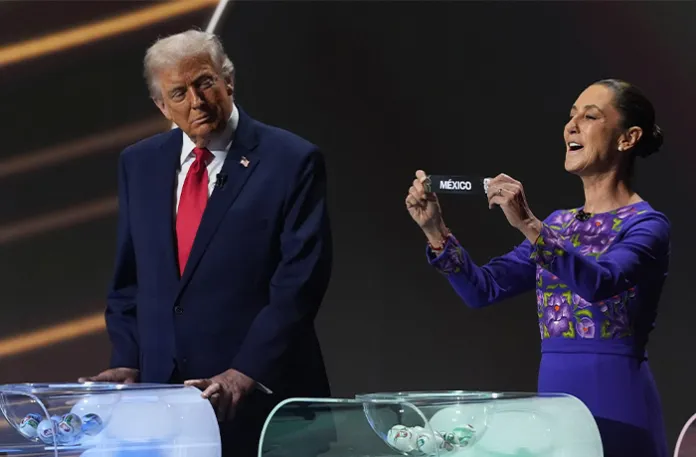
A significant ingredient of President Donald Trump‘s foreign policy during his second term is keeping other nations off balance. Whether allies, enemies, or nations worried about becoming the latter, the collective international inability to predict what Trump will do next anywhere in the world has left many nations wondering whether to extend a presidential invite or prepare for war.
Most recently, Trump’s surprise raid in Venezuela stretched the boundaries of what foreign players believe he might do. Now, while more extremist commentators in Canada have warned that the president could look to grab northern territory, it’s Mexico that has a more legitimate reason to worry.
The Trump administration made clear a desire to stem the drug trade, especially in light of the current fentanyl epidemic, putting the cartels and any officials seen as supporting them on notice. While a direct assault on the Mexican military seems unlikely, Trump clearly has his targets set on the country’s powerful narco cartels. However, he could find those drug organizations more difficult targets than comparatively weak Mexican forces.
Irina Tsukerman is a human rights and national security lawyer based in New York and a member of the North American Society for Intelligence History. While Tsukerman conceded that an attack on Mexican cartels is realistic as a concept, she said she believes a full-scale, sustained military campaign inside Mexico is far less plausible.
“The main reason is that Mexico is not a distant battlefield,” Tsukerman said. “It is a neighboring sovereign country, one of America’s-largest trading (destination) and a crucial partner on migration and border enforcement. A visible cross-border intervention would immediately trigger a sovereignty crisis and a diplomatic rupture.”
If any action takes place, Tsukerman said she believes it would involve expanded drone surveillance, intelligence-driven raids targeting a small number of high-value targets, cyber disruption, maritime interdiction, financial strikes against cartel money flows, and support for Mexican units (rather than U.S. units operating openly).
Tsukerman added that the likelihood of successful strikes against the cartels depends heavily on what “success” means.
“Is it killing or capturing a handful of high-profile leaders?” she asked. “The U.S. can do that in some circumstances, especially with good intelligence and cooperation. If success means dismantling cartel power across Mexico, the odds drop sharply. (The drug empires) can regenerate leadership quickly, splinter, merge, change routes, and move into new revenue streams when pressured.”
Tsukerman lists several factors against a U.S. attack. Mexican officials who want tougher action against cartels would be pressured to oppose U.S. military action on Mexican soil. That backlash could weaken those in the government who cooperate with the United States and empower more nationalist or anti-U.S. voices.
“It would likely also fuel cartel propaganda, allowing criminal groups to present themselves as defenders against foreign aggression,” she said.
Carol Wise, Ph.D., is a professor with the Department of Political Science and International Relations at the University of Southern California. She agreed strongly with Tsukerman’s expectation that an assault on the cartels would empower Mexican nationalism and rally support for cartels in the face of the Mexican government’s effort to curtail their power.
“Cartels have destroyed cities, states, families, municipalities,” Wise said. “They have their own armies that are stronger than the defunded Mexican army. (The cartels) like to behead mayors, so they’re terrified of them. While the Mexican government wouldn’t side with the cartels in the case of an American strike, it’s not going to sit still, either.”
Wise stressed that the drug operations are in such a powerful position within Mexico’s sociopolitical structure because previous governments supported their growth.
“For 71 years, the ruling party (Partido Revolucionario Institucional) made a deal to look the other way before finally getting voted out in 2000,” Wise explained. “Today, government salaries are still so low that federal, state, and municipal level political actors are often being paid (by drug lords).”
Wise concurred with the analysis that destroying one drug operation would only allow for another to emerge elsewhere. She said she sees the current environment evolving into three camps: drug cartels, the hostile U.S. government, and frightened civilians that could end up in the crossfire.
“The U.S./Mexico relationship has always been tense — a delicate balance,” she said. “No one tipped those scales since the Mexican Revolution. Now, if the U.S. military creates a presence (in Mexico), they’re going to face the cartels. It could be very violent and end up like an Iraq or Afghanistan situation within a couple of weeks. Then, it could spill north of the border.”
Fergus Hodgson is the author of The Latin America Red Pill and the publisher of “Impunity Observer,” a publication focusing on “the rule of law and economic development in the Americas, with a particular focus on Mexico and the Northern Triangle.”
Hodgson said he fears that any U.S. military action against the cartels would take place close to the American border and could prove misguided.
“There is not one single head to chop off … and there is no clear path to victory over a definable enemy,” Hodgson said. “Further, going after President Claudia Sheinbaum directly, even if she is a compromised official, would be destabilizing for the region.”
If winning for Trump in his possible war against the cartels means ending drug presence and influence in Mexico, Hodgson said he sees zero chance for success.
“Given insatiable demand north of the border, any touted victory would be short-lived, since there would be an opportunity vacuum waiting to be filled by the next cartel,” he explained. “This is why the (MAGA) America-First coalition needs to rethink how to approach the drug war. It has failed and will continue to fail, since fighting it merely makes narcotics more lucrative.”
However, Hodgson said he believes there is another possible endgame for Trump’s Mexico pressure.
“If the Trump Administration’s intent is to oust Chinese Communist Party officials from Mexico and the broader region, that is more promising,” he proposed. “Pressure placed on President Sheinbaum could tie her hands regarding CCP relations. That means whatever involvement the CCP has in promoting harmful contraband would be reduced.”
TRUMP’S BORDER SECURITY MEASURES GO FAR BEYOND JUST A WALL. HERE’S WHAT TO KNOW
In New York, Tsukerman said she hopes hard-liners around the president tread carefully because, unlike the surgical strikes the U.S. military has made in Iran and Yemen so far during Trump’s second term, anti-cartel action would play out very close to U.S. citizens.
“Even people who want a hard approach must understand that a major military move would create blowback that can quickly outweigh any short-term operational gains,” she said.
John Scott Lewinski (@johnlewinski) is a writer based in Milwaukee.




Discount Applied Successfully!
Your savings have been added to the cart.