

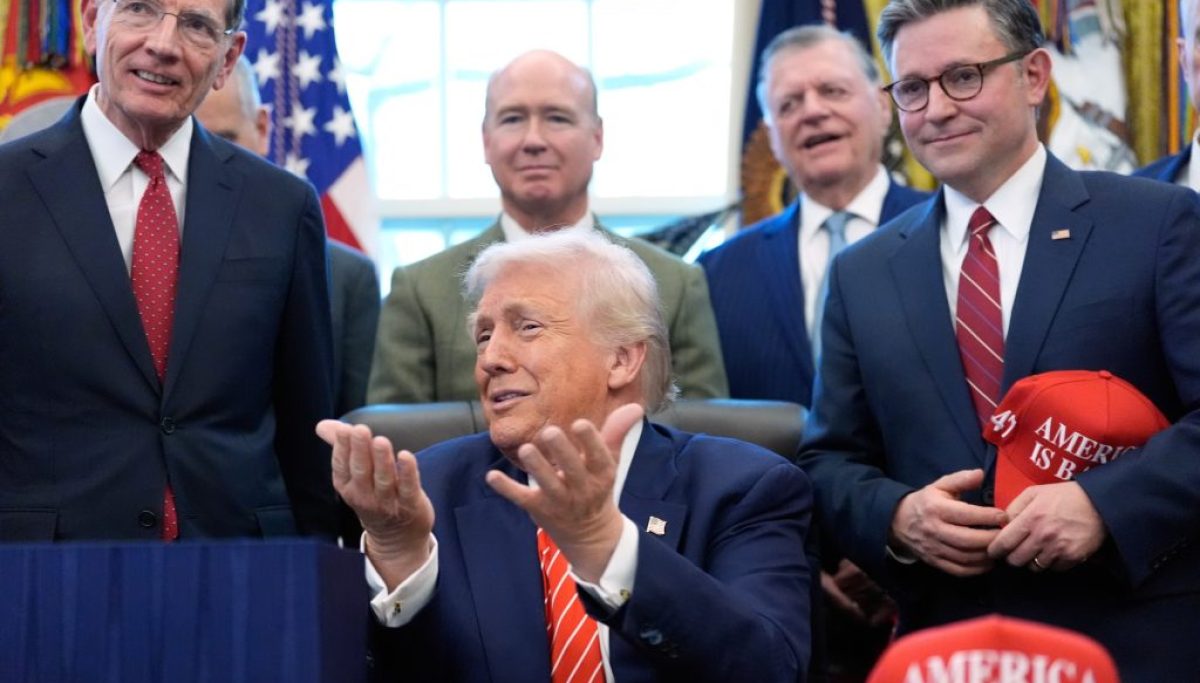
Black Americans abandoned the Democratic Party by significant margins in 2024, helping propel President Donald Trump back into the White House. But, one year in office, the president has few achievements specifically tailored to black America.
Trump dramatically increased his share of the black vote in the 2024 election to 15%, up from about 8% in 2020 and 2016, according to voter data verified by Pew Research.
During his first term, Trump championed criminal justice reform through the 2018 First Step Act, alongside rapper Ye, reality TV star Kim Kardashian, and Democrat Van Jones. That landmark piece of legislation, which is underpinned by the importance of reducing recidivism, decreased mandatory minimums for nonviolent drug offenses and resulted in the early release from prison for thousands of people.
Trump also created so-called Opportunity Zones through the 2017 Tax Cuts and Jobs Act, which the administration claims has attracted $75 billion in new private investment into low socio-economic communities and $11 billion in new wealth for minority neighborhoods.
That is in addition to ensuring $255 million in annual funding for historically black colleges and universities through the 2019 FUTURE Act.
But, one year into his second term, Trump’s approach has been remarkably different, as he and the White House reiterated how his policies have helped all Americans, not only black Americans, from tax cuts and “Trump Accounts” through the 2024 One Big Beautiful Bill Act to programs for U.S. service members and military veterans.
The one exception is the administration’s announcement last September that it was providing HBCUs and tribally controlled colleges and universities with an additional $495 million, bringing HBCUs to more than $1.34 billion during fiscal 2025.
“His policies are advancing opportunity and prosperity for all Americans,” White House press secretary Karoline Leavitt told reporters on Wednesday. “So there is a lot this president has done for all Americans, regardless of race.”
Leavitt’s talking point echoes this year’s National Black History Month proclamation, which, unlike that of last year, stipulates that “‘black history’ is not distinct from American history — rather, the history of black Americans is an indispensable chapter in our grand American story.”
“Not only are we celebrating a century of Black History Month also, as you know, this year will also be celebrating the 250th anniversary of nation’s founding,” Trump also said Wednesday during a White House Black History Month event. “Black History Month is really all about American history. This is a big year.”
When asked about Trump’s apparent different approaches to black America, coinciding with his opposition to diversity, equity, and inclusion policies, the White House was adamant that “no president has done more for black Americans than President Trump has.”
“During his five years in office, President Trump signed criminal justice reform, prison reform, opportunity zones, long-term funding of historically black colleges, school choice funding, Trump Accounts, and the largest middle-class tax cuts in history,” White House spokeswoman Olivia Wales told the Washington Examiner. “President Trump was proud to receive historic support from the black community in 2024, and he is working around the clock to deliver for them and make our country greater than ever before.”
Trump and the White House’s messaging notwithstanding, his average approval rating among black polling respondents has drastically declined from 35% approve-44% disapprove to 23% approve-74% disapprove over the course of the president’s second term, according to poll aggregator Decision Desk HQ.
To that end, Black Democratic strategist Dallas Jones, who is based in Texas, said there are black male Trump supporters who are experiencing “buyer’s remorse.”
“Nobody really expected so much, so fast, and I think that, as a result, there’s a mutual disenchantment across the board around what the country is seeing,” Jones told the Washington Examiner. “There’s been a rollback in programs that use race as an equalizer, whether those are minority contracting programs as part of the war on DEI. [But] I think all of it [is] combined in the soup pot in just one year.”
As part of his second-term agenda, Trump repealed DEI policies dating back to Lyndon B. Johnson’s administration within hours of being sworn in, a move welcomed by many of his supporters.
Republican strategists have downplayed concerns that Trump’s opposition to DEI is complicating his appeal to Black America on behalf of the GOP before this year’s midterm elections.
One black Republican strategist, whom the Washington Examiner granted anonymity, contended that Trump’s opposition to DEI does not complicate his appeals — it simply “reframes the conversation.”
“Many black voters are increasingly focused on outcomes over labels — economic opportunity, public safety, education quality, and upward mobility,” the source said. “Messaging that emphasizes tangible results, dignity of work, and expanding access to opportunity often resonates more than institutional frameworks or bureaucratic language.”
Nevertheless, Jones, the Democrat, advised his party to be mindful about their own messaging regarding DEI, considering its political repercussions and voter competing priorities.
“I think the DEI stuff matters, but I also think it’s a very wonky issue that doesn’t resonate down to Main Street,” the CEO and president of Elite Change said. “The DEI programs that exist, and have existed, I think for folks that are operating at a higher level, they’re having impact, and certainly there’s an economical impact, particularly on black businesses.”
“So I think the DEI piece has an impact, right? And do I think it’s an opportunity for Dems? I do, I think, within a certain sect, but I also think that there is a lot of work to be done around our messaging to the black community,” he continued. “We have to be able to talk directly to the varying and diverse voices within our party with the messages that they care about the most, and we cannot allow ourselves to minimize one community’s messaging over the other.”
At the same time, Danielle Alvarez, a senior adviser to former Rep. Byron Donalds, a Black Republican who campaigned for Trump before embarking on his own bid for governor in Florida, repeated that the president has been “abundantly clear that America is a meritocracy and that the Democrats’ divisive DEI agenda and racial gaslighting are non-starters.”
“Our agenda, not divisive DEI policies, will Make America Great Again,” Alvarez told the Washington Examiner.
Former 2016 National Diversity Coalition for Trump board member Leah LeVell agreed that “opportunity should be rooted in merit and that businesses and institutions should reward talent, hard work, and excellence regardless of background.”
“While policy debates about DEI will continue, I believe the administration’s focus remains on expanding economic mobility, educational access, and pathways to success for all Americans,” LeVell, the former Republican National Committee staffer-turned-lawyer who is also based in Florida, told the Washington Examiner.
Trump upset black Republicans this month when an aide, according to the president, reposted a video on Truth Social that depicted the Obamas as apes.
“Praying it was fake because it’s the most racist thing I’ve seen out of this White House. The President should remove it,” Sen. Tim Scott (R-SC), the only black Republican in the Senate and chairman of the National Republican Senatorial Committee, wrote on X at the time.
Aboard Air Force One, Trump told the Washington Examiner the post would not dampen his support among black America, describing himself as the “least racist president you’ve had in a long time” before defending the video.
“We did criminal justice reform. I did the historically black colleges and universities. I got them funded,” Trump said. “That’s why I got a tremendous, the highest vote with male black voters that they’ve seen in many, many decades. I’ve done great with them. Black voters have been great to me. I’ve been great to them.”
Then, on Tuesday, Trump mourned the death of the Rev. Jesse Jackson with a lengthy statement that included his record for black America, along with a dozen photographs of the two men.
EUROPE BRACES FOR RUBIO REMARKS IN MUNICH AFTER VANCE’S FIERY ADDRESS
“The Reverend Jesse Jackson is Dead at 84,” Trump wrote. “I knew him well, long before becoming President. He was a good man, with lots of personality, grit, and ‘street smarts.’ He was very gregarious – Someone who truly loved people! Despite the fact that I am falsely and consistently called a Racist by the Scoundrels and Lunatics on the Radical Left, Democrats ALL, it was always my pleasure to help Jesse along the way.”
Trump marked Black History Month during the first year of his second term in spite of his opposition to DEI, though the president’s executive action prompted War Secretary Pete Hegseth to remove all commemoration days from the Pentagon’s calendar.




Discount Applied Successfully!
Your savings have been added to the cart.