


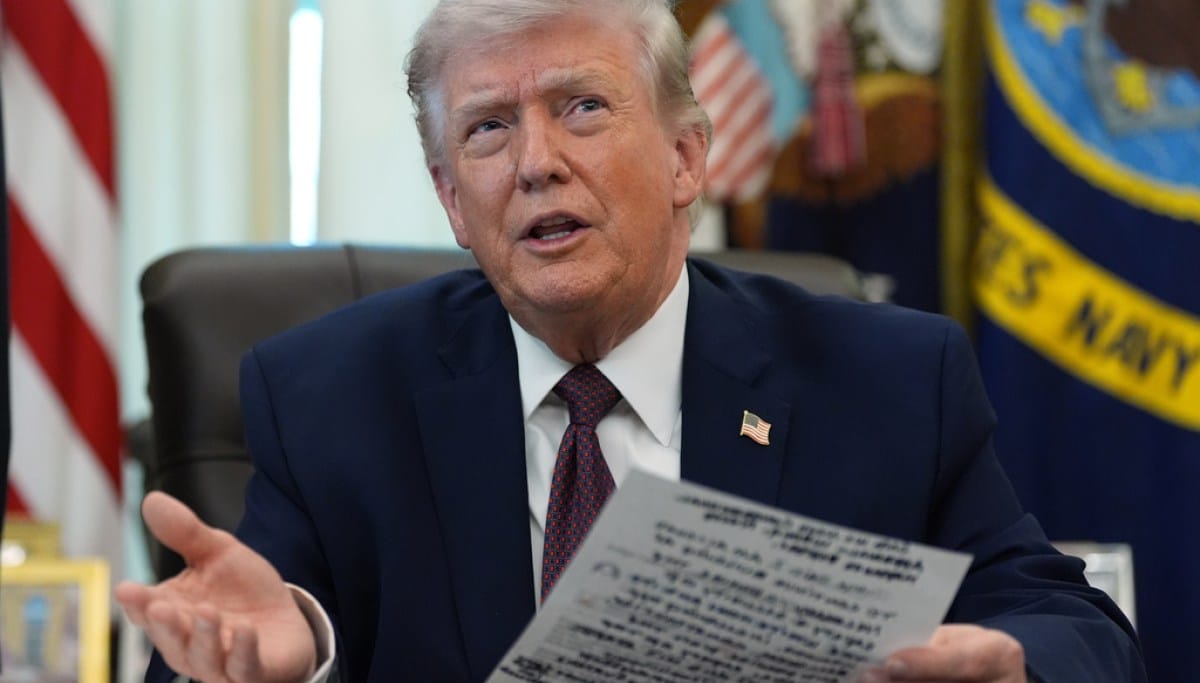
The White House released its much-anticipated budget proposal on Friday. It contains a laundry list of requests. Here are some that might have flown under the radar.
President Donald Trump’s proposal got a lot of attention for its move to increase defense spending to $1.5 trillion, a large increase of about 50% from the previous year. The plan would also cut spending on nondefense programs by about 10%, or $73 billion.
“A historic paradigm shift in the budget process is occurring and is producing real results for the American public,” said Russ Vought, director of the Office of Management and Budget. “Fiscal futility is ending.”
The Department of Homeland Security has been in the headlines the past several weeks over funding fights on Capitol Hill and a partial shutdown of the agency. The Transportation Security Agency, formed in the aftermath of the Sept. 11 terrorist attacks, has gotten attention recently for long lines at airports because of the shutdown.
The budget proposal includes language that would begin privatization for the agency. The budget estimates that process would come as a $52 million cut in spending.
Specifically, the request “begins the privatization of TSA’s airport screeners” by mandating that small airports enroll in the Screening Partnership Program, which is where the TSA pays for private screeners at certain airports.
“The airports that already use this program have demonstrated savings compared to Federal screening operations,” the budget request reads. “The move would yield cost savings compared to Federal screening and begin reform of a troubled Federal agency.”
Once housing notorious gangsters such as Al Capone, the notorious Alcatraz Federal Penitentiary closed its doors to prisoners in 1963, since becoming a museum.
Trump is pushing to remake Alcatraz into a prison, part of his law-and-order push. Located on Alcatraz Island in the San Francisco Bay, it was known for housing the country’s most dangerous criminals.
The budget requests $152 million to cover the first year of project costs “to rebuild Alcatraz as a state-of-the-art secure prison facility.”
Last year, the Trump administration began feasibility studies to reopen the iconic prison, and Trump himself has lobbied for the project. He posted about it on X, invoking the symbolic nature of the prison’s reopening.
“We will no longer be held hostage to criminals, thugs, and Judges that are afraid to do their job and allow us to remove criminals, who came into our Country illegally,” Trump said. “The reopening of ALCATRAZ will serve as a symbol of Law, Order, and JUSTICE. We will, MAKE AMERICA GREAT AGAIN!”
The proposal also contains language designed to beautify Washington, which the president has talked about for years. Trump has long decried the brutalist architecture styles of some federal buildings in the nation’s capital, such as the FBI’s headquarters.
The budget request includes a $10 billion mandatory fund to establish the “Presidential Capital Stewardship Program” within the National Park Service, aimed at coordinating and planning construction and beautification projects in the district.
“Once complete, these projects would improve safety and accessibility, rehabilitate historic buildings and landscapes, and enhance architectural grandeur so that Americans can once again be proud of the Nation’s capital,” the budget request reads.
The budget contends that such a “generational investment” in Washington would drive economic development in the city and increase the number of visitors to the nation’s capital.
Within the Department of Housing and Urban Development section, the White House proposes cutting funding for two housing programs. The proposal would end the Community Development Block Grant program, which the administration says has sent money to “ideological pet projects” rather than communities in need.
“The program has been used for many projects that the Federal Government should not be funding, such as improvement projects at a brewery, a concert plaza, and skateboard parks,” the budget proposal said.
Also on the chopping block is the HOME Investment Partnerships Program, a major housing program administered by HUD. The administration wants to cut $1.3 billion for the HOME program, which it argues “funnels money into a broken system without any clear positive outcomes.”
“State and local governments are better positioned to comprehensively address the array of unique market challenges, local policies, and impediments that contribute to housing affordability problems,” the budget reads. “This program is yet another bloated Federal slush fund that pours billions of dollars into systems rife with red tape without necessarily reaching the people it is intended to serve.”
The inclusion is notable given bipartisan housing legislation making its way through Congress. Rep. Mike Flood (R-NE), chairman of the housing subcommittee, and ranking member Emanuel Cleaver (D-MO) included significant reforms to HOME as part of the House version of the legislation.
“This compromise that came out of our committee 50-1 is the first meaningful reform of the HOME partnership program since it was authorized in 1993,” Flood told reporters earlier this year.
The budget request also includes a $1 billion request to restore and protect the Great Salt Lake in Utah, which is the largest saltwater lake in the Western Hemisphere. Trump has pushed to restore the lake in the past.
The administration describes the lake as a “critical economic and ecological asset” for the United States. The budget proposes a federal program led by the Department of the Interior to make investments to help with water flow, remove invasive species, and restore ecosystems.
“Together, these investments would ensure the Great Salt Lake continues to support global aquaculture, serves as a domestic source of critical minerals, and drives economic activity in Utah and beyond,” the budget reads.
Americans watched this week as Artemis II sent four astronauts on a flyby mission around the moon and back to Earth. This was the first crewed mission beyond low Earth orbit since 1972 and set the stage for man to eventually walk on the moon once again.
The budget specifically requests $8.5 billion for the Artemis program, which the White House hopes will land U.S. astronauts on the moon before the end of 2028.
HERE ARE THE HOLDUPS FOR THE BILL MEANT TO FIX THE HOUSING AFFORDABILITY CRISIS
The budget also provides $175 million in new investment for robotic missions to the moon.
“The Budget fully funds the lunar landers, space suits, lunar surface systems, and astronaut transportation systems necessary to safely and cost-effectively expand America’s presence to the surface of the Moon,” the document reads.
![Enjoy the [Road] Show Travel Mug with Handle, 14ozEnjoy the [Road] Show Travel Mug with Handle, 14oz](https://georgemagazine.com/wp-content/uploads/2024/08/479070202831754764_2048-300x300.jpeg)
Discount Applied Successfully!
Your savings have been added to the cart.