Behind the scenes: cease‑fire hopes, but Hormuz still tight
- Cease‑fire / peace deal talks: Negotiations between the U.S. and Iran have narrowed differences, with reports of a draft memorandum that would halt the war and gradually reopen the Strait of Hormuz over a defined window. Yahoo Finance
Vantage
- But not done yet: U.S. strikes on Iranian targets and Iran’s threats of retaliation show the deal is fragile; both sides are signaling progress and pressure at the same time. Yahoo Finance
CNBC
- Flows through Hormuz: Some LNG and crude cargoes have started to move again, but traffic is still restricted…markets see potential normalization, not full relief. Yahoo Finance
Vantage
Net effect: the market is pricing in a higher probability of peace and partial reopening, which pulls prices down, but keeps a risk premium in place because the deal can still fail.
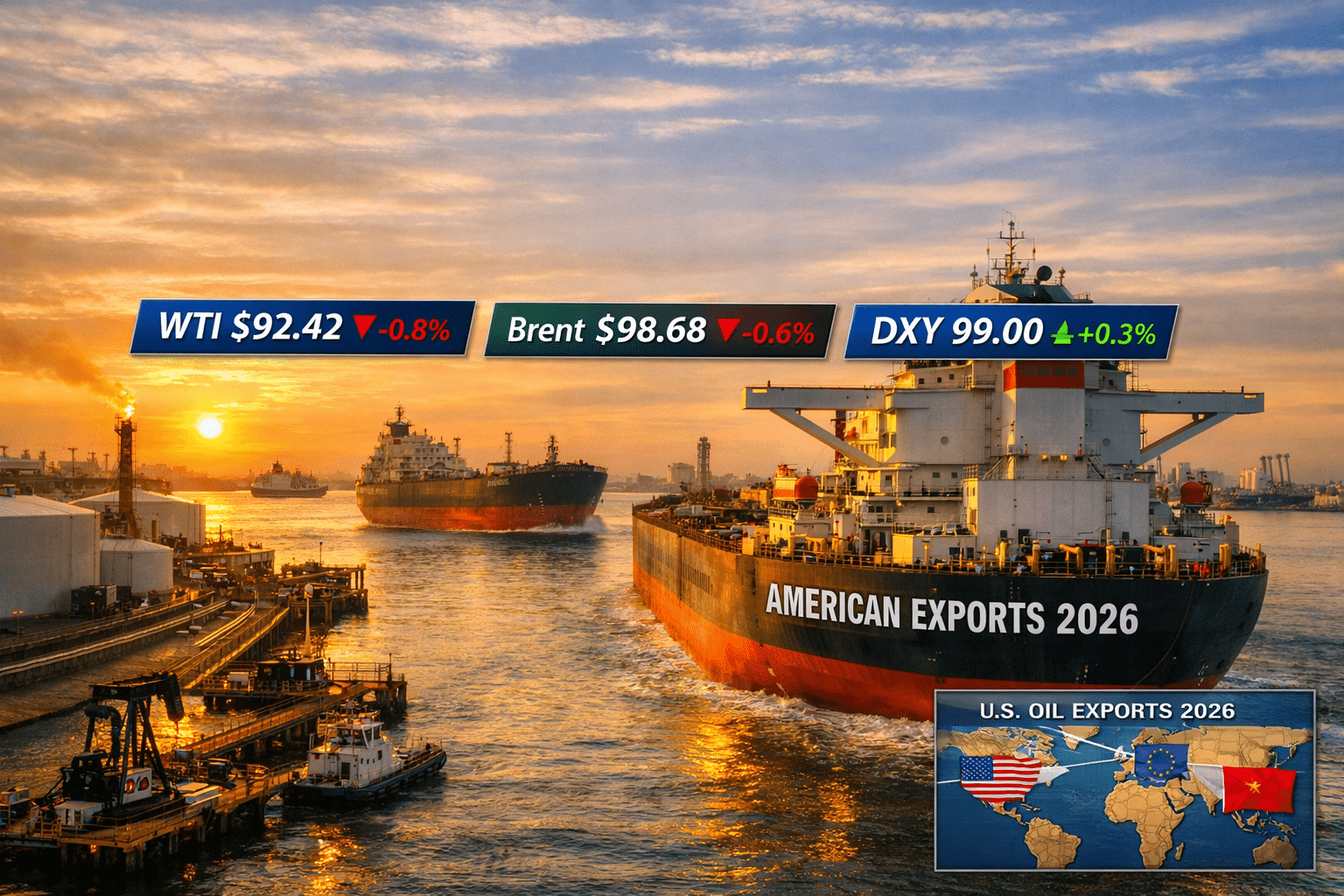
U.S. exports: still the swing barrel for Europe and China
- Europe: With Middle East flows constrained and Russian barrels structurally reduced, European refiners remain heavily oriented toward U.S. light sweet crude and other Atlantic Basin supply. The cease‑fire talk doesn’t instantly rebuild trust in Gulf logistics, so the U.S. keeps its role as primary stabilizer. Yahoo Finance
CNBC
- China:
- China has been pulling in cargoes that can reliably clear Hormuz or avoid it altogether; U.S. barrels remain a reliability hedge even as prices ease.
- As diplomacy around Iran improves, Beijing can diversify more…but the recent shock has reinforced the value of U.S. and non‑Gulf supply in its energy mix. Yahoo Finance
Vantage
So even with prices down, the structural shift toward U.S. exports doesn’t reverse…it just becomes slightly less frantic and more price‑sensitive.
Iran, the U.S. Navy, and a “managed” blockade
- Blockade dynamics: The U.S. naval posture and mine‑clearing conditions are central to the cease‑fire framework; reports suggest Iran would clear mines and allow freer navigation under a deal, but until that’s verified, risk remains priced in. Yahoo Finance
CNBC
- Iran “crumbling” narrative: Iran is under heavy economic and infrastructure strain, but it still has leverage via missiles, drones, and proxies. Markets are treating it as weakened but still capable of disruption, which is why Brent hasn’t collapsed to pre‑war levels. Yahoo Finance
CNBC
Today’s price drop is less “all clear” and more “maybe we’re moving from acute crisis to chronic tension.”
U.A.E. out of OPEC/OPEC+ and under attack
- OPEC fracture: The U.A.E.’s decision to leave OPEC/OPEC+ and pursue its own production path weakens the cartel’s cohesion and long‑term ability to manage prices. Vantage
- Iranian attacks: Iranian strikes on U.A.E.‑linked infrastructure fit the pattern of Tehran punishing a Gulf rival that both left quota discipline and is investing in routes that bypass Hormuz. This raises regional risk even as cease‑fire headlines circulate. Yahoo Finance
CNBC
For traders, that combination…cartel fracture + targeted attacks…reinforces the idea that Atlantic Basin and U.S. barrels deserve a structural premium in reliability.
How increased U.S. exports boost the U.S. economy
- Export revenues: Even at $90–100, with strong volumes, U.S. producers and midstream firms enjoy very healthy cash flows, supporting earnings and investment. CNBC Vantage
- Capex and jobs:
- Continued build‑out of pipelines, export terminals, storage, and shipping along the Gulf Coast.
- Local employment and tax receipts in energy hubs stay elevated.
- Trade balance: High‑value crude and product exports improve the U.S. trade balance, bringing in foreign currency at a time when others are paying both a dollar and energy premium.
The flip side: U.S. consumers still face relatively high fuel prices versus pre‑crisis norms, so the macro win coexists with micro‑level pain.
Strong dollar, strong Fed note, and the oil pullback
- DXY near 99: A firm Dollar Index signals ongoing demand for dollar assets amid geopolitical risk and tight inventories. CNBC Vantage
- Why prices can fall anyway:
- As cease‑fire odds rise and shipping risk appears to ease, the war premium compresses, pulling WTI and Brent down even against a strong dollar.
- Inventories are still tight, but the market is looking forward: if Hormuz gradually reopens, the worst‑case supply scenarios get priced out. Yahoo Finance Vantage
So today’s move is the classic “less bad is good”: prices fall not because the world is flush with oil, but because disaster risk is being discounted.
What to expect in today’s trading
With WTI at $92.42 and Brent at $98.68:
- Base case: A choppy, headline‑driven session…every new line about the cease‑fire, U.S. strikes, or Iranian retaliation can swing prices. Yahoo Finance CNBC
- Bullish triggers:
- Talks break down, or Iran escalates against Gulf infrastructure or shipping.
- Evidence that inventories are drawing faster than expected despite lower prices.
- Bearish/relief triggers:
- Concrete, verifiable steps: mine‑clearing, escorted convoys, and a visible pickup in Hormuz traffic.
- Clear messaging from Washington and Tehran that a binding framework is in place and being implemented.
Energy equities likely stay supported but less euphoric; refiners and transport names may benefit from slightly lower crude, while fuel‑intensive sectors still wrestle with elevated…but no longer extreme…energy costs.
Blind spots:
- Cease‑fire optimism bias: Markets (and this analysis) may overweight positive diplomatic headlines; several prior attempts at deals have failed late. A single attack or political misstep could re‑inflate the risk premium quickly. Yahoo Finance Vantage
- Western/market lens:
- The framing emphasizes U.S. exports, dollar strength, and GDP effects…this is a Western financial perspective.
- It underplays how emerging markets experience this as imported inflation and currency stress, even with prices off the highs. CNBC Vantage
- “Iran crumbling” narrative: Iran’s internal strain is real, but the phrase can obscure its remaining asymmetric capabilities and regional influence; assuming linear collapse is a risk.
- Sustainability blind spot: The focus on export windfalls can hide the long‑term strain on U.S. inventories and domestic fuel prices if exports stay elevated while global supply remains tight.
Calling these out explicitly helps keep the story from sliding into “U.S. wins, everyone else loses” oversimplification.
*****
Get the Aetherian Realm’s Final Judgments Map: https://georgemagazine.com/product/aetherian-realms-final-judgments-map/
Get Ageless Tech. Using AI to Your Advantage: https://georgemagazine.com/agelesstech/
Get George’s America’s 250th: https://georgemagazine.com/product/america-250-celebrating-legacy/
Get America’s 250th George Magazine T-Shirt: https://georgemagazine.com/product/americas-250th-george-magazine-t-shirt/
Get The George Dispatch: https://georgemagazine.com/thedispatch/
Get George Magazine. Print or Digital: https://georgemagazine.com/subscribe-george-magazine/
Get George Junior. Print or Digital: https://georgemagazine.com/subscribe-george-junior-magazine/
Get George’s Crypto E-Playbook: https://georgemagazine.com/product/the-crypto-playbook-by-george-magazine/
Visit Project Looking Glass: https://projectlookingglass.org/




Wow- excellent analysis with detail analysis of the specific regions of the world regarding not only oil production & the type of oil but also the refineries & their critical role. European refineries buying the smooth USA crude oil. Stay the course! OPEC is loosing dominance-Russia is in the fight of their life& the USA is selling oil to the Europeans & Chinese! This is a masterpiece in Trump’s administration in directing the region’s of the world to buy from us !!! Drill baby drill! Gas prices will come down in due time -No pain no gain- Same w/ the tariffs! Thank you Almighty Jesus Christ our King who resides in heaven at the Father’s right Hand for blessing this country for a bountiful supply of oil & all the natural resources you have bestowed upon us! May we give you glory & praise Alone! Please continue to protect our troops & the members of your Living Body who are fighting against the evil regime of Iran. Amen