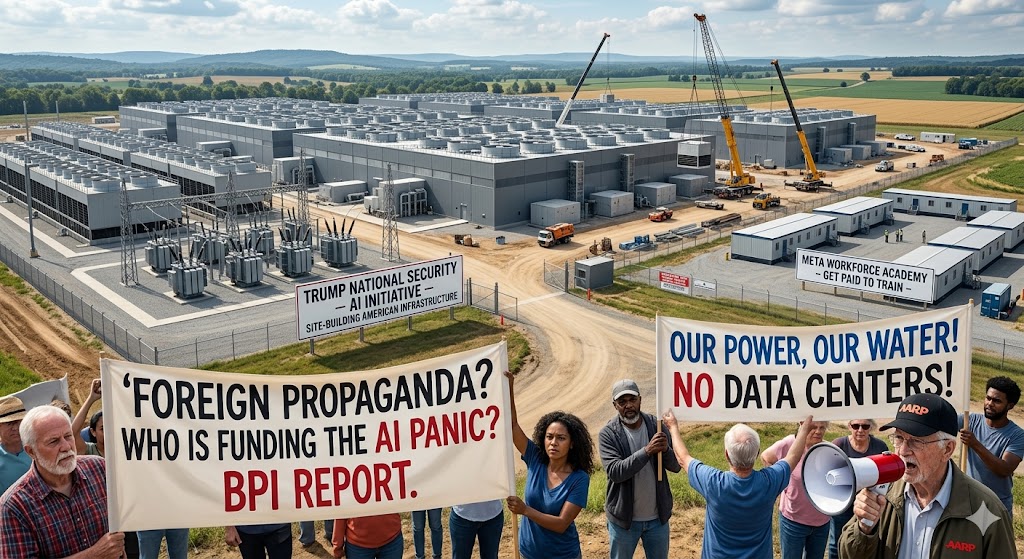
The Construction Landscape: A Rural and Regional Surge
The sheer scale of AI data center development is staggering. According to a Pew Research Center analysis from April 2026, over 1,500 new data centers are in various stages of development nationwide. Cushman & Wakefield reports that as of late 2025, 25.3 GW of capacity was under construction, with a pre-commitment rate of nearly 89%, indicating insatiable demand.
A profound shift in location is underway. The majority of new U.S. data centers are moving to rural areas. While 87% of existing data centers are in urban centers, 67% of planned ones are destined for rural counties, with nearly 40% going to areas that currently have none. Geographically, the South and Midwest are the primary battlegrounds, accounting for three-quarters of all planned construction. States like Virginia and Texas lead the nation in both operational and planned facilities, followed by Georgia, Illinois, and Arizona.
The Opposition: Local Fear, Foreign Funding
This breakneck expansion has triggered a massive, bipartisan counter-movement. In the first three months of 2026 alone, more than 75 data center build-outs worth a combined $130 billion were successfully blocked or delayed…matching the total for the entire previous year.
Local resistance is rooted in concrete fears about the “physical footprint” of the cloud. Chief among these are soaring power and water costs, with residents worrying that they will bear the financial burden while “Big Tech reaps the profits.” A Reuters-Ipsos poll in 2026 found that 77% of Americans fear rising electricity bills due to AI. Noise, land-use conflicts, and strain on the power grid have led to moratoriums in at least 69 local jurisdictions.
However, a disturbing dimension has emerged. A May 2026 report from the Bitcoin Policy Institute (BPI) documents that this anti-data-center campaign is being fueled by a coordinated “foreign influence operation.” The BPI report identifies three key vectors:
- Foreign State Media: English-language propaganda outlets from China (CGTN, China Daily, Global Times) and Russia (RT) are actively campaigning against U.S. AI data centers and export controls.
- The Singham Network: A U.S. 501(c)(3) nonprofit ecosystem funded by Shanghai-based expatriate Neville Roy Singham, who is under congressional inquiry for reported ties to the CCP, is producing anti-US AI content.
- Foreign-Billionaire “Dark Money”: Charitable vehicles linked to Swiss and British billionaires have funneled over $2 billion into U.S. advocacy infrastructure, with a significant portion now flowing to organizations driving the anti-data-center movement.
The report warns that this campaign aims to freeze U.S. computing power, allowing China to seize the strategic advantage.
President Trump’s Push for the “American Pie”
President Trump has taken a multi-pronged approach to ensure the “American People” get a central “piece of the AI pie,” focusing on national security, jobs, and anti-bias principles. In June 2026, he signed a National Security Presidential Memorandum on AI to put the most advanced and secure systems into the hands of American warfighters and build out “next-generation, high-security computing facilities.” This action was paired with an Executive Order to advance American AI innovation to strengthen cybersecurity and protect critical infrastructure.
His “AI Action Plan,” launched in 2025, centers on “accelerating innovation” and “building American AI infrastructure,” with a stated goal of driving historic private-sector investment to create “countless new jobs for Americans” and ensure the “frontier of this technology is built here at home.” He also signed an Executive Order preventing the Federal government from using AI models with “ideological biases or social agendas,” framed as “preventing woke AI.”
The AI Workforce: META and an Army of Others
To build and run this new infrastructure, tech companies are launching massive training programs. The user-requested META Workforce Academy (officially “America’s Workforce Academy”) launched in 2026 as a nationwide program to pay participants to train for AI infrastructure jobs, with pilot locations in Baton Rouge, Louisiana, and other states like Texas, Indiana, and Ohio. Crucially, the program, which requires no prior experience, provides a guaranteed job placement upon graduation.
Meta is far from alone. An “army” of other organizations is upskilling the workforce:
- Google: Offers a Google AI Professional Certificate with hands-on practice, as well as an “AI Works” initiative to empower millions with job-ready training, validated by a coalition of major employers.
- Amazon: Its AWS AI & ML Scholars program aims to empower 100,000 learners globally, leading to Udacity Nanodegree scholarships. AWS also offers specific AI practitioner certifications.
- Microsoft: Provides an AI Skills Navigator with diverse learning paths for business leaders, developers, and educators.
- NVIDIA: Hosts an expansive hub of learning resources, workshops, and certifications.
- OpenAI: Partnered with the American Federation of Teachers to create the National Academy for AI Instruction, providing free, structured AI training for 1.8 million members.
Accelerating Baby Boomer Adoption
The challenge of getting the Baby Boomer generation to adopt AI quickly is being met with strategies that focus on utility and familiarity rather than complex technology. Experts from AARP and groups like Bethesda Health Group recommend a “use-case first” approach:
- Voice-Activated Convenience: Focus on tools they already use, like Siri, Alexa, or Google Assistant, to perform simple tasks: making hands-free calls, checking the weather, or setting smart thermostats. AARP notes, “AI for seniors can be as simple as asking your computer or smartphone a question…just like you were talking to another human being.”
- Everyday Utility: Highlight AI for non-technical tasks, such as using generative AI to draft a letter or email, or utilizing wearable devices (Apple Watch, Fitbit) to monitor health, manage medications, and share data with doctors.
- Health and Safety: Showcase smart home technology for fall detection, automated lighting, and environmental monitoring, which reduces risk for those aging in place.
Programs like the All Seniors Foundation are already integrating AI into senior support services to demonstrate these benefits directly.
AI’s Boost to the U.S. Economy
The growth of AI is already providing a concrete, measurable boost to the U.S. economy, albeit with some nuance. A June 2026 report from the Economic Policy Institute (EPI) states that “AI-related spending is providing much of the growth in the U.S. economy today.”
The primary drivers of this growth are:
- Massive Capex Investment: Business investments in “structures and equipment” (capex), driven specifically by AI firms, have accelerated noticeably, adding over a percentage point to GDP growth.
- A “Wealth Effect” on Consumption: The historic stock boom in AI-related companies has created a wealth effect that is spurred consumption.
- Local Revenue and Jobs: A Washington Examiner op-ed compares data centers to the factories of the 20th century, highlighting the large capital investment, construction activity, permanent operations jobs, and crucial “property-tax revenues to host communities.”
While some analysts, like those at EPI, warn that the current stock and capex spending “seem fragile,” the immediate effect has been a substantial contribution to national GDP and local economic resilience.
Get “Co V Fe Fe” Shirt here: https://georgemagazine.com/product/cov-fe-fe-george-magazine/
Get the Aetherian Realm’s Final Judgments Map: https://georgemagazine.com/product/aetherian-realms-final-judgments-map/
Get Ageless Tech. Using AI to Your Advantage: https://georgemagazine.com/agelesstech/
Get George’s America’s 250th: https://georgemagazine.com/product/america-250-celebrating-legacy/
Get America’s 250th George Magazine T-Shirt: https://georgemagazine.com/product/americas-250th-george-magazine-t-shirt/
Get The George Dispatch: https://georgemagazine.com/thedispatch/
Get George Magazine. Print or Digital: https://georgemagazine.com/subscribe-george-magazine/
Get George Junior. Print or Digital: https://georgemagazine.com/subscribe-george-junior-magazine/
Get George’s Crypto E-Playbook: https://georgemagazine.com/product/the-crypto-playbook-by-george-magazine/
Visit Project Looking Glass: https://projectlookingglass.org/