The U.S. Dollar vs. BRICS Nations
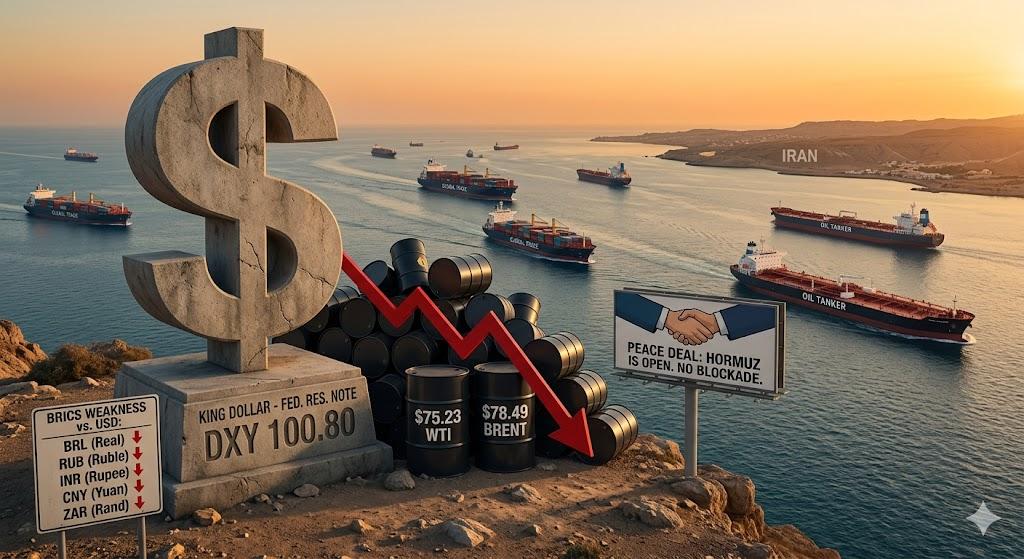
The known BRICS bloc faces a direct challenge from this renewed dollar strength. Their collective long-term ambitions for de-dollarization are hitting a wall of short-term reality as a strong DXY pressures their local currencies.
- Brazilian Real (BRL): Trading at 1 USD = 5.11 BRL. While Brazil’s agricultural exports offer some insulation, a dollar pushing past 100.80 limits the Real’s ability to make meaningful gains.
- Russian Ruble (RUB): Positioned at 1 USD = 85.0 RUB. The heavily managed Ruble faces a compounding crisis. A surging dollar combined with collapsing oil revenues severely limits Moscow’s financial flexibility.
- Indian Rupee (INR): Weakened to 1 USD = 83.2 INR. India is enduring persistent structural deficits. While cheaper oil imports offer vital relief to their balance sheets, the relentless strength of the dollar keeps the Rupee pinned down.
- Chinese Yuan (CNY): Pegged loosely around 1 USD = 7.23 CNY. Beijing continues its tight management of the Yuan. Cheap energy lowers manufacturing costs, but a dominant global dollar forces China to actively defend its currency corridor.
- South African Rand (ZAR): Trading at a weak 1 USD = 18.2 ZAR. The highly volatile Rand remains exposed to domestic economic headwinds and capital flight toward higher-yielding U.S. assets.
Geopolitical Breakthrough: The Iran War Ends, Blockade Lifted
The primary catalyst altering global trade maps is the official conclusion of the war with Iran. Following the finalization of a comprehensive peace agreement, a stable and durable deal is now fully operational.
The most immediate operational change is the complete removal of the U.S. Naval blockade of the Strait of Hormuz. This vital maritime artery, responsible for the transit of roughly 20 percent of global oil supply, is open for unrestricted commercial shipping.
This sudden resolution has entirely erased the geopolitical risk premium that historically inflated energy prices. The psychological shift from an escalating conflict to an open, operational trade route has radically altered global supply projections.
The Relation to Oil Markets (CNBC.com Pricing)
The collision of a surging U.S. Dollar and an open Strait of Hormuz has triggered a massive capitulation event in the energy sector. According to real-time data from CNBC.com, prices have broken key support levels.
Oil Prices (Priced by CNBC.com):
- West Texas Intermediate (WTI): $75.23 (Down significantly)
- Brent Crude: $78.49 (Down significantly)
Analysis of the Relationship: The Ultimate Double-Whammy
The current pricing reflects two powerful macroeconomic forces working together to crush energy valuations:
First, a massive supply shock is underway. The lifting of the blockade instantly normalizes shipping logistics in the Persian Gulf and clears the way for unhindered regional oil exports. With zero risk of localized supply disruptions, speculative buyers have entirely abandoned the market.
Second, the strong dollar accelerates this downward momentum. Because global oil is priced in U.S. Dollars, a DXY at 100.80 makes every barrel substantially more expensive for foreign nations buying in local currencies. This demand-side suppression, hitting at the exact same moment that supply restrictions disappear, locks prices into a deep, deflationary spiral.
Blind Spots:
This revised analysis remains susceptible to the following specific blind spots:
- Monetary Policy Bias: Attributing the market dynamics solely to the peace deal ignores the Federal Reserve’s underlying interest rate trajectory, which is likely the primary anchor keeping the DXY at 100.80.
- Oversimplifying the Oil Mechanism: Assuming the strong dollar is a primary cause of the oil drop could confuse a correlation with a causation. The physical reality of an open shipping lane is arguably doing the heavy lifting, regardless of where the DXY sits.
- Execution Risk Disregard: The analysis treats the peace deal as a flawless, static event. Any friction in the rollout of the agreement or naval repositioning could instantly trigger a short squeeze in energy markets.
*****
Get “Co V Fe Fe” Shirt here: https://georgemagazine.com/product/cov-fe-fe-george-magazine/
Get the Aetherian Realm’s Final Judgments Map: https://georgemagazine.com/product/aetherian-realms-final-judgments-map/
Get Ageless Tech. Using AI to Your Advantage: https://georgemagazine.com/agelesstech/
Get George’s America’s 250th: https://georgemagazine.com/product/america-250-celebrating-legacy/
Get America’s 250th George Magazine T-Shirt: https://georgemagazine.com/product/americas-250th-george-magazine-t-shirt/
GIANT Dispatch flying out now. Inside Baseball!!!
Get The George Dispatch Free: https://georgemagazine.com/thedispatch/
Get George Magazine. Print or Digital: https://georgemagazine.com/subscribe-george-magazine/
Get George Junior. Print or Digital: https://georgemagazine.com/subscribe-george-junior-magazine/
Get George’s Crypto E-Playbook: https://georgemagazine.com/product/the-crypto-playbook-by-george-magazine/
Visit Project Looking Glass: https://projectlookingglass.org/





![Enjoy the [Road] Show Travel Mug with Handle, 14ozEnjoy the [Road] Show Travel Mug with Handle, 14oz](https://georgemagazine.com/wp-content/uploads/2024/08/479070202831754764_2048-300x300.jpeg)