Boomers: Adoption Through Friction
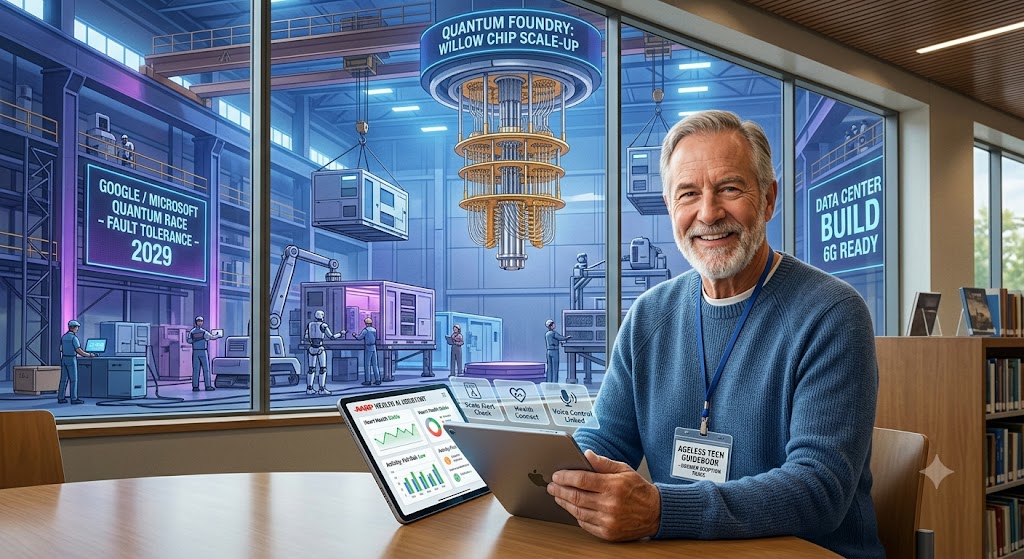
Behind the scenes, the story of AI adoption among the 55+ demographic is one of necessary pragmatism winning out over deep-seated hesitation. While 2026 consumer research confirmed that 55% of Baby Boomers initially refused to use AI shopping tools due to a major “trust gap,” adoption has surged where utility and safety intersect.
Instead of navigating complex creative prompts, seniors are embracing AI as an invisible utility. The push is coming from grassroots training hubs. Libraries and senior centers are currently prioritizing safety-first workshops. This month, “Senior Planet from AARP” is running heavily attended sessions focused exclusively on “AI & Disinformation,” teaching older adults how to identify deepfakes and voice cloning to prevent digital deception.
The immediate outlook for the upcoming month is a localized explosion of this utility-focused training. We are moving away from teaching what generative AI is and focusing on what it does for independence. In advanced markets like Singapore, 72% of boomers now use AI for specific investment tasks, favoring a hybrid model where AI complements a human advisor. This model of “trusted utility” is now the blueprint for global adoption. Expect technology companies to shift their 55+ marketing this month from “novelty creation” to “fraud protection” and “health monitoring.”
The Quantum Leap Behind the Scenes
While AI dominates public discourse, a quieter, far more profound technological race is unfolding inside Big Tech’s highly restricted labs. The current month marks a shift from theoretical quantum advantage to industrial application scaling.
Google has solidified its lead on scientific proof. Building on its 105-qubit “Willow” chip—which early in 2026 demonstrated calculations taking seconds that would take supercomputers septillions of years—Google made a significant strategic move in late March. To accelerate progress, Google Quantum AI ceased to be a single-technology operation, opening a second hardware avenue focused on neutral atom quantum computing to run parallel with its long-standing superconducting qubit work.
Microsoft is pursuing a distinct “highest-convexity” strategy, focusing on building a usable platform from the software up. Realizing that raw hardware milestones mean little without usability, Microsoft used the last 30 days to launch its “2026 Quantum Pioneers Program.” This initiative is aggressively recruiting leading academic researchers to build the foundational software stack—specifically compilers, fault-tolerant error correction, and algorithmic resource estimation—for their unique, highly error-resilient topological qubits.
Apple, true to form, is pursuing quantum readiness rather than building a quantum computer. Its strategy is defensive and localized. Starting this month with the rollout of iOS 26 and macOS Tahoe 26, Apple is automatically activating post-quantum cryptographic standards (NIST ML-KEM/ML-DSA) inside iMessage and TLS connections. Apple is optimizing its own silicon to run these sophisticated new codes instantly on-device, ensuring user data today is protected from attackers trying to record it now to decrypt it with a future quantum machine.
References and Citations
-
Salsify. (2026, April). “2026 Consumer Research: Generating Brand Trust.” Salsify Blog.
-
Insurance Asia. (2026, July 9). “Nine in 10 investors do not trust AI for investment decisions.” Insurance Asia Event News.
-
Institute for Public Relations. (2026, March 18). “Most Americans Use AI But Still Don’t Trust It.” Institute for PR.
-
Senior Planet from AARP. (2026, July 5). “Virtual AI Resources – AARP.” Senior Planet Website.
-
Tech Intel. (2026, January). “Google’s Willow Quantum Chip: The Beginning of a New Computational Age.” Medium Tech Intel.
-
Quantum Zeitgeist. (2026, June 27). “Google Quantum AI: The Complete 2026 Guide.” Quantum Zeitgeist.
-
Microsoft Quantum. (2026). “2026 Quantum Pioneers Program – Microsoft.” Azure Quantum.
-
Apple Security. (2026, May 22). “A blueprint for formal verification of Apple corecrypto.” Apple Security Blog.
-
Apple Support. (2026, June). “Prepare your network for quantum-secure encryption in TLS.” Apple Support Pages.
-
New Market Pitch. (2026, June 29). “Who will win the quantum computing race? Nobody has won yet.” *New Market Pitch Summary.*
*****
George’s America’s 250th: https://georgemagazine.com/product/america-250-celebrating-legacy/
Q is for Quantum Shirt: https://georgemagazine.com/product/q-is-for-quantum/
Ageless Tech E-Book Using AI to Your Advantage: https://georgemagazine.com/agelesstech/
Q is for Quantum Coffee Mug: https://georgemagazine.com/product/q-is-for-quantum-coffee-mug/
George’s Crypto E-Playbook: https://georgemagazine.com/product/the-crypto-playbook-by-george-magazine/
Aetherian Realm’s Final Judgments Map: https://georgemagazine.com/product/aetherian-realms-final-judgments-map/
America’s 250th George Magazine T-Shirt: https://georgemagazine.com/product/americas-250th-george-magazine-t-shirt/
George Dispatch Free: https://georgemagazine.com/thedispatch/
George Magazine. Print or Digital: https://georgemagazine.com/subscribe-george-magazine/
George Junior. Print or Digital: https://georgemagazine.com/subscribe-george-junior-magazine/
Project Looking Glass: https://projectlookingglass.org/