When you are completely stationary, almost all of your total speed is dedicated to moving forward through time, allowing you to age at a normal rate. However, once you begin moving through physical space, a portion of that total speed must be diverted. As a result, your passage through time literally slows down compared to a stationary observer. If a physical object could ever accelerate to the speed of light, one hundred percent of its spacetime velocity would be consumed by spatial movement. Consequently, time from the perspective of an outside observer would completely stop.
Physicists illustrate this mechanical reality using a thought experiment known as the light clock, which consists of a single photon bouncing vertically between two parallel mirrors. For a stationary observer standing right next to the clock, the photon travels in a simple, straight up-and-down line. But if that exact same clock is placed on a remarkably fast-moving spaceship zooming past, an outside observer sees the photon tracing a much longer, diagonal path to catch up with the forward-moving mirrors. Because the speed of light is an absolute constant and the photon absolutely cannot speed up, traversing this longer distance takes more time. Each individual tick of the moving clock is stretched out. This conceptually proves that physical motion directly slows the passage of time for the traveler.
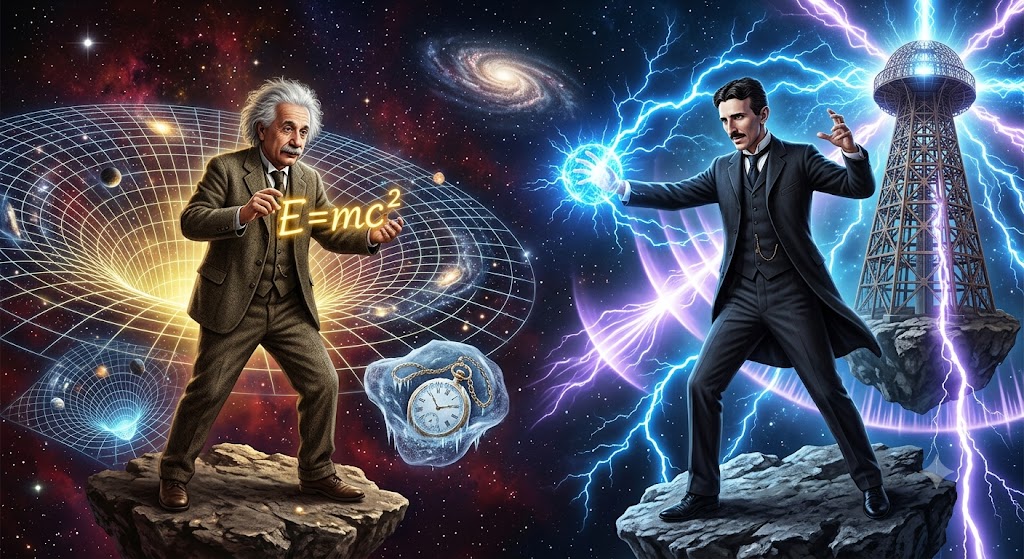
Despite the elegance and eventual mathematical proof of Einstein’s theories, Nikola Tesla refused to accept this paradigm. Tesla was a classical physicist who fundamentally disagreed with the concept of an empty vacuum governed by curved spacetime. Instead, he championed the existence of a luminiferous ether, an invisible gaseous medium that he believed permeated all of space and facilitated the transfer of electromagnetic waves. To Tesla, asserting that empty space could bend or govern matter was a logical fallacy.
Their disagreement extended to the relationship between mass and energy. While Einstein’s famous equation proved that matter and energy were interchangeable forms of the same thing, Tesla argued the exact opposite. He believed matter had no intrinsic energy at all, but rather acted as a conduit that absorbed forces from the surrounding ether. Furthermore, because Tesla rejected relativity, he entirely dismissed the speed of light as a cosmic limit. He firmly believed that longitudinal waves and cosmic rays traveling through his proposed ether could move at speeds millions of times faster than light.
History, observational astronomy, and experimental physics ultimately vindicated Einstein’s mathematical mechanics. Nuclear power, the discovery of black holes, and the detection of gravitational waves have all proven beyond a shadow of a doubt that relativity, time dilation, and mass-energy equivalence are fundamental realities governing our universe. However, Tesla was not entirely wrong in spirit. While his rigid, mechanical ether definitively does not exist, modern quantum physics reveals that space is not an empty, dead void either. It is instead filled with underlying, invisible quantum fields and constantly fluctuating virtual particles. Today, the scientific community still seeks to fully unify Einstein’s brilliantly proven spacetime with the vibrant, energy-rich quantum vacuum that conceptually echoes Tesla’s earliest intuitions.
*****
The Armour of Light Issue 42: https://georgemagazine.com/product/george-magazine-issue-42/
George’s America’s 250th: https://georgemagazine.com/product/america-250-celebrating-legacy/
Q is for Quantum Shirt: https://georgemagazine.com/product/q-is-for-quantum/
Ageless Tech E-Book Using AI to Your Advantage: https://georgemagazine.com/agelesstech/
Q is for Quantum Coffee Mug: https://georgemagazine.com/product/q-is-for-quantum-coffee-mug/
George’s Crypto E-Playbook: https://georgemagazine.com/product/the-crypto-playbook-by-george-magazine/
Aetherian Realm’s Final Judgments Map: https://georgemagazine.com/product/aetherian-realms-final-judgments-map/
America’s 250th George Magazine T-Shirt: https://georgemagazine.com/product/americas-250th-george-magazine-t-shirt/
George Dispatch Free: https://georgemagazine.com/thedispatch/
George Magazine. Print or Digital: https://georgemagazine.com/subscribe-george-magazine/
George Junior. Print or Digital: https://georgemagazine.com/subscribe-george-junior-magazine/
Project Looking Glass: https://projectlookingglass.org/






Absolutely nothing has been proven with any certainty that Einsteins theroys are true what so ever!!!! Matter of fact I believe its all Bullshit! He was a deepstate tool!!!!!