However, there was a glaring mathematical problem. Traditional sovereign wealth funds are built on surplus revenue, and the United States is currently running massive, multi-trillion dollar national deficits. Finding the loose change in the couch cushions of the Treasury to capitalize a brand new sovereign wealth fund proved to be an impossible task. The original 90 day plan mandated by the executive order stalled. Planners quickly realized that formally establishing a pooled investment vehicle required explicit congressional action and statutory authority. Furthermore, insulating such a fund from the usual political horse trading would severely limit the executive branch’s direct control over the capital. The dream of a traditional sovereign wealth fund quietly died behind closed doors.
But politicians rarely let a catchy financial concept go to waste. By August 2025, the administration executed a dramatic strategic pivot. Commerce Secretary Howard Lutnick announced that while the traditional sovereign wealth fund was off the table, the administration was launching the National and Economic Security Fund. This new entity was not built on domestic tax revenue. Instead, it was engineered around a massive influx of foreign investment capital secured through aggressive trade and tariff negotiations. It was a clever workaround. If the United States did not have the cash on hand, it would leverage its sheer market size to compel allied nations to foot the bill.
The scale of this foreign capital injection is staggering. According to the January 2026 Commerce Department report, the administration secured $900 billion in combined commitments. Japan pledged an incredible $550 billion to rebuild the American industrial base. South Korea followed suit with a $350 billion commitment focused heavily on shipbuilding and national infrastructure. This was no longer a wealth fund in the traditional sense. It had morphed into a state directed private equity firm, using allied money to forcefully reindustrialize the American heartland.
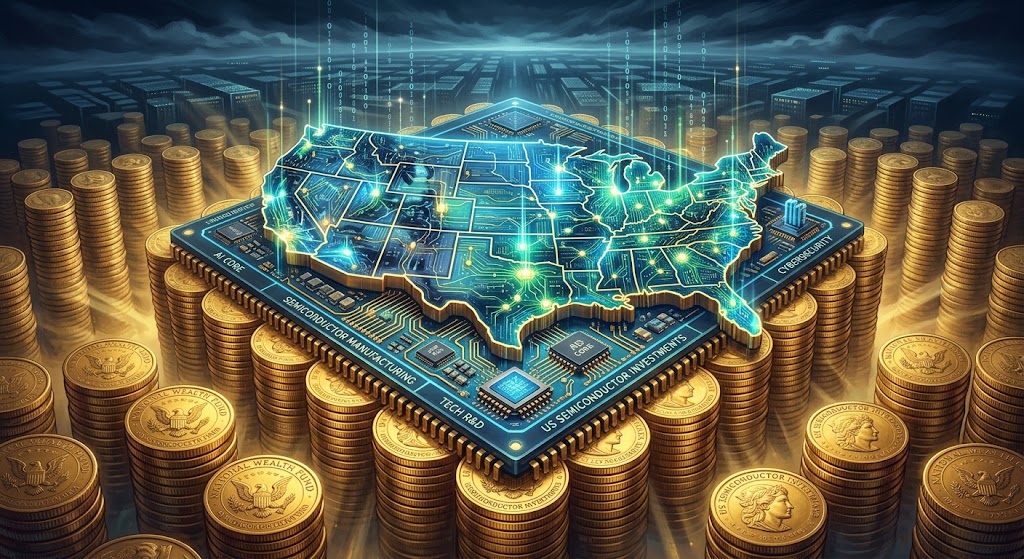
The most aggressive and controversial application of this new strategy came to light early in 2026 regarding the domestic semiconductor industry. For years, the federal government had been handing out massive, non-refundable grants to tech behemoths to encourage domestic chip manufacturing. It was corporate welfare on a silver platter. The new administration decided to change the terms of the deal. Instead of simply giving away taxpayer money, the Commerce Department converted previous federal grants and new capital injections into a direct 9.9 percent equity stake in Intel.
This move fundamentally altered the relationship between the federal government and private enterprise. The United States government is now essentially a major shareholder in one of the most critical technology companies on the planet. The goal is to lock down the domestic semiconductor ecosystem, ensuring that the supply chains required for advanced artificial intelligence and military hardware are physically located within the borders of the United States. It is a bold, heavy-handed industrial policy that makes free market purists sweat profusely.
The physical footprint of this massive capital deployment became apparent during the March 2026 Washington summit between President Trump and Japanese Prime Minister Takaichi Sanae. The meeting laid out the first wave of tangible projects funded by the Japanese capital commitment. The focus was heavily skewed toward energy infrastructure, acknowledging a critical vulnerability in the modern economy. Artificial intelligence and advanced manufacturing require an astronomical amount of electricity. To meet this demand, the administration announced a $33.3 billion natural gas generation project and a $2.1 billion expansion for crude oil exports.
Perhaps the most futuristic element of the summit was the announced commercial deployment of advanced Small Modular Reactors. These localized, compact nuclear power plants are specifically targeted to supply power to new, co-located data centers. By building dedicated power generation for tech hubs, the administration is attempting to insulate the residential power grid from the massive energy drain of corporate artificial intelligence projects. It is an infrastructure push on a scale not seen since the Eisenhower administration.
The geopolitical implications of relying on Japanese and South Korean capital cannot be understated. By deeply entwining the economic fates of these three nations, the United States is forging a financial alliance that acts as a bulwark against competing global powers. Japan and South Korea are not simply handing over billions out of goodwill. They are buying guaranteed access to the American market and securing their own supply chains under the protective umbrella of the United States military. It is a transactional relationship disguised as an investment fund. This dynamic creates a delicate balancing act for the administration. The United States must ensure that the domestic benefits outweigh the influence ceded to foreign investors. While the capital is currently building American factories, the profits generated will eventually flow back to Tokyo and Seoul. Managing this outflow while maintaining domestic economic sovereignty will be the true test of the National and Economic Security Fund.
Furthermore, the risks associated with the government taking direct equity stakes in companies like Intel are substantial. When the state becomes a major shareholder, the line between regulation and corporate governance becomes dangerously blurred. There is an inherent conflict of interest. Will the government enact strict environmental or labor regulations if those regulations negatively impact the profit margins of a company it partially owns? Will failing companies be allowed to go bankrupt, or will the government continuously bail them out to protect its initial investment? Critics argue that this model stifles innovation, as government backed behemoths are shielded from the creative destruction of a truly free market. The ghost of “too big to fail” looms large over this entire endeavor. The administration is gambling that its heavy hand will guide these industries to global dominance, but history is littered with the carcasses of state sponsored monopolies.
So, where does this leave the average American citizen? The most common question surrounding the original sovereign wealth fund proposal was whether citizens would receive a direct financial dividend. People pointed to the Alaska Permanent Fund, which pays out an annual cut of state oil revenues directly to residents. If you are waiting for a government check in the mail from the National and Economic Security Fund, you should probably stop waiting. The blunt reality is that the benefits to the public are entirely indirect and structural.
The administration argues that this trickle-down industrial policy will ultimately serve the working class far better than a modest annual dividend. The primary argument is job creation. Pumping $900 billion into heavy construction, semiconductor fabrication, and energy infrastructure creates immediate, high-paying demand for blue collar labor. The administration is betting that revitalizing the industrial base will rebuild the middle class and provide generational employment security.
A secondary benefit is grid reliability and cost control. As mentioned, the aggressive investment in natural gas and localized nuclear power for tech hubs is designed to prevent rolling blackouts. If corporate data centers are forced to drain power from the existing grid, residential utility rates would inevitably skyrocket. The infrastructure investments are positioned as a defensive measure to keep the lights on and the utility bills manageable for average households.
Finally, there is the concept of the taxpayer upside. By shifting from a grant model to an equity model, the American public theoretically owns a piece of the upside. If companies like Intel thrive under this new nationalist economic model, the United States Treasury holds a highly valuable asset. In an optimistic scenario, the dividends and capital gains from these government held equity stakes could be used to offset the crushing national debt or fund domestic public services without raising taxes.
Of course, this entire structure is a massive, unprecedented gamble on centralized economic planning. The government is essentially picking winners and losers on a macroeconomic scale. If these corporate ventures fail, or if they simply use the capital to automate their factories and eliminate human labor, the American citizen gets nothing. In that scenario, the public gets a front row seat to a spectacular display of corporate welfare, while mega-corporations enjoy state-backed financial leverage.
As we sit here in August 2026, the United States does not have a traditional sovereign wealth fund. What it has is a sprawling, aggressive National and Economic Security Fund powered by foreign capital and a willingness to take direct equity stakes in private companies. It is a radical departure from historical American economic policy. Whether it results in a manufacturing renaissance or a bloated, state sponsored corporate oligopoly remains to be seen. The stakes could not be higher, and the American public is along for the ride, whether they like it or not.
References & Citations
-
Executive Order 14196 (February 3, 2025)
-
Department of Commerce Report (January 2026)
-
Statements from Commerce Secretary Howard Lutnick (August 2025)
-
United States and Japan Washington Summit Policy Announcements (March 2026)
-
Cato Institute Analysis on Sovereign Wealth Funds and Statutory Authority





![Enjoy the [Road] Show Travel Mug with Handle, 14ozEnjoy the [Road] Show Travel Mug with Handle, 14oz](https://georgemagazine.com/wp-content/uploads/2024/08/479070202831754764_2048-300x300.jpeg)