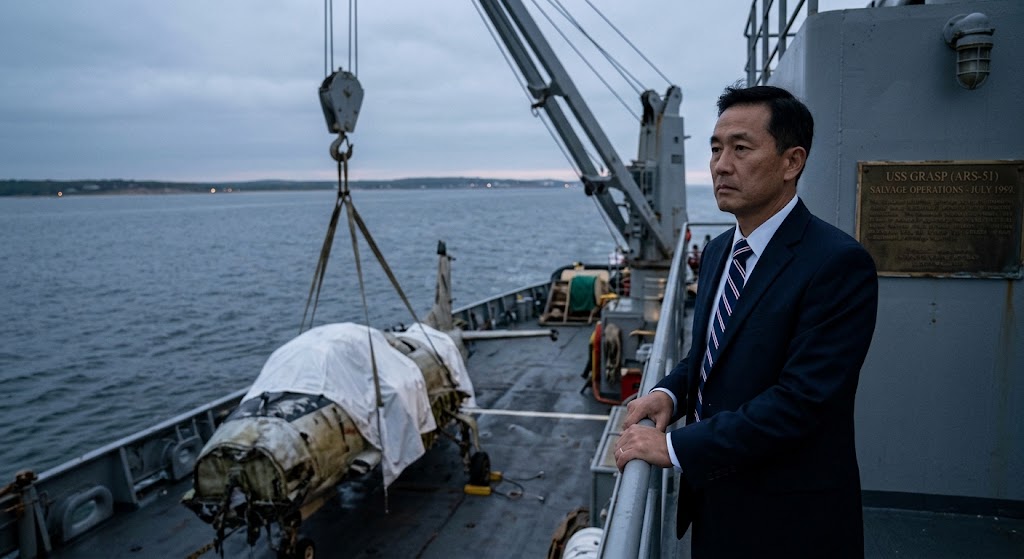
At the time, Cao was a young officer in Navy Special Operations, qualified as a deep-sea diver and salvage specialist. When Kennedy’s aircraft failed to arrive at its destination, an anxious nation watched a massive search-and-rescue operation rapidly evolve into a grim recovery mission. Naval assets mobilized to the waters off Massachusetts, including the salvage and rescue ship USS Grasp. Cao was thrust into the center of the effort as the mission’s operations officer, tasked with coordinating the salvage teams and overseeing logistics in the open ocean.
The pressure on the recovery crew was immense. The entire country, the media, and the Kennedy family were desperately waiting for answers. Operating in murky, cold coastal waters with sophisticated side-scan sonar, the naval team located the scattered wreckage sitting more than one hundred feet down on the ocean floor within roughly twelve hours of beginning their grid search.
Locating the aircraft was only half the battle. Deep-sea diving under heavy salvage conditions is physically taxing and hazardous. Divers absorb nitrogen under pressure, requiring strict limits on underwater exposure to prevent decompression sickness. As the operation progressed, all primary divers became what the Navy terms “dirty,” meaning their saturation levels had hit safety thresholds, requiring mandatory surface decompression and a twenty-four-hour rest period before they could dive again.
With ocean weather threatening to turn and the mission hanging in the balance, Cao chose to gear up and dive into the depths himself, accompanied by another salvage diver. Down in the gloom of the Atlantic seabed, Cao personally rigged lifting straps to the mangled aluminum fuselage so the salvage ship’s crane could haul the wreckage to the surface. Even more somber was the task of recovering the bodies of Kennedy, his wife, and her sister, ensuring they could be returned home.
Cao later described the recovery as one of the most emotionally profound missions of his life. He reflected on how surreal it was to lay “America’s son” to rest, invoking the iconic image etched into the American psyche of a three-year-old JFK Jr. saluting his assassinated father’s casket in 1963. For Cao, who had arrived on American soil in 1975 as a refugee fleeing the fall of Saigon, the salvage was a solemn duty to bring closure to a family and a country that had provided his own family freedom and opportunity.
Cao went on to complete a distinguished twenty-five-year naval career, deploying to combat zones across Iraq, Afghanistan, and Somalia. From the depths of the Atlantic salvage operations to the helm of the United States Navy, his career reflects the silent, heavy burdens borne by military divers when history calls them into the deep.
*****
Is Your Child Safe? George Issue 47 : https://georgemagazine.com/product/george-magazine-issue-47/
All George Magazine Past Issues: https://georgemagazine.com/past-george-issues/
George’s America’s 250th: https://georgemagazine.com/product/america-250-celebrating-legacy/
Ageless Tech E-Book Using AI to Your Advantage: https://georgemagazine.com/agelesstech/
George’s Crypto E-Playbook: https://georgemagazine.com/product/the-crypto-playbook-by-george-magazine/
Aetherian Realm’s Final Judgments Map: https://georgemagazine.com/product/aetherian-realms-final-judgments-map/
Q is for Quantum Coffee Mug: https://georgemagazine.com/product/q-is-for-quantum-coffee-mug/
The CoVFeFe T-Shirt you want: https://georgemagazine.com/product/cov-fe-fe-george-magazine/
Q is for Quantum T-Shirt: https://georgemagazine.com/product/q-is-for-quantum/
America’s 250th George Magazine T-Shirt: https://georgemagazine.com/product/americas-250th-george-magazine-t-shirt/
George Magazine. Print or Digital: https://georgemagazine.com/subscribe-george-magazine/
George Junior. Print or Digital: https://georgemagazine.com/subscribe-george-junior-magazine/
George Dispatch Free: https://georgemagazine.com/thedispatch/