

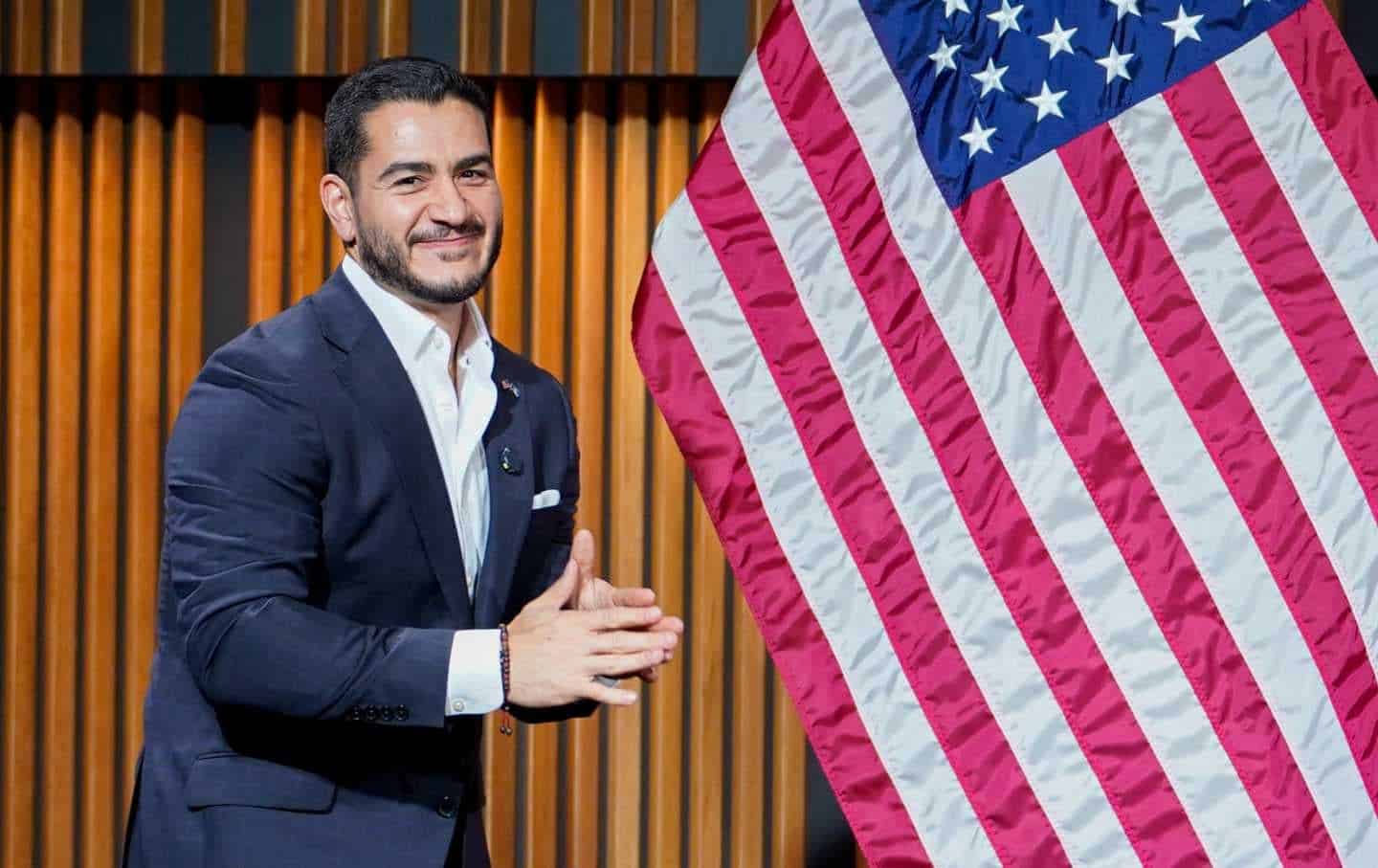
Just one drop in the blue wave.
(Sarah Rice / Getty)
Victory has a hundred parents, as President Kennedy would doubtless have put it if he’d lived to our more enlightened times, but defeat is an orphan.
Tuesday’s stunning electoral tsunami was big enough, and blue enough, to allow everyone from Chuck Schumer (who recruited Janice Mills to stop Graham Platner in Maine, and also backed Haley Stevens to block Abdul El-Sayed in Michigan) to Our Revolution (the Bernie Sanders–aligned group that pushed Maine Democrats to pick Troy Jackson, rather than a more anodyne centrist, as their candidate after Platner withdrew) to claim a share of the credit. This wave was also wet enough to water whatever pet theory you had ready, whether that was The New York Times’ incessant evangelizing for “moderate Democrats” or journalist David Sirota’s claim that “Bernie Sanders’ form of anti-oligarch populism is now the real center” of the Democratic Party. In the blinding light of this new electoral dawn, even Mamdani strategist Morris Katz’s rash prediction that “the Rahm Emanuel Democrat hardly exists anymore” had a kind of crazy plausibility—though this old leftist is keeping my hammer, stake, and garlic ready to hand.
Still, while we’re handing out trophies, here are my four nominees for PVP (Particularly Valuable Player) in Tuesday’s election victories:
The Nation’s late and much-lamented strikes correspondent, Jane McAlevey, always insisted there are “no shortcuts” in politics, and whatever else it does or doesn’t prove, Tuesday’s unexpected redrawing of the electoral map ought to remind us that with sufficient organizing no cause need be regarded as hopeless. I donated money to three candidates this cycle: Brad Lander (because I live in his district, and know him to be a mensch), Dan Sullivan (the Alaska “spoiler” who made the Times clutch its pearls—because why should the other side have all the fun?), and Scott Colom, who at the time seemed like the unlikeliest of the three (despite some of the best ads in this or any political season). If bare-knuckled, profane economic populism can win statewide in Mississippi, it can win anywhere.
But will it be given the chance? Will Chuck Schumer, the “senator from Wall Street,” who is almost certain to run unopposed for majority leader, really pursue economic policies that will make a difference to working families? Will Hakeem Jeffries start harmonizing with the Squad just because it is in the nation’s interest? The politics of dislodging either are not encouraging—at least in the short term. Rather than recruiting sacrificial candidates to oppose them, congressional progressives might consider adopting a “short leash” approach to the Democratic leadership—and a short list of legislative demands to test their good faith.
As Corbin Trent, one of the cofounders of Justice Democrats (a group that also deserves considerable credit for never buying the Trump “vibe shift” fairly tale) put it on NBC, “We’ve been given the keys by the American people, and it’s time to drive the car to a better place.”
What does that look like—especially when Donald Trump still has two more years left in office? As my colleague Robert Borosage notes, “Americans want their leaders to focus attention and resources at home.” This means bold action to end the war with Iran—starting now, not (as the infinitely patient Schumer proposes) waiting until next year. It means ending military aid to Israel, and making clear to whoever forms that country’s next government that America will no longer be complicit in genocide or the slow strangulation of Palestinian hopes for justice and self-determination.
But in an election where voters told pollsters their top three concerns were the economy, the future of democracy, and healthcare, it is domestic matters that will rightly preoccupy Democrats. Clawing back GOP handouts to the Epstein class (and redistributing them downward), restoring the Affordable Care Act subsidies eliminated by Trump, and banning stock trading by sitting government officials and members of Congress would all signal the kind of change in direction Americans just voted for. Vetoing any of these measures would also be an albatross Democrats could hang around the necks of Republicans for the next two years and beyond.
As would my own favorite policy proposal: a phased transition to Medicare for All. From El-Sayed in Michigan to Annie Andrews in South Carolina, fixing our broken healthcare system is an issue that cuts across both state and party lines, with 65 percent of Americans saying they would be in favor. The details of getting there may be “gnarly,” but bold action by the next Congress on healthcare cost and access—making Trump and his GOP loyalists the defenders of the status quo—would be smart politics now, and potentially transformative later.
Speaking of smart politics, what about accountability? No matter how richly he may deserve it, anyone with a functioning memory should be wary of devoting too much time and energy pursuing yet another futile impeachment of Donald Trump. But that needn’t deter Congress from using its oversight powers to illuminate the depths of Trump and his family’s corruption and profiteering from office—or from investigating the tech oligarchy’s cozy relationship with the Trump White House. A full reckoning with Elon Musk (anyone else for nationalizing Starlink?), or Jeff Bezos, or Mark Zuckerberg, may have to wait until there’s a (social) Democrat in the White House. But can we at least stop the fawning?
Because that breeze we’ve all felt since Tuesday night is the Overton window blowing wider open than it has been in decades. Let’s not waste the moment.



Discount Applied Successfully!
Your savings have been added to the cart.