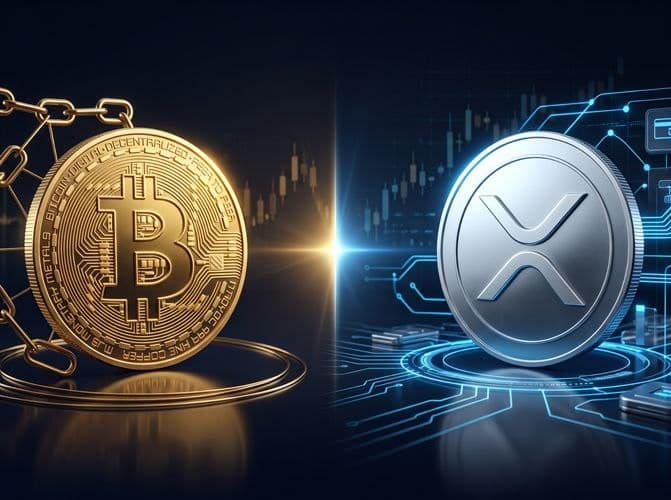
Two Assets, Two Financial Missions
Bitcoin emerged in 2008, when the global financial crisis exposed weaknesses in traditional banking and monetary systems. Introduced by Satoshi Nakamoto, Bitcoin was designed as a peer-to-peer electronic cash system with a fixed maximum supply of 21 million coins.
Its defining characteristic is mathematical scarcity. No central bank or corporate committee can arbitrarily increase Bitcoin’s supply. Its Proof of Work consensus mechanism uses computational resources to secure transactions and maintain the blockchain.
For many investors, this makes Bitcoin a potential long-term store of value, often compared to digital gold.
XRP follows a different approach.
The XRP Ledger was designed to facilitate fast, efficient value transfers. XRP can serve as a bridge asset for cross-border payments, allowing financial institutions to convert between currencies without necessarily maintaining large pools of pre-funded capital in overseas accounts.
According to the official XRP Ledger consensus documentation, the network uses a validator-based consensus protocol rather than Bitcoin’s energy-intensive Proof of Work system.
The result is a different operational profile. Bitcoin prioritizes decentralization, security, and scarcity. XRP emphasizes transaction speed, settlement efficiency, and liquidity.
The Numbers Tell Different Stories
| Feature |
Bitcoin |
XRP |
| Primary purpose |
Store of value |
Cross-border liquidity and settlement |
| Maximum or initial supply design |
21 million BTC maximum |
100 billion XRP created |
| Consensus |
Proof of Work |
Federated Byzantine consensus |
| Typical settlement |
About 10 to 60+ minutes, depending on confirmation requirements |
Approximately 3 to 5 seconds |
| Transaction fees |
Variable, depending on block-space demand |
Generally fractional cents, subject to network conditions |
| Major risks |
Volatility, macroeconomic conditions, network security considerations |
Liquidity, adoption, regulation, and market volatility |
These characteristics come from the assets’ different designs, not a guarantee of future investment returns.
Why the Institutional Market Matters
Cross-border payments remain complicated. The Bank for International Settlements discusses persistent challenges, including high operating costs, settlement delays, opaque fees, and fragmented market access in its Paper 167 on cross-border payment technologies.
XRP’s proposed role in this environment is understandable. Faster settlement and access to liquidity can potentially reduce friction.
But here is the kicker: efficient technology does not automatically create demand for a token.
Financial institutions must also consider liquidity depth, trading slippage, regulatory requirements, custody, and competition from stablecoins and tokenized deposits.
Bitcoin faces a different institutional question. Investors must decide whether its scarcity, decentralization, and potential role as a macroeconomic hedge justify its volatility and other risks.
The Real Problem With Choosing Between Them
The question is not simply whether Bitcoin is better than XRP.
It is whether either asset fits your financial objectives, investment horizon, and tolerance for losses.
Bitcoin’s slower settlement does not invalidate its store-of-value proposition. XRP’s faster settlement does not automatically make it a superior investment.
Coming Up in Part 2: We will build a practical decision framework for evaluating Bitcoin and XRP, assessing their risks, and deciding whether one or both deserve a place in your portfolio.
About This Series: This three-part series examines Bitcoin and XRP through their underlying technology, institutional utility, investment considerations, and risk management. It is educational content, not individualized financial advice.
References
Claessens, S., & Rice, T. (2026). Cross-border payment technologies: Innovations and challenges. Bank for International Settlements, BIS Papers No. 167. https://www.bis.org/publications/paper-167-cross-border-payment-technologies-innovations-and-challenges
Nakamoto, S. (2008). Bitcoin: A peer-to-peer electronic cash system. https://bitcoin.org/en/bitcoin-paper
XRP Ledger. (n.d.-a). Consensus structure. https://xrpl.org/docs/concepts/consensus-protocol/consensus-structure
XRP Ledger. (n.d.-b). Transaction cost. https://xrpl.org/docs/concepts/transactions/transaction-cost