

President Donald Trump fired his first American diplomatic salvos against Canada early in his second, nonconsecutive term.
Hosting then-Canadian Prime Minister Justin Trudeau at his Mar-a-Lago home in Florida, Trump mused about making the northern neighbor of the United States a “51st state.” That February 2025 tête-à-tête between the North American leaders turned out to be the last of Trudeau’s decadelong run as Canada’s prime minister.
But the meeting between leaders of what up to then were allied countries quickly turned bitter. Trump rolled out a new tariff regime against Canada, presaging the protectionist president’s global “Liberation Day” program on April 2, 2025 — much of which the Supreme Court would strike down nearly a year later in a 6-3 decision.
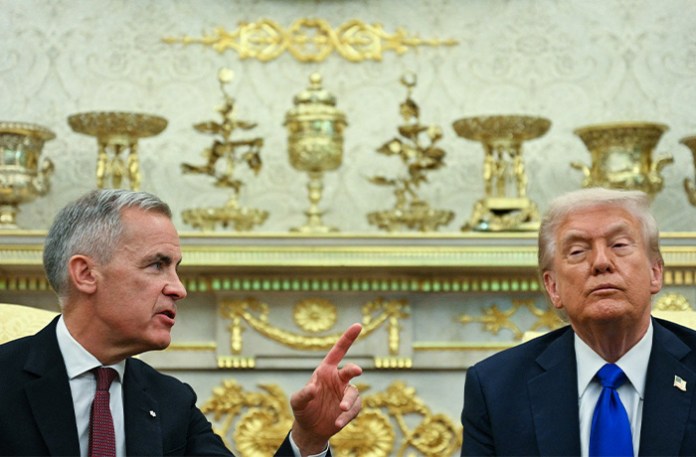
U.S.-Canada friction hasn’t eased since Prime Minister Mark Carney succeeded Trudeau as prime minister on March 14, 2025. If anything, cross-border tension has increased with the voluble Trump and stolid yet stiff-spined Carney at their respective government helms.
Nowhere was that more evident than in late January in Davos. At the World Economic Forum, when Trump told the gathered elite in Switzerland, “Canada lives because of the United States. Remember that, Mark.”
Trump added, dismissively, “He wasn’t so grateful” in U.S.-Canada trade negotiations over the prior months.
Firing back, Carney said, “Canada and the United States have built a remarkable partnership. In the economy, in security, and in rich cultural exchange. But Canada doesn’t live because of the United States.”
Such verbal sparring between the U.S., a global superpower of more than 340 million people, and 42 million-person Canada, which Carney at Davos called a “middle power,” has stiffened political support for the prime minister at home as he faces off against Trump.
“MPs and parliamentary secretaries like myself get called a lot of things,” said Vince Gasparro, a Toronto-area member of Parliament who is a member of Carney’s Liberal Party caucus, in an interview. “We have a thick skin. But first and foremost, we’re going to do what’s right for Canadians.”
Carney, a former top official at the central banks of Canada and the United Kingdom, and a seasoned investment executive, used his Davos speech to warn of a “rupture” in the U.S.‑led global order. He further criticized the use of economic coercion by great powers; a line widely read as an implicit rebuke of Trump’s foreign policy style.
For his troubles, Carney was unceremoniously dumped from the Trump-led “Board of Peace,” launched at the World Economic Forum — otherwise filled with global statesmen to lead the rebuilding of war-ravaged Gaza. Trump’s Truth Social “letter” rescinding the invitation did not give a formal reason, but the timing, hours after Carney’s Davos speech and independence comments, led multiple outlets to describe it as a direct response to those remarks.
Vincent Rigby, a former Canadian national security and intelligence adviser who spent 15 years working at the Department of National Defence, said in an interview with the Canadian outlet Global News that the U.S. was “acting like a hostile state actor” toward Canada.
What’s behind the apparent growing rift? How long has it been festering? Is it merely theater, typical political jabs, diplomatic derision, personality, or a real political divide?
Prior to the World Economic Forum, from Jan. 13 to Jan. 17, after a visit to China, Carney, who said it was a “more predictable partner” than the U.S., pledged to work with the communist country to ship in electric vehicles to Canada. That was much to the consternation of the American president, who called it “one of the worst deals.”
Also planned by the Canadian government are increased joint manufacturing deals with China, while Canada “wouldn’t rule out Chinese state-owned companies buying majority stakes in Canadian companies,” the Free Press reported.
Treasury Secretary Scott Bessent noted that even if Canada dropped its tariffs, the U.S. would not return the favor, given the conflict with the Asian country.
The main risk is not that Carney is breaching a single clear U.S.-Canada treaty obligation, but that deeper business ties with China could collide with overlapping U.S. export‑control and sanctions regimes that bite extraterritorially. U.S. sanctions on Chinese entities can penalize non‑U.S. firms that “materially support” targeted actors, creating exposure for Canadian banks, insurers, and suppliers who deepen China business lines, contrary to U.S. policy.
None of these automatically makes a Canadian prime minister’s diplomatic outreach “illegal,” but they constrain what Canadian firms can do if Canada’s China policy pushes into areas Washington has ring‑fenced as security‑sensitive: advanced chips, dual‑use AI, military‑civil fusion sectors.
If Carney encourages deals that skirt close to U.S. red lines, such as joint ventures with Chinese firms on U.S. sanctions lists or financing projects that help sanctioned sectors, Canadian banks, pension funds, and corporates could be exposed to U.S. sanctions — even though the policy is being promoted by a friendly allied government.
Gasparro, a onetime special assistant to Prime Minister Paul Martin, who led Canada from 2003 to 2006, said that “if you look at where he’s gone and the agreements he’s negotiated,” referring to Carney, “he is focused on making sure Canadian goods and services have access to markets around the world. And that is exactly what the role of our prime minister has to be, and it is.”
The prime minister’s speech at Davos, which clearly roiled Trump, was a “clarion call to the world that the old economic order is over,” Gasparro said, adding that Carney was “highlighting some of the issues that existed in the old order, that there were rules for everyone else except a certain country or two.”
Gasparro added, “If that ruffled some feathers in other jurisdictions, then so be it.”
Georganne Burke, a staffer to Prime Minister Stephen Harper, who led Canada from 2004 to 2015, said Carney’s speech was tantamount to saying, “We don’t need the U.S. anymore. We’re looking to China.”
The concept of a “new world order,” said Burke, who has worked on many Conservative Party campaigns over two and a half decades, “would be annoying to somebody like Trump, knowing how magnanimous, to be very blunt, the U.S. was with Canada.”
Burke, who went to college in the U.S. at the State University of New York at Buffalo, added that there is an “essential difference” between America dealing with China or Qatar and Canada’s.
“The U.S. comes at it from a position of great strength and power. Canada does not,” she said.
“Canada comes from the bottom of the middle of powers. So, it’s a very different relationship when they go on bended knee to China or to Qatar. As opposed to Trump, who goes from a position of great power and strength. You don’t mess with a big, giant gorilla in the room.”
And that gorilla appears to be poked, now perceiving Canada as an “economic burden, a security burden, a trusted partner burden,” she said. “That’s why [Trump is] looking at Greenland, because he can’t trust Canada to be an ally on the north.”
It would be one thing were it only policy, Burke said. She added there’s also a personality split. Though Trump likes to brag about being an alum of the University of Pennsylvania’s Wharton School, he rose to power as a populist figure.
Compare that to the technocratic mien of Carney, who grew up in Edmonton, the son of a University of Alberta professor. Carney went to college in the U.S., at Harvard University, and then earned master’s and doctoral degrees at Oxford University.
“Trump doesn’t like elitist people with highfalutin degrees that are always lording their intelligence over other people. He doesn’t like that. He likes regular people, taxi drivers, and waitresses and waiters to people like Mark Carney in terms of general overall preferences,” she said. The Liberal Party “thought [Trump] would be just gobsmacked by this fabulous Oxford-educated whatever.”
In her estimation, Carney, in the team sport of politics, needs to read the room better.
“You’ve got to dance with a girl you’ve brung. He’s there, and that’s who they have to deal with,” she said of Carney’s interaction with Trump. “So, would you not be wiser to get to know the person and try to understand where they come from? I’m not saying suck up to him. He doesn’t actually admire that, either. But treat him as an equal and respond to the things that you know will move him in the direction you want, rather than fighting him tooth and nail every inch of the way, which is what they’ve been doing.”
Carney, to Canada’s detriment, was “not helping things” during his election campaign by “ratcheting up the anti-Trump stuff.”
That sentiment draws nods from Andrew Hale, a fellow at Advancing American Freedom, a think tank affiliated with former Vice President Mike Pence, with a traditional conservative bent meant to counter the Trump era’s populist tilt.
“The anti-American sentiment is at historic levels,” he said, noting that in the lead-in to the March 2025 election, Carney “wrapped himself in the flag” of patriotism, to show his thumb-nosing bona fides, and came within a hair of a majority, in an election that was earlier predicted to give the Conservatives a landslide victory.
Still, Hale thinks the estrangement is more of a Trump problem than Carney’s fault.
“Let’s face it — President Trump started it,” Hale said of the jabs. “He stoked it, made it worse. For the harmony between our two nations — it was unnecessary.”
Yet Trump has “justified concerns” over tepid Canadian defense spending, which he says is one of the lowest in NATO, “and he’s willing to use trade and trade negotiations to address that.” The issue, for Hale, a trade and foreign policy specialist, is that even though Canada has been “freeloading for far too long,” he believes “Trump has really gone way too far.”
Overall, Carney has been personally “cordial” with Trump, he believes, despite the China overtures being seen as “adversarial.”
BYRON DONALDS TOOK LARGE DONATIONS FROM CCP-LINKED FIRM DESPITE CRITICISM OF CHINA
But again, the Trump-initiated trade war has been “actually pushing our allies into the arms of China,” Hale noted.
“The Canadians are saying, ‘Hey, if you tariff our stuff, we’re going to have to sell our stuff elsewhere. You’re asking for all these things, but what on earth are we going to get in return? Just more abuse, more 51st state, more insults?’”
Dave Gordon (@davegordonwrite) is a Toronto-based freelance journalist and has written for dozens of publications in Canada, the United States, and globally.

![[GOOD PRESS] ON[GOOD PRESS] ON](https://georgemagazine.com/wp-content/uploads/2024/08/16389056566437433941_2048-300x300.jpeg)

Discount Applied Successfully!
Your savings have been added to the cart.