
NEWYou can now listen to Fox News articles!
For three years, the Washington foreign policy establishment has insisted that there is only one acceptable outcome in Ukraine: total victory over Russia achieved through relentless military aid, indefinite financial support, and escalation readiness regardless of the risks. But strategy and morality are not always the same thing — and real leadership demands confronting reality as it exists, not as we wish it to be.
I write this not as an academic or pundit, but as someone who worked at the center of this conflict. As U.S. ambassador to the European Union during the first Trump administration, President Donald Trump tasked me with bringing Europe into alignment—truly into alignment—behind Ukraine.
That meant ending the EU’s habitual double-game: proclaiming solidarity with Kyiv while enriching Moscow through energy purchases and dragging its feet on serious sanctions. I saw firsthand how Europe’s hesitation and transactional approach sent Moscow exactly the wrong message. It told President Vladimir Putin the West was divided, unserious and ultimately unwilling to sacrifice comfort for principle. That perception was part of his calculus.
PUTIN VOWS VICTORY IN UKRAINE IN NEW YEAR’S ADDRESS AMID TRUMP-BACKED PEACE TALKS
The uncomfortable truth is that the United States is closer to strategic exhaustion than our rhetoric admits. Europe’s defense industries remain underbuilt. American stockpiles are finite. And while Russia has paid a staggering price, it has not collapsed, surrendered, or reversed course. Worse, every escalation increases the probability of something unthinkable: a desperate Kremlin resorting to tactical nuclear weapons. That would not be “just another step” on the escalatory ladder; it would fundamentally shatter global stability.
Against that background, the Trump administration’s instinct to seek a quasi-business resolution is not weakness. It is classic realpolitik—recognition that the job of American leadership is to maximize U.S. security, economic leverage, and strategic flexibility while minimizing existential risk.
Business leaders know what Washington too often does not: the perfect deal rarely exists. The question is not whether we can achieve a morally pure resolution; it is whether we can lock in outcomes that are measurably better for American interests—and for Ukraine—than a perpetual, bleeding stalemate.
A negotiated settlement, backed by enforceable conditions and leverage, could do precisely that.
First, a settlement can provide Ukraine with a bespoke security guarantee—credible enough to deter renewed aggression but structured to avoid NATO Article 5 entanglement. This isn’t a vague promise; it is a contract with clear performance terms. The U.S. guarantee would stand as long as Russia adheres to its commitments. But if Russia violates the agreement, the snapback provisions would trigger instantly—not months later, not after diplomatic waffling—immediately unlocking full-scale U.S. and NATO support for Ukraine, including offensive weapons, advanced air defense, training, and intelligence integration.
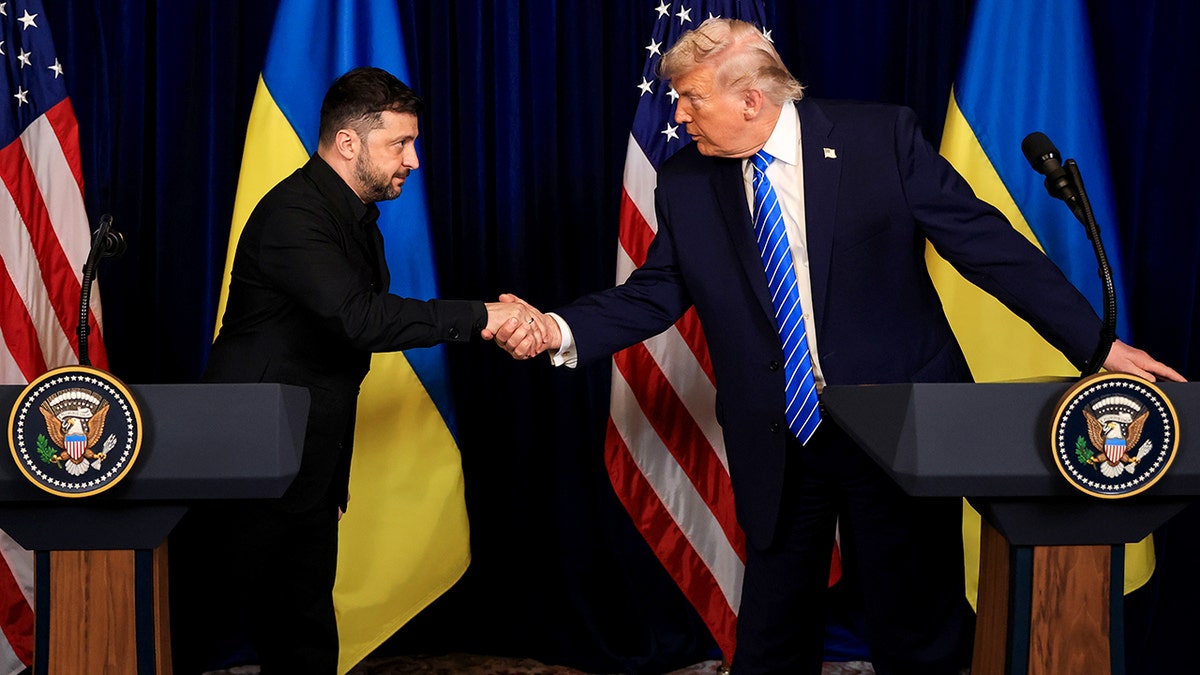
President Donald Trump and Ukrainian President Volodymyr Zelenskyy shake hands at a news conference following a meeting at Trump’s Mar-a-Lago club on December 28, 2025, in Palm Beach, Florida. (Joe Raedle/Getty Images)
TRUMP PUSHES PEACE IN EUROPE, PRESSURE IN THE AMERICAS — INSIDE THE TWO-FRONT GAMBLE
Just as important, the consequences of Russian cheating would be explicit, not theoretical:
If Moscow breaks the deal, the United States would reserve the option to openly back Ukraine in retaking every inch of territory—up to and including restoration to its pre-2014 borders. Moscow would know this going in. Deterrence works best when penalties are unmistakable.
And crucially, this would all be public. No more pretending, hedging, or quiet back-channel shipments. The world—and Russia—would know that renewed aggression automatically and lawfully unleashes overwhelming Western support, with the U.S. leading confidently and unapologetically. That clarity is a deterrent in itself.
ZELENSKYY SAYS PEACE DEAL IS CLOSE AFTER TRUMP MEETING BUT TERRITORY REMAINS STICKING POINT
Equally important, this structure protects U.S. sovereignty in the agreement. If Ukraine violates its obligations, the American guarantee becomes void at our sole discretion. Not a bureaucratic process. Not a committee vote. The United States decides. That means Ukraine has every incentive to maintain discipline and treat the arrangement not as a blank check, but as a powerful partnership grounded in responsibility.
Second, a negotiated deal can generate tangible U.S. economic advantage. Ukraine holds minerals and rare earths essential to American industry, national security, and technological supremacy. China knows this. Russia knows this. Only Washington’s old guard pretends resource control is not strategic policy. A structured agreement ensuring privileged U.S. access strengthens manufacturing, energy resilience, and economic security.
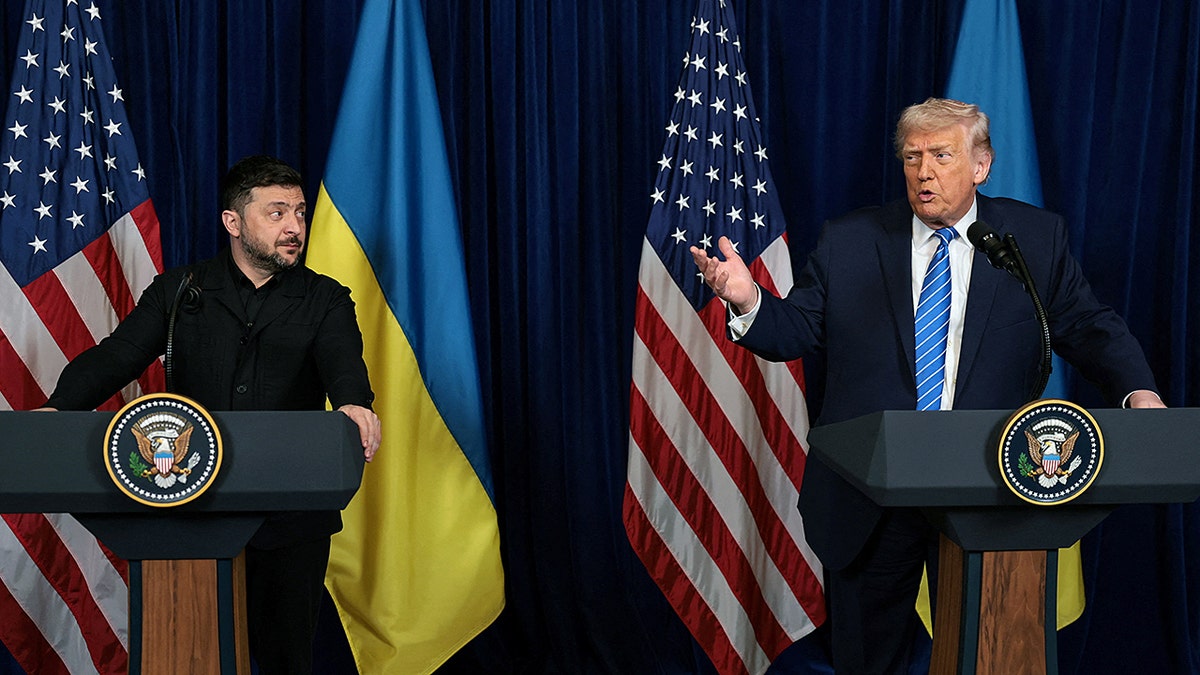
Ukrainian President Volodymyr Zelenskiy listens to U.S. President Donald Trump, after Trump said that Russian President Vladimir Putin expressed willingness to help Ukraine “succeed,” during a press conference at Trump’s Mar-a-Lago club, in Palm Beach, Florida, on December 28, 2025. (Reuters/Jonathan Ernst)
Third, a settlement can wedge open the relationship between Moscow and Beijing. Right now, the war has pushed Russia completely into China’s arms. That alignment is bad for the United States and for global balance. A disciplined settlement begins unwinding that dependency. America doesn’t need friendship with Moscow; it needs leverage over it. Realpolitik is about advantage, not affection.
PUTIN REJECTS KEY PARTS OF US PEACE PLAN AS KREMLIN OFFICIAL WARNS EUROPE FACES NEW WAR RISK: REPORT
Fourth, a deal can compartmentalize strategic theaters. If Russia insists on regional influence, the U.S. can demand reciprocal space in our hemisphere—particularly in Venezuela, narcotics interdiction, and energy-linked criminal networks—reducing adversarial reach in the Americas.
Critics will scream “Munich.” They always do. But Adolf Hitler was leading a rising ideological empire bent on global conquest. Russia is a demographically and economically declining power seeking regional positioning. Brutal, yes—but not irrational. Mature powers negotiate with rivals when negotiations produce superior outcomes.
Others claim any deal rewards aggression. That assumes deterrence is binary—victory or failure. In reality, deterrence is layered.
UKRAINE–RUSSIA AT A CROSSROADS: HOW THE WAR EVOLVED IN 2025 AND WHAT COMES NEXT
A settlement that leaves Russia bloodied, sanctioned, strategically constrained, and facing automatic, overwhelming Western military escalation—potentially including U.S. support for Ukraine restoring its 2013 borders — if it cheats is not a reward. It is a warning carved into treaty stone.
Meanwhile, the humanitarian and financial realities matter. Endless war means endless dead Ukrainians, shattered cities, and endless U.S. taxpayer exposure with no defined victory condition. That may thrill think tanks that never fight wars, but it is not serious governance.
CLICK HERE FOR MORE FOX NEWS OPINION
Most importantly, a business-style settlement introduces accountability—currently absent from Washington’s “as long as it takes” mantra. Under a structured deal, compliance is measurable. Triggers are automatic. Support is not improvised—it is guaranteed. Enforcement is not theoretical—it is built in. And unlike today, America would no longer need to whisper its involvement. It would act openly, decisively, and with treaty authority.
The alternative? A forever-war with rising nuclear risk, continued strategic drift, and deepening alignment between Russia and China. That is not strategy. It is inertia dressed as courage.
CLICK HERE TO DOWNLOAD THE FOX NEWS APP
Realpolitik does not abandon values. It protects them intelligently. A disciplined, enforceable settlement—with clear snapback provisions benefiting both the U.S. and Ukraine; explicit authority to openly arm Ukraine and potentially support full territorial restoration if Russia cheats; and a guarantee revocable at America’s sole discretion if Ukraine violates terms—is not capitulation.
It is strategic control.
In geopolitics, as in business, the strongest player is not the one who insists on endless confrontation. It is the one who knows when to fight—and when to close the deal.




Discount Applied Successfully!
Your savings have been added to the cart.