


JERUSALEM — Military strategists are already drawing lessons about the effectiveness of military hardware and battle strategies from the 40-day war that the United States and Israel are fighting against Iran, even if its outcome is far from certain.
The war, which began on Feb. 28, involved some of the most sophisticated weaponry, defense systems, and intelligence gathering of the 21st century. Their effectiveness or failings have revealed the strengths and vulnerabilities of modern warfare — information that militaries around the world will be quick to utilize.
Despite claims by President Donald Trump in June 2025 that the U.S. and Israeli airstrikes had “completely and totally obliterated” Iran’s key nuclear enrichment facilities, the 12-day military operation did not destroy Iran’s nuclear weapons program or its ability to manufacture and launch drones and ballistic missiles.
The 12-day war played out against the backdrop of Israel’s ongoing military campaign in Gaza — a direct response to Oct. 7, 2023, attacks by Hamas that claimed about 1,200 lives and 251 people as hostages. The Gaza conflict wouldn’t end until October 2025 with the release of remaining living hostages and the remains of the dead. Enforcing terms of the ceasefire, including how to ensure that Hamas relinquishes its arms, remains an open question.
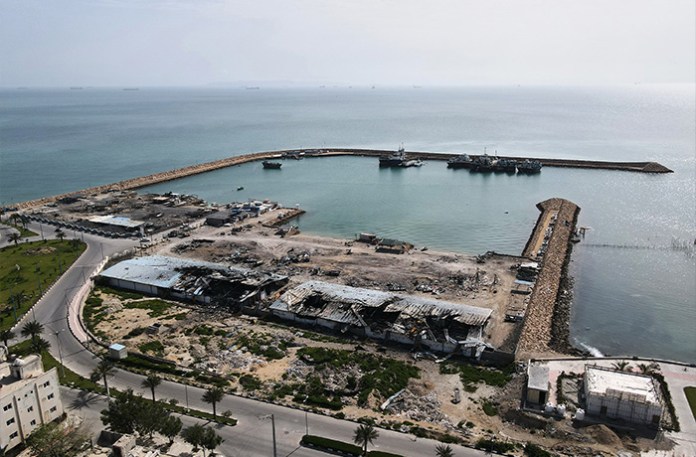
June 13 to 24, 2025, marked the most direct conflict between Israel and Iran since Shia theocrats took over the latter Middle East nation’s government in the 1979 Islamic Revolution. Trump, back in the White House for a second, nonconsecutive term, ordered U.S. military forces to join in Israeli targeting of Iranian nuclear infrastructure.
The results of that episode, and ensuing regional tensions, provided ample justification for the recent 40-day Iran war, said Yaakov Katz, senior fellow at the Jewish People Policy Institute.
“To me, the biggest lesson is that Israel did the right thing by not waiting for the enemy to obtain capabilities, but rather to deter them so the threat could be contained,” Katz said.
The U.S. and Israel “were surprised” by how quickly Iran was able to replenish its missile supply, said Katz, author of While Israel Slept: How Hamas Surprised the Most Powerful Military in the Middle East. “If Iran had been allowed to increase its stockpiles even more, “it would have overpowered Israel’s missile defense capabilities. If Iranians had 10,000 ballistic missiles and 2,000 launchers, you’re in a different reality.”
Thanks to lessons gleaned from last year’s shorter Iran conflict, when Israel and the U.S. focused mostly on military targets and military launching pads, this time they struck Iran’s defense industrial base, the production facilities, the assembly lines, “all the things needed to produce missiles,” Katz said.
The 40-day war has proved that even a highly successful air campaign has its limitations.
About 10% of the 700-or-so ballistic missiles Iran fired at Israel evaded missile defenses, resulting in damaged and destroyed buildings and 23 civilian deaths. Many were cluster bombs, which separate into dozens of bomblets that can scatter for miles.
Ryan Brobst, deputy director of the Center on Military and Political Power at the Foundation for Defense Democracies, said that despite the U.S. and Israel’s best efforts, “it was impossible” to destroy Iran’s capabilities in such a short period of time. “For that, the war would need to continue.”
At the start of the war, Brobst said, the U.S. may have underestimated the vulnerability of American troops, military bases, radar systems, and warships and Iran’s ability to target them, often with pinpoint accuracy. To accomplish this, Iran “may have been helped” by Chinese surveillance satellites and Russian intelligence. The superpowers’ assumed role in the war against the U.S. could have significant military and diplomatic repercussions.
If the 40-day war taught the U.S. anything, it is that the Pentagon needs to invest in countermeasures and decoys to avoid being successfully targeted by both missiles and drones, Brobst said. “It should also build concrete aircraft shelters and more bunkers to protect American troops.”
One of the clearest successes of the war has been the high level of coordination between the U.S. and Israel, said Eado Hecht, a military analyst at the Bar-Ilan University Center for Strategic Studies.
“The U.S. wants its allies to pull their weight, and Israel definitely pulled its weight,” Hecht said. Working so closely together “increased trust between the Israeli and U.S. militaries.”
This level of “alliance warfare” — sharing intelligence, dividing operational duties, and leveraging comparative advantages is unprecedented in the 21st century and could serve as a model in future conflicts.
But it is commonly understood that the joint mission robbed Israel of its military autonomy. The U.S. military and Trump, and not necessarily Israel, set many of the war’s goals and decided when to agree to a ceasefire, said retired Israeli military Major General Gadi Shamni, who served as the Israeli defense attaché to Washington from 2009 to 2012.
“For me, it was stunning to see the goals of the war change every week, and Israel almost lost its ability to make its own decisions,” Shamni said. “The interests of Israel and the U.S. aren’t always aligned.”
The war also underscored Israel’s dependence on the U.S. for military aid, at a time of increasing calls on Capitol Hill to deny Israel that aid.
“Since its founding in 1948, Israeli prime ministers have always said, ‘We don’t need anyone to defend us.’ That’s no longer the case,” Shamni said.
Hecht agrees.
“To fight Iran, we need American help,” especially now, Hecht says, because Israeli forces, including large numbers of reservists, have been fighting on multiple fronts since Oct. 7, 2023. These battles have greatly reduced Israel’s supply of ammunition, making it even more dependent on the U.S. military. The same is true of Israel’s air defenses.
“The IDF is good at running a 100-meter dash, but this is a marathon,” Hecht said.
“The 40-day war has provided a reality check for the U.S. as well,” Hecht said. “The equation is quality versus quantity. The higher the quality of the weaponry, the more it costs.”
Shooting down a drone costs tens of thousands of dollars, and interceptors used to intercept an incoming missile cost at least $1.5 million per interceptor.
HERE’S WHERE HOUSE AND SENATE RETIREMENTS STAND IN 2026
While the most expensive drones can perform sophisticated reconnaissance and drop bombs, others may have a shorter range or carry less ammunition. It can be a tough call to make.
The bottom line: “We need to find cheaper ways to protect ourselves,” Hecht said.
Michele Chabin (@MicheleChabin1) is a journalist whose work has appeared in Cosmopolitan, the Forward, Religion News Service, Science, USA Today, U.S. News & World Report, and the Washington Post.


Subscribe to George Magazine and unlock exclusive bonuses. Your subscription now includes a free crypto essentials guide and three premium downloadable images. These images are perfect for personal use as desktop or mobile backgrounds, with thumbnail previews shown below.




Discount Applied Successfully!
Your savings have been added to the cart.