

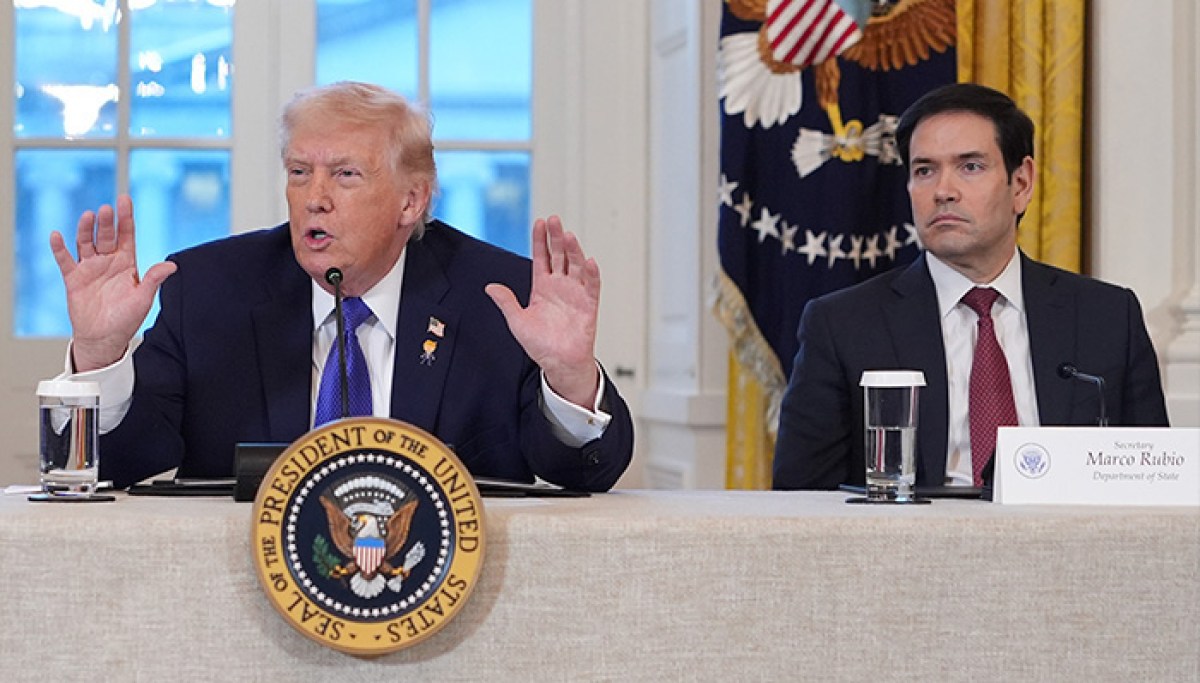
A founding principle of President Donald Trump’s MAGA platform was a return to a USA-first military policy, flirting with a 21st-century brand of isolationism. Rejecting the neoconservative principle of international American exceptionalism as the world’s police force, Trump and his supporters have said they eschew foreign entanglements that could lead to drawn-out conflicts such as the Iraq and Afghanistan wars of the early 2000s.
Yet, the Jan. 3, 2026, attack on Venezuela to capture strongman Nicolas Maduro leaned into regime change for the Trump administration. Meanwhile, Trump continues to cast a covetous eye toward Greenland and Cuba — even as he weighs military action to aid the Iranian revolution. His supporters face a dilemma of continuing their dedicated support of the president or calling out a violation of a central MAGA tenet.
Ido Oren, associate professor of political science emeritus at the University of Florida, agrees that Trump is not living up to the consistent MAGA aversion to foreign military interventions.
“In the year since Trump’s inauguration, the U.S. bombed Iran’s nuclear facilities; bombed targets in Nigeria; blockaded and attacked Venezuelan maritime traffic and abducted Venezuela’s leader,” Oren said in an interview. “So far, none of these recent interventions has become the kind of ‘forever war’ that Trump has repeatedly decried. But the invasions of Afghanistan and Iraq by the George W. Bush administration were not intended to become long-lasting quagmires, either.”
As for the incident in Caracas, Oren doubts Trump’s claim that Maduro’s status as a narco-terrorist made the incursion necessary, insisting economic interests were behind the military action. He holds that possible threats to other nations, such as strife-racked Iran, depend on the success of the Venezuela project.
“If (Venezuela’s new leader) Delcy Rodriguez cannot or does not fully meet Trump’s demand for 30-50 million barrels of oil, and if Trump subsequently ratchets up military pressure to the point of placing U.S. boots on Venezuela’s territory, then the Iranian leadership can breathe more easily,” Oren added.
Eric Cole is a national security expert who was President Barack Obama’s cybersecurity commissioner. He agrees with Oren that the need for oil guides Trump’s plans. But Cole cites other natural resources beyond oil, driving his designs on other countries.
“Iran has little to worry about because all of this is really about positioning the United States from a natural resource standpoint over the next 15 to 20 years,” Cole said, “There’s not really a lot of natural resources that we want in Iran.”
For Cole, Greenland is a more vital target for Trump as the U.S. needs more sources of essential minerals.
“In this age of AI, one of the things nobody talks about with artificial intelligence is the intense amount of computing power and data centers that are needed,” he explained. “Those computers all require natural resources for the chips. Those chips aren’t just silicon. There’s a need for very specialized minerals.”
Cole lists the main areas for those minerals as China, Greenland, Venezuela, Ukraine, and the Moon.
“Russia took Ukraine, and China has the moon,” Cole said. “From the U.S., the only option is Greenland. If Trump has Venezuela and Greenland, he has a really nice array of natural resources to compete with China and Russia in the future. So, all of this is more about business.”
Pierre Pahlavi is the deputy head for the Department of Defence Studies at the Canadian Forces College and Royal Military College of Canada. Even if Trump’s targeted interventions could benefit the U.S., Pahlavi believes many MAGA true believers could object to expanding military involvement around the world.
“The Trump administration’s recent foreign-policy moves do appear to contradict the isolationist ‘America First’ ethos that animated the MAGA movement since 2017,” Pahlavi said. “However, concluding that Trump has abandoned MAGA isolationism would be premature. A closer look suggests that U.S. foreign policy in Trump’s second term occupies an intermediate space between orthodox non-interventionism and classical interventionism. What may appear as inconsistency is better understood as a strategic recalibration.”
As with Cole, Pahlavi sees an arms and resources race with another power driving Trump’s aggression.
“U.S. foreign policy is increasingly organized around the systematic countering of Chinese influence wherever Beijing’s economic, diplomatic, and security footprint expands,” he added. “From Panama to Greenland, from South America to global trade architecture, American assertiveness reflects an effort to disrupt China’s global advance.”
With China in mind, Pahlavi sees Iran reentering Trump’s target range.
“(Trump’s) concern is not Iran in isolation, but Iran as a potential pillar of Chinese power projection,” Pahlavi said. “Should Iranian leaders be concerned that Trump’s attention could turn toward them? Yes— but not in the form of immediate large-scale military action. Such a strike would likely push Iran into China’s orbit. Instead, renewed maximum pressure, calibrated escalation, and strategic ambiguity aim to weaken Iran’s alignment with Beijing.”
Matthew Zierler is an associate professor of political science at James Madison College at Michigan State University. He urges any MAGA supporters who fear Trump might wander into the neocon priority of proliferating democracy to put the worry out of their minds.
“Spraying democracy is nowhere in Trump’s vision,” Zierler said. “This is all about spheres of influence, taking things for economic gain, and trying to have relatively easy wins. I’m saying that with all due respect for the soldiers who risk their lives, but these (military actions) aren’t on the scale of Iraq or Afghanistan.”
Considering Trump’s eye for “easy wins,” Zierler believes Cuba should be looking over its shoulder.
“Cuba should be nervous because they’re no patron states or buddies (such as Russia) around them anymore,” he explained. “Trump would get a domestic boost from the Cuban community in the U.S., just like he got a boost from the Venezuelan community. But the question is, how long does that boost give him? Trump is already worrying about the midterms. Would a win in Cuba help in those elections? Maybe not.”
FBI NAMES LONGTIME AGENT AS DAN BONGINO’S REPLACEMENT FOR DEPUTY DIRECTOR
Regardless of whether the nation in Trump’s crosshairs is Venezuela, Greenland, or Iran, Zierler insists the central driving principle of the president’s decision-making will be his self-interest.
“(Trump) wants to be able to seize another victory for Trump.”
John Scott Lewinski (@johnlewinski) is a writer based in Milwaukee.

Discount Applied Successfully!
Your savings have been added to the cart.