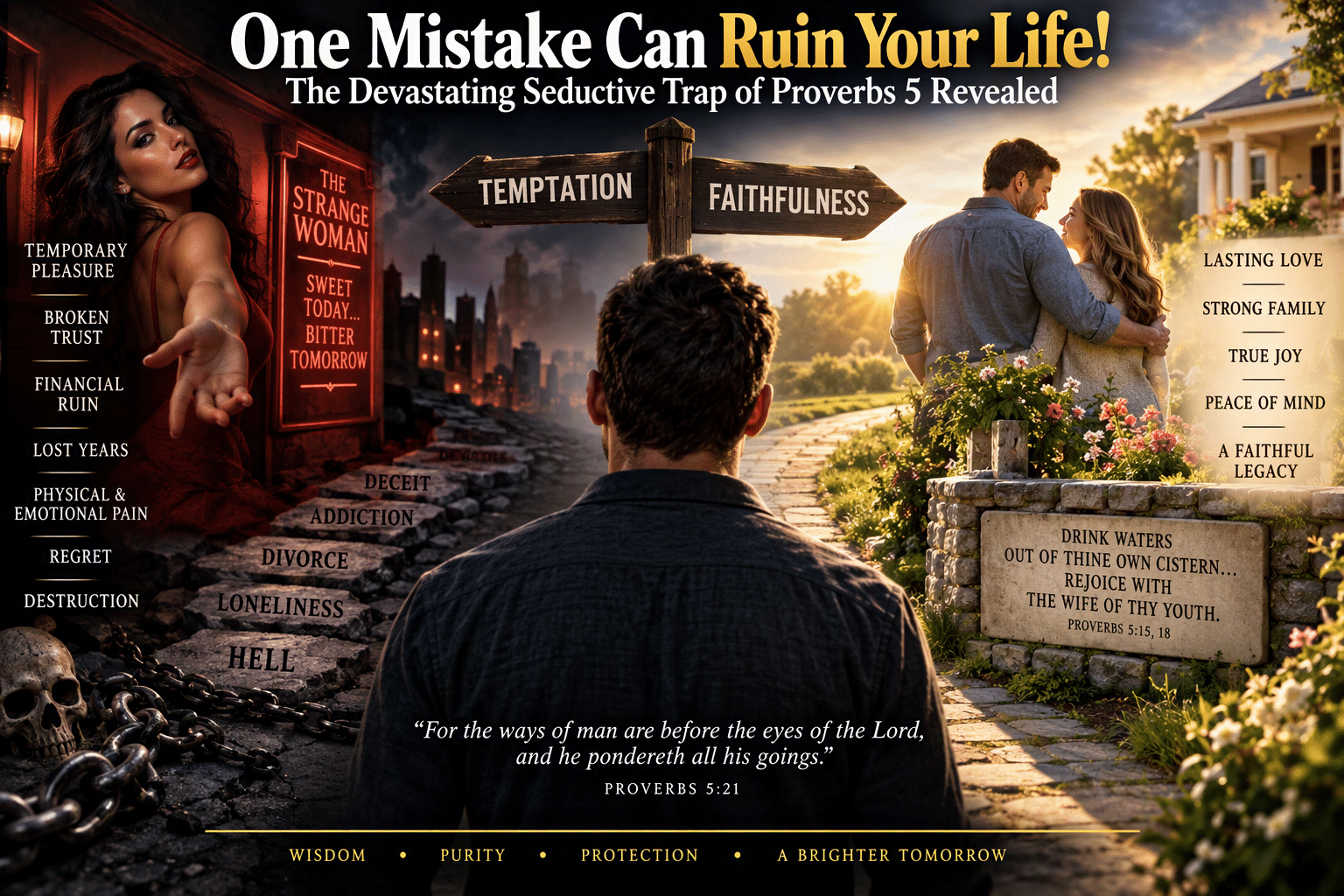
In a contemporary context, the “strange woman” represents any seductive temptation that promises effortless, immediate gratification while bypassing your covenants, values, or better judgment. Whether it is a secret romantic entanglement, an unethical professional shortcut, or an addictive lifestyle, the bait is always sweet like “honeycomb” and effortless like “oil.” It appeals directly to our egos, our loneliness, or our craving for excitement.
However, the text immediately pivots to the brutal, unseen aftermath: “But her end is bitter as wormwood, sharp as a twoedged sword. Her feet go down to death; her steps take hold on hell.” (verses 4-5).
The contrast is stark: honey and oil quickly transform into bitter poison and cutting blades. This represents the deceptive nature of bad choices…they are heavily front-loaded with pleasure, but back-loaded with immense, inescapable pain. In real life, affairs, deceit, and moral compromises always offer the quick win up front, hiding the ultimate cost until the trap has snapped shut. The warning is that the path of compromise is unstable (“her ways are moveable, that thou canst not know them”), leading to a chaotic, unpredictable descent.
2. The Defensive Imperative: Create Severe Distance
Solomon’s instruction for avoiding this trap is absolute and physical: “Remove thy way far from her, and come not nigh the door of her house.” (verse 8).
The instruction is not to flirt with temptation, negotiate with it, or test your willpower against it. It is to stay as far away as possible. The real-life wisdom here is preemptive. If you are struggling with a specific temptation, do not place yourself in situations where that compromise is easily accessed. If a partnership, an environment, or a relationship is toxic, create severe distance. Integrity is often won or lost in how we manage our environments before the temptation even arrives. By the time you are standing at “the door of her house,” your willpower has already been severely compromised. Wisdom dictates setting boundary lines so far back that you are never in a position to fail.
3. The Devastating ROI of Moral Failure
The text then outlines the devastating, multi-layered cost of failing to heed this boundary. Solomon warns that compromise will cause you to “give thine honour unto others, and thy years unto the cruel: Lest strangers be filled with thy wealth; and thy labours be in the house of a stranger.” (verses 9-10).
In today’s world, the cost of moral failure remains incredibly high. It is a massive drain on your reputation (“honour”) and a thief of your life’s momentum (“thy years”). The financial ruin of divorce, the loss of influence, the destruction of family legacies, and the fallout of scandals are modern-day equivalents of seeing strangers “filled with thy wealth” and your hard-earned “labours” being handed over to others.
Moreover, the text warns of the biological and psychological decay: “And thou mourn at the last, when thy flesh and thy body are consumed” (verse 11). Living a double life, navigating the constant anxiety of exposure, and suffering the breakdown of your most vital relationships takes an immense physical toll.
Worst of all is the burden of self-reproach: “And say, How have I hated instruction, and my heart despised reproof; And have not obeyed the voice of my teachers, nor inclined mine ear to them that instructed me! I was almost in all evil…” (verses 12-14).
Regret is a heavy, bitter companion. To realize, after the dust settles, that you traded your family, your finances, your peace, and your name for a fleeting moment of pleasure is a profound tragedy. Wisdom alerts us to this outcome ahead of time so we do not have to learn through catastrophic failure.
4. The Path of True Contentment: Watering Your Own Garden
In verses 15 through 19, the text transitions from a stern warning to a beautiful, life-giving alternative: “Drink waters out of thine own cistern, and running waters out of thine own well.”
This is an instruction to find satisfaction, joy, and intimacy where you have made your covenants. Solomon warns against scattering your “fountains” and “rivers of waters” abroad to strangers (verses 16-17). Instead, he encourages the reader to “rejoice with the wife of thy youth” and to be “ravished always with her love” (verses 18-19).
In real life, this is the discipline of nurturing what you already have rather than looking over the fence. Cultivating a deep, thriving, and faithful partnership requires work, but it is the ultimate safeguard against the seductive “honey” of the stranger. When your own well is full and cared for, you are far less susceptible to the fleeting, deceptive invitations of the world. Trust, intimacy, and a shared history cannot be bought or quickly replicated; they must be grown.
5. The Unseen Watcher and the Cords of Sin
Finally, the chapter closes by reminding us that our lives are never lived in secret: “For the ways of man are before the eyes of the Lord, and he pondereth all his goings.” (verse 21).
You can hide your actions from your peers, your spouse, or your colleagues, but you cannot hide them from divine truth. Beyond that, the natural laws of consequence are unforgiving: “His own iniquities shall take the wicked himself, and he shall be holden with the cords of his sins. He shall die without instruction; and in the greatness of his folly he shall go astray.” (verses 22-23).
Sin has its own momentum. The compromised decisions you make today become the very “cords” that bind you tomorrow, locking you into destructive patterns that eventually carry you far beyond where you intended to go. Proverbs 5 is a desperate, loving attempt to keep us from ever picking up those cords in the first place, urging us to choose the lasting, peaceful legacy of a faithful, guarded life.


 George Magazine 2027 Calendar: Messiah’s Narrative – Celestial Revelation
1 × $34.95
 George Magazine 2027 Calendar: Messiah’s Narrative – Celestial Revelation
 GEORGE Magazine, Issue 49, Hardcover Collector’s Edition