

The most remarkable aspect of President Donald Trump’s trip to China is just how unremarkable it’s proven to be.
Chinese President Xi Jinping hasn’t skimped on the pomp for his two-day bilateral summit with Trump, but, halfway through, the proceedings have hardly deviated from the official guidance and predictions laid out by policy experts.
Both sides have focused on easily anticipated top priorities. For Trump, that’s improving the U.S. trade standing with Beijing and ensuring that China, at the very least, doesn’t intervene on Iran‘s behalf to further slow Trump’s chosen path for ending the conflict in the Middle East. Xi similarly focused on trade but clearly viewed Taiwan as his top foreign policy priority. Both nations provided readouts indicating to their respective populaces that the leaders had sufficiently discussed the topline issues.
“President Trump had a good meeting with President Xi of China. The two sides discussed ways to enhance economic cooperation between our two countries, including expanding market access for American businesses into China and increasing Chinese investment into our industries. Leaders from many of the United States’ largest companies joined a portion of the meeting,” the White House wrote on Thursday. “The Presidents also highlighted the need to build on progress in ending the flow of fentanyl precursors into the United States, as well as increasing Chinese purchases of American agricultural products. The two sides agreed that the Strait of Hormuz must remain open to support the free flow of energy. President Xi also made clear China’s opposition to the militarization of the Strait and any effort to charge a toll for its use, and he expressed interest in purchasing more American oil to reduce China’s dependence on the Strait in the future. Both countries agreed that Iran can never have a nuclear weapon.”
TRUMP INVITES XI JINPING TO VISIT WHITE HOUSE IN SEPTEMBER
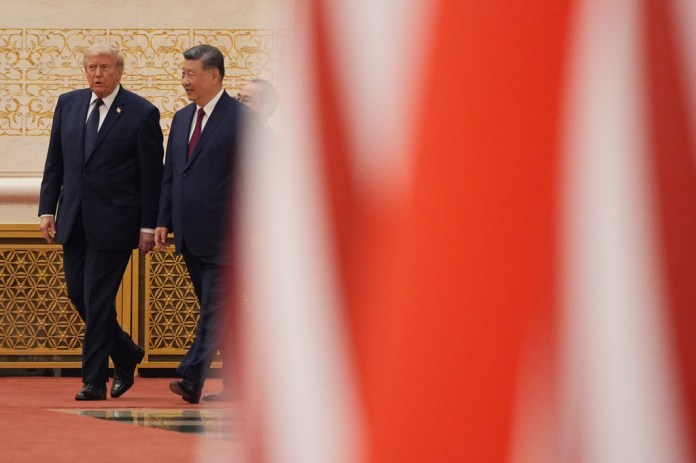
Xinhua News Agency, China’s official state news agency, published a statement similarly touting the importance of trade but said that Taiwan “is the most important issue in China-U.S. relations.”
“If handled well, bilateral relations can maintain overall stability. If handled poorly, the two countries will clash or even clash, pushing the entire China-US relationship into a very dangerous situation,” the readout stated. “‘Taiwan independence’ and peace across the Taiwan Strait are incompatible; maintaining peace and stability across the Taiwan Strait is the greatest common denominator between China and the US, and the US must handle the Taiwan issue with utmost caution.”
Trump is known for going off-script, even while hosting visiting dignitaries at the White House or conducting diplomacy abroad, but the president has been uncharacteristically tight-lipped since touching down in Beijing on Wednesday.
During his brief interactions with the press, Trump has limited himself to heaping praise on his counterpart — he frequently refers to Xi as a “gentleman” and says the two have a great relationship. Meanwhile, the president has not posted any statements to Truth Social since getting into the country, just video clips of the public portions of his visit.
Trump was particularly impressed with the roughly 300 Chinese youths and military honor guard who greeted him upon his arrival at Beijing International Airport on Wednesday.
“The children were amazing,” he said. “There are some who say it’s going to be the biggest summit ever.”
ALLIES SAY XI HAS NO SHOT AT CONVINCING TRUMP TO CHANGE TAIWAN POLICY
Even White House communications director Steven Cheung, known equally for professionally cooperating behind closed doors and lobbying incendiary attacks against critics on social media, was on his best behavior. A stone-faced Cheung declined to answer the traveling press pool when peppered with questions about Trump and Xi’s private conversations.
Earlier this week, John Ullyot, the former chief National Security Council spokesman from Trump’s first term in office, suggested in an interview with the Washington Examiner that any announcements, regardless of the policy area, coming out of Trump’s bilateral might be underwhelming.
“There’s always deals that are ready to be signed dealing with trade — agriculture, aircraft — trade related announcements that are being negotiated. That’s part of the formula for a head of state summit between major powers,” he explained. “The question about whether it goes beyond that is really an open one. It’s up to President Trump, who is as skilled a negotiator as we’ve had in the last 50 years or more as president.”
Trump isn’t slated to depart China until Friday afternoon local time, and while the prospect of a major announcement or two over the next 24-plus hours remains low, two marginally noteworthy developments did occur during the first 24 hours.
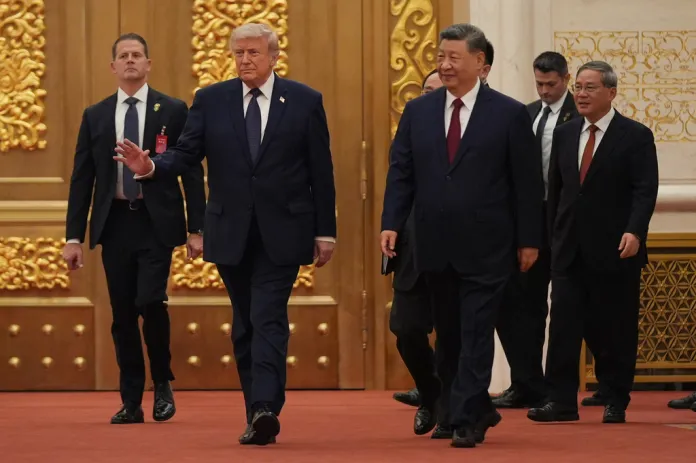
First, while escorting Trump into the Great Hall of the People for a private conversation, Xi gestured toward the site of 1989’s infamous Tiananmen Square Massacre, located just outside the hall. The two leaders spoke briefly as Xi pointed, but reporters were not close enough to hear the words exchanged.
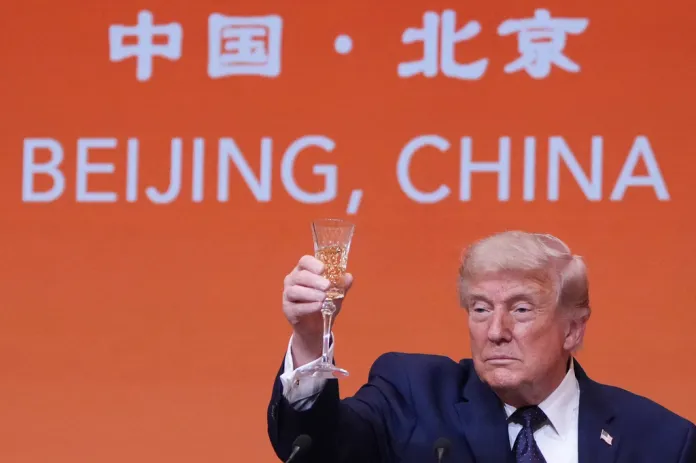
And, during the official state banquet later that evening, Trump confirmed one of the worst-kept secrets in Washington by formally inviting Xi to visit the White House in September.
Ullyot described the trip’s truncated schedule and low propensity for major news as “a mix of relationship building as well as serious negotiation time.”
“Those are two big goals, alone, that both of the leaders have,” he explained. “A real breakthrough might happen, might not happen, but at the same time, if they can both walk away with some of that relationship building, pointing to a breakthrough down the line, that’s a victory on both sides.”

Discount Applied Successfully!
Your savings have been added to the cart.