

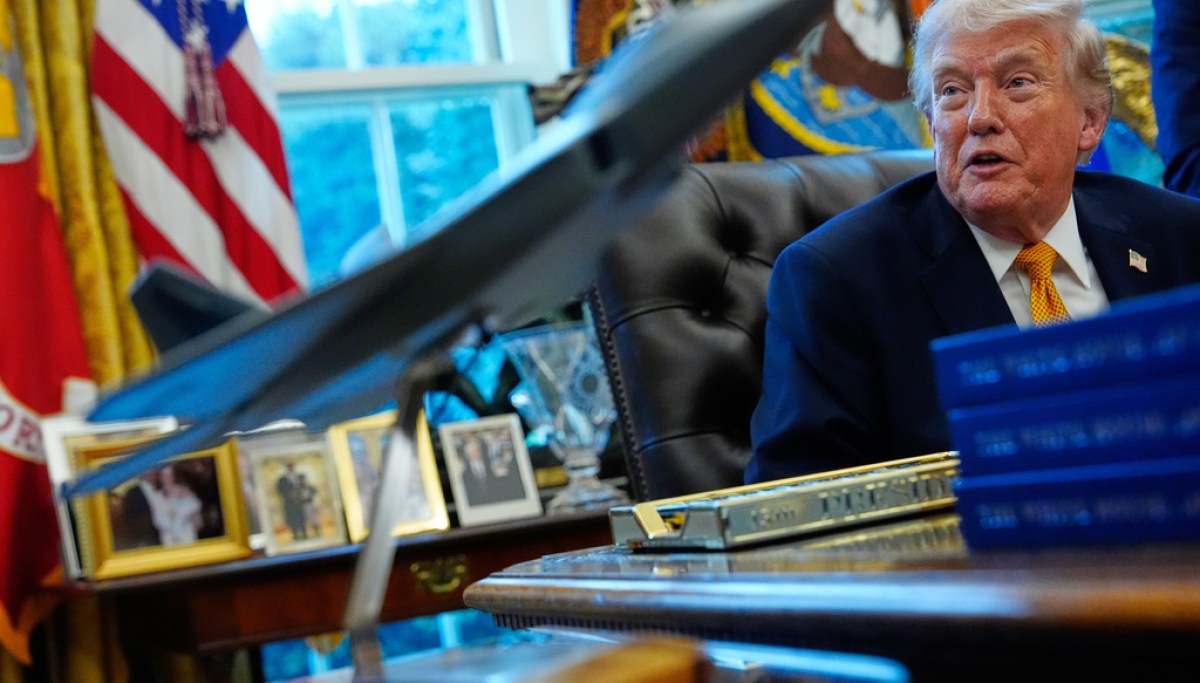
President Donald Trump does not appear to regret his more adversarial strategy toward allies, even as many resist his calls for help with the Strait of Hormuz.
Instead, more than two weeks into his war against Iran, Trump is portraying the resistance as proof of his point that the world is overreliant on the U.S. and that he should put “America First,” particularly considering the world will reap the rewards if the U.S. can assert control over the strait.
“For 40 years, we’re protecting you, and you don’t want to get involved in something that is very minor?” the president asked Monday during the public portion of lunch with Trump-Kennedy Center Board members at the White House.
Trump’s comments on Monday come after he proposed last weekend a seven-member coalition, including the likes of China, France, Japan, South Korea, and the United Kingdom, to help the U.S. secure the Strait of Hormuz.
All have publicly resisted Trump’s pressure campaign, at least so far, despite his threats — even Japanese Prime Minister Sanae Takaichi, who is poised to meet with the president on Thursday at the White House.
“Whether we get support or not, but I can say this — and I said it to them — we will remember,” Trump told reporters aboard Air Force One en route from Florida to Washington, D.C., on Sunday.
Other countries are supposedly willing to help, including some that may not be named, according to Trump.
Operation Epic Fury and its U.S.-Israeli strikes near the Strait of Hormuz, connecting the Persian Gulf and the Gulf of Oman, have put pressure on crude oil and gas prices because Iran is the ninth-largest global oil producer and the regime is speculated to have placed mines along what has become one of the world’s most strategic choke points.
However, for Council on Foreign Relations senior fellow and Trump’s former special representative to Iran Elliott Abrams, “most allies in Europe or Asia are just watching, with most trying to stay out.
“In many cases they really lack the military power to do very much to help,” Abrams told the Washington Examiner. “But the president’s call on them to help clear the Strait of Hormuz is compelling, because most of them need Middle Eastern oil in ways that we do not. I expect we will see many helping with that effort.”
American Enterprise Institute nonresident senior fellow Heather Conley agreed that European allies are especially “conflicted and divided about supporting the U.S. and the war in Iran.”
“They will study the request and perhaps offer very limited support, but for the foreseeable future, they will remain on the sidelines until there is clarity about the end of the military operation,” Conley told the Washington Examiner. “Allied involvement has been limited to [European Union] members deploying naval vessels to protect Cyrus and [the North Atlantic Treaty Organization] has intercepted three ballistic missiles from Iran over Turkey.”
To that end, German Chancellor Friedrich Merz told reporters on Monday through a translator that Germany will not help in the Strait of Hormuz and that he had not been advised of any “concept” to protect it.
Germany was part of the Joint Comprehensive Plan of Action, or the 2015 Iran nuclear deal between Iran and the P5+1 — the U.S., the U.K., France, China, Russia, and Germany.
“What concerns us most is that there is clearly no common plan for bringing this war to a swift and convincing conclusion,” Merz said in German.
Nevertheless, Conley, the former president of the German Marshall Fund and a State Department alumna, said “Some European leaders may reconsider their wait-and-see approach should they encounter a more dire energy and economic situation.
“But they [will] confront not only very negative public opinion but they lack an international or European legal mandate to deploy military forces abroad,” she said. “A wise lesson is to gather your allies and partners before you begin a regional conflict.”
Former Biden National Security Council spokesman Sean Savett repeated Conley’s point, contending “it’s clear to allies and to the world that … Trump blundered into this conflict unprepared to respond to Iran’s retaliation, which was quite foreseeable and experts had long warned about.
“He invested no time or effort in trying to build a coalition and win over allies to his cause before launching the war – after all he has barely tried to make his case to the American people — and he has spent much of the past year burning bridges over tariffs, Denmark, etc.,” Savett told the Washington Examiner. “There is not much goodwill.”
Center for Strategic and International Studies Zbigniew Brzezinski Chair in Global Security and Geostrategy Jon Alterman discouraged drawing a “straight line” between disagreements over trade and Greenland, among other issues, and the Iran war, but reminded Trump that allies are not always “available on a dime” or “are on call” whenever the U.S. needs them.
“Any U.S. military action in the Middle East has required a lot of diplomacy and negotiation before allies join on board,” Alterman told the Washington Examiner. “How much the president’s able to get after those negotiations will depend on a number of factors and his tariff strategy may mean that, at the end, he would emerge with less than other presidents.”
Trump reflected on his strategy regarding allies during two press appearances on Monday, revealing during the Trump-Kennedy Center Board luncheon that he does not think he has given allies a “hard sell,” at least regarding Iran.
“I don’t do a hard sell on them because my attitude is we don’t need anybody,” the president said. “We’re the strongest nation in the world. We have the strongest military by far in the world. We don’t need them.”
He continued: “But it’s interesting, I’m almost doing it in some cases, not because we need them, but because I want to find out how they react. Because I’ve been saying for years that if we ever did need them, they won’t be there, not all of them, but they won’t be there.”
TRUMP GRAPPLES WITH THE GREATEST COST OF HIS WAR IN IRAN: THE HUMAN COST
Trump, during the luncheon and a later event unveiling an anti-fraud initiative, specifically criticized British Prime Minister Keir Starmer for his initial opposition to the Iran war, including his resistance to sending British assets to the Middle East and providing the U.S. with logistical assistance, such as access to their bases.
“I was not happy with the UK,” he said. “I think they’ll be involved, but they should be involved enthusiastically. We’ve been protecting these countries for years with NATO because NATO is us.”


Discount Applied Successfully!
Your savings have been added to the cart.