

NEWYou can now listen to Fox News articles!
The conflict among power factions in Tehran is no longer hidden; signs of confusion in a tense atmosphere, internal clashes and a power struggle are clearly visible, and internal rifts have become more apparent than ever. Under current conditions, Ahmad Vahidi, commander-in-chief of the Islamic Revolutionary Guard Corps (IRGC), operates as a shadow leader; his faction stands in opposition to the faction of parliamentary Speaker Mohammad Bagher Ghalibaf, while in the meantime the faction of Director of the Supreme National Security Council Mohammad Zolghadr plays the role of a hidden orchestrator. The circle of power is becoming tighter day by day, and in practice, the structure of governance has turned into a kind of joint-stock company of intelligence-security criminals.
Supreme Leader Ali Khamenei’s son, Mojtaba Khamenei, too, has so far been kept hidden by the core of power; and gradually, rumors of his death are spreading in society. But the question remains: how long can the ruling establishment continue this game? Is he even alive to be unveiled one day? If conditions are normal, what is the purpose of all this cat-and-mouse game; and if he is not alive, does this not mean an intensification of the power struggle within the regime?
At present, the remnants of the Assembly of Experts have issued a statement declaring that he is alive, and some regime-affiliated clerics — known as Shiite sources of emulation — have also confirmed this claim through official notices. But are all these staged scenes anything more than a political trick? Are the street mobilizations and regime propaganda among its supporters real, or merely part of a controlled performance? If the truth is revealed, does the regime have the capacity to respond to the destructive consequences?
Meanwhile, U.S. and Israeli intelligence and espionage agencies have so far not fully confirmed whether he is alive or dead. On the other hand, it is still unclear why and how he was selected, through what process he rose to this position and by what mechanism he was approved.
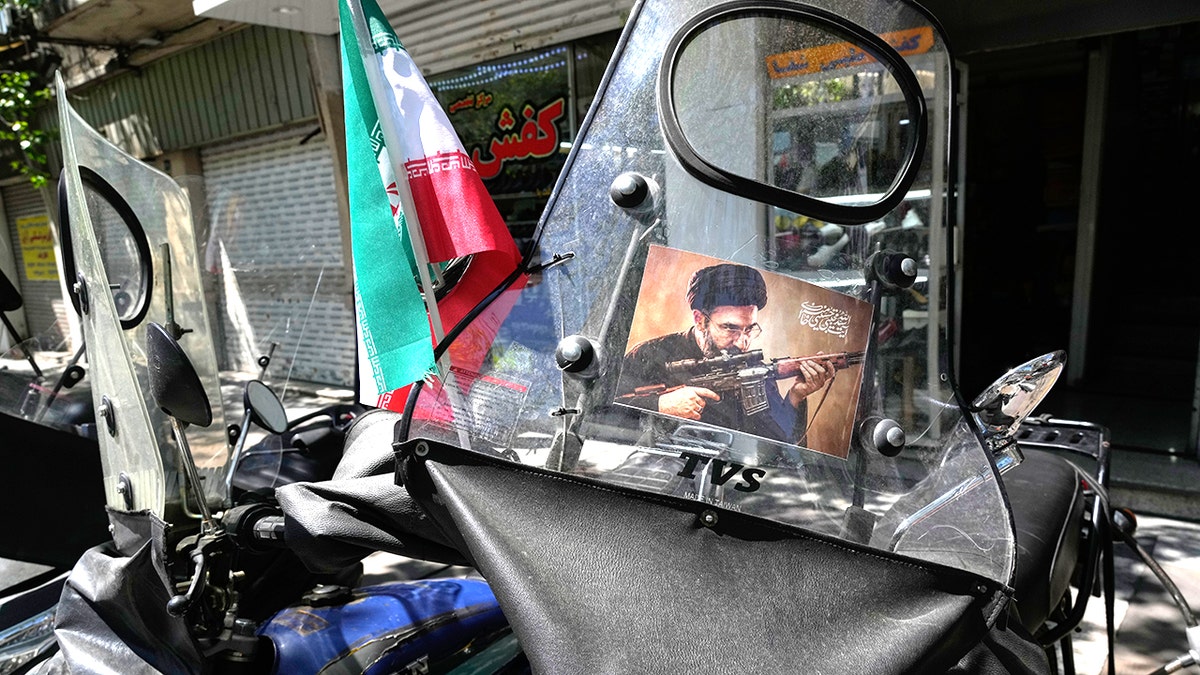
A poster is pasted on a motorbike windshield with graphic depicting Iran’s Supreme Leader Ayatollah Mojtaba Khamenei as government supporters gather to mark the 40th day since the killing of his father, Supreme Leader Ayatollah Ali Khamenei, in Tehran, Iran, Thursday, April 9, 2026. (Vahid Salemi/AP Photo)
What is also evident to international observers is that within the logic governing this structure, democracy, the people’s vote and electoral mechanisms have no place; what exists is the continuation of a dictatorship defined under the title of “absolute guardianship of the jurist,” and referred to by the Islamic community as “pure Muhammadan Islam” — a delusional interpretation that, within its specific ideological framework, is completely detached from the common standards of modern governance, rationality and civility.
The junta-like segment of the regime also acts as a serious obstacle to any negotiation with President Donald Trump and the United States and continues to pursue its declared goal of the destruction of Israel. From Tehran’s perspective, Trump is not inclined toward entering a war and seeks to avoid direct confrontation; for this reason, a strategy of attrition, wasting time and deception has been placed on the agenda.
At the same time, the first circle of power and the regime’s hard core still include figures who have not been eliminated by Israel or the United States — a combination of fanatical elements with Russophile and Anglophile tendencies who are unwilling to concede any advantage. Internal divisions and conflicts are far deeper than what U.S. and Israeli intelligence agencies imagine or analyze. In this context, it is still unclear who will ultimately be willing to “drink from the poisoned chalice.”
LIZ PEEK: TRUMP IS PUTTING AMERICA FIRST BY BACKING IRAN INTO A CORNER
At the same time, it has nothing to offer at the negotiating table. In this context, giving time under the guise of diplomacy by Washington and Israel can effectively create an opportunity for propaganda exploitation, allowing Tehran’s government to claim a kind of “victory” through narrative construction; as if there is no decisive will to bring the process of structural change to an end.
The regime, in order to preserve appearances, has kept this negotiation channel open and created a quasi-suspended and ambiguous atmosphere. At the same time, it tends to expand the scope of tensions in order to use them as a tool for extracting concessions and wearing down the other side.
What is stated by the IRGC is more a play on words than a clear response; neither transparent diplomacy is visible, nor is there a specific answer to U.S. demands. The main strategy is to buy time and continue the game within the dimension of time — a deliberate effort to exhaust the opposing side, particularly the United States and the Trump administration. In this framework, time has become one of the most important tools in the hands of Iran’s ruling actors.
OPERATION EPIC FURY: HOW AMERICA’S AIR POWER IS CRUSHING IRAN’S TERROR REGIME
At various times, the regime leaves the negotiating table — not as part of a calculated diplomatic strategy, but due to its inability to understand the logic of diplomacy and its inclination toward psychological warfare, displays of leverage and the reproduction of crisis. These very behaviors are themselves signs of Tehran’s disorientation. The ruling establishment is caught in a vague and deadlocked situation and seeks to project that it determines the timing and conditions; whereas this is more than anything a psychological game to preserve prestige. The main objective is to avoid direct confrontation, not to move toward a real agreement. In this framework, the tactic of pressure is employed as the primary tool.
What is presented by the IRGC lacks real credibility and weight in the eyes of the United States, and Israel is well aware that Iran’s responses will never be clear or reliable. This political structure, more than being familiar with the language of negotiation, is shaped within a framework that prioritizes confrontation and the application of pressure. In such an environment, genuine dialogue has been replaced by ambiguity, suspension and attritional tactics.
CLICK HERE FOR MORE FOX NEWS OPINION
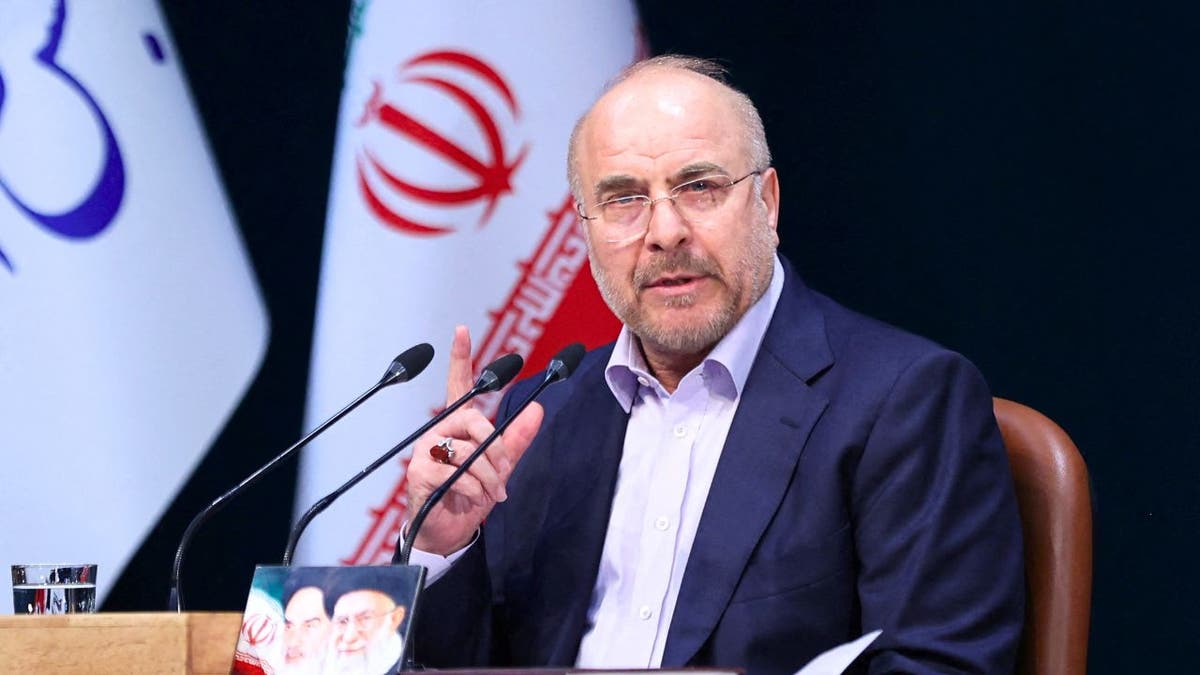
Iranian Parliament Speaker Mohammad Bagher Ghalibaf speaks during a press conference in Tehran, Iran, Nov. 27, 2024. (Majid Asgaripour/WANA (West Asia News Agency) via REUTERS)
For this ruling establishment, Iran’s national interests are not a priority, and there is no inclination to offer concessions, because it possesses only limited reliable tools. Excessive reliance on levers such as the nuclear program or regional networks, rather than generating sustainable power, has led to the deepening of crises. Under such conditions, the prospect of stability in Iran and the Middle East is increasingly tied to fundamental transformations in the structure of power. This is no longer a structure of power; it is a scene of the erosion of power. In other words, power in Tehran is not being divided — it is collapsing from within.
Ultimately, what is unfolding in Tehran today is not a sign of power management, but an image of its erosion. This is no longer a cohesive structure; it is a collection of rival factions, each fighting for survival, not for governing the country. Power in this system is neither consolidated nor distributed — it is disintegrating from within.
CLICK HERE TO DOWNLOAD THE FOX NEWS APP
Secrecy, psychological warfare, playing with time and propaganda displays are all signs of a deeper reality: a ruling system that no longer has the capacity for decisive decision-making and is merely trying to buy time. Under such conditions, even diplomacy has turned into a tool for delaying crisis, not resolving it.
In this context, the main question is no longer who will take power, but whether this worn-out structure can continue at all. What is seen in Tehran is not competition for the future, but a struggle over the survival of a decaying order — an order that is closer than ever to its endpoint.


Discount Applied Successfully!
Your savings have been added to the cart.