

President Donald Trump is boosting his relationships with key leaders in the Middle East as hostilities with Iran have increased following the end of the memorandum of understanding between the two nations.
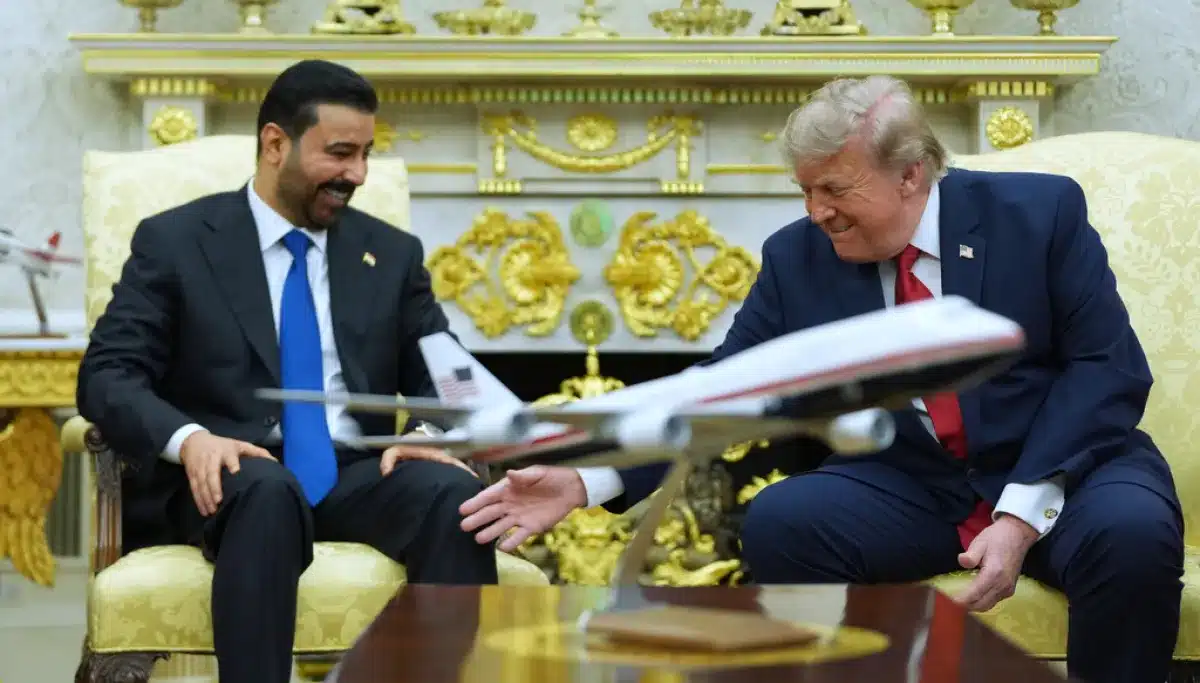
The administration’s strategy is centered on weakening Iran’s regional influence by pairing new economic partnerships with pressure on Tehran’s closest allies. The strategy was evident Tuesday during a bilateral meeting with Iraqi Prime Minister Ali al Zaidi when Trump heaped praise upon the foreign leader, teased a future oil deal, and warned that Iran was losing its effectiveness as the war continues.
“I just want to say it’s a great honor to have the prime minister of Iraq with us,” Trump said in his opening remarks. “He’s been a great fighter, and he’s been a great fan of America.”
Trump also alluded to Energy Secretary Chris Wright taking the lead in announcing an oil deal with Iraq on Friday.
“In a short period of time, he’s changed that country so much, especially toward their thinking about the United States, and we have partnerships,” Trump said while speaking of al Zaidi. “Chris was just saying we have tremendous oil partnerships all of a sudden being formed over the last short period of time, and I guess you’re going to be announcing them this week or next week.”
An expanded energy partnership would further deepen economic ties between Washington and Baghdad and could help undercut the global reliance on Iranian oil.
Trump and al Zaidi also announced that on Sept. 30, U.S. forces will have left Iraq while U.S. companies will remain inside the country with a focus on the economy.
“In Iraq, I think the administration definitely sees an opportunity here to create some space,” said David Schenker, former U.S. assistant secretary of state for Near Eastern affairs. “We’ve got a prime minister who is saying all the right things about disarming the militia, signing big business deals with Washington already, Chevron, Halliburton.”
Chevron is reportedly negotiating two Iraqi oil fields, while Halliburton recently secured a contract with Iraq’s Basra Oil Company. These actions help to limit Iran’s influence over Iraq.
Yet Schenker also cautioned that despite Trump’s efforts, “it’s going to be a hard endeavor” to completely ice out Iran.
“Basically, Iran is embedded in the Iraqi government, and the leading coalition of the government is comprised of Iranian-backed militia that don’t want to give up their weapons,” said Schenker, who is now a Taube Senior Fellow at the Washington Institute and director of the Linda and Tony Rubin Program on Arab Politics.
Iraq, however, is only one piece of a broader regional strategy that has emerged in recent days.
Just before Tuesday’s bilateral meeting, Trump announced on Truth Social that he would replace the 20% fee the United States had planned to charge for protecting shipping through the Strait of Hormuz with expanded trade and investment agreements from Gulf partners.
“Those Investments will be MASSIVE but, at the same time, extraordinarily good for them, and their future,” he wrote on Truth Social.
Trump singled out Saudi Arabia, the United Arab Emirates, Qatar, Bahrain, and Kuwait as several nations that “would love to invest more money in the United States at record amounts, and that would be very acceptable.”
The announcement illustrates how the administration is attempting to pair military pressure on Iran with deeper economic integration among Washington’s Gulf partners, reducing Tehran’s leverage while strengthening U.S. influence.
The president also reportedly pressured Israeli Prime Minister Benjamin Netanyahu to remove forces from Syria and Lebanon, where the Iran-backed Hezbollah is stationed, last week. “They don’t want you there. You should redeploy,” Trump told Netanyahu, according to Axios.
Whether Netanyahu follows through remains unclear, but the reported request signals Trump’s desire to prevent the Israel-Hezbollah conflict from expanding as the administration focuses on Iran.
Trump’s actions “probably reflect exactly where the president’s at … he thinks that Israeli presence is destabilizing and undermining,” Schenker said.
Trump also reportedly gave his approval to Saudi Crown Prince Mohammed Bin Salman to act against the Iran-backed Houthis in Yemen.
Trump’s comments underscored the administration’s belief that weakening Iran politically and economically is as important as degrading its military capabilities.
“The Middle East, believe it or not, is coming together,” Trump said. “We are getting rid of the bully of the Middle East. Iran was the bully of the Middle East. They bullied Iraq. They bullied every country.”
“There was fear all over the Middle East with other countries. I understand that, but there was fear,” Trump continued. “But there’s no fear anymore because their military capability has been knocked to hell.”
The White House also emphasized that the Gulf nations are standing behind the U.S. in opposition to Iran ever obtaining nuclear capabilities that would destabilize their region.
“Iran is more isolated than ever before as they lash out against their innocent neighbors who bear no involvement in the current conflict,” said Anna Kelly, a White House spokesperson. “In contrast, the United States is stronger than ever before and bolstered by our partnerships with allies in the region. As President Trump has emphasized for the past year, Iran can never have a nuclear weapon, and Gulf countries agree as the entire world is watching Iran’s erratic, indiscriminate attacks in real-time.”
GULF ALLIES’ BACKROOM PRESSURE CAMPAIGN FORCES TRUMP TO REVERSE TAX ON STRAIT OF HORMUZ
So far, the most effective tool in Trump’s arsenal against Iran is the naval blockade. But “the Iranians are going to try and drag this out,” Schenker said. “They’re willing to absorb a great deal of punishment.”
And as the U.S. and Tehran trade strikes, “we’re still in the same situation we were in six or eight weeks ago,” he added.


Discount Applied Successfully!
Your savings have been added to the cart.