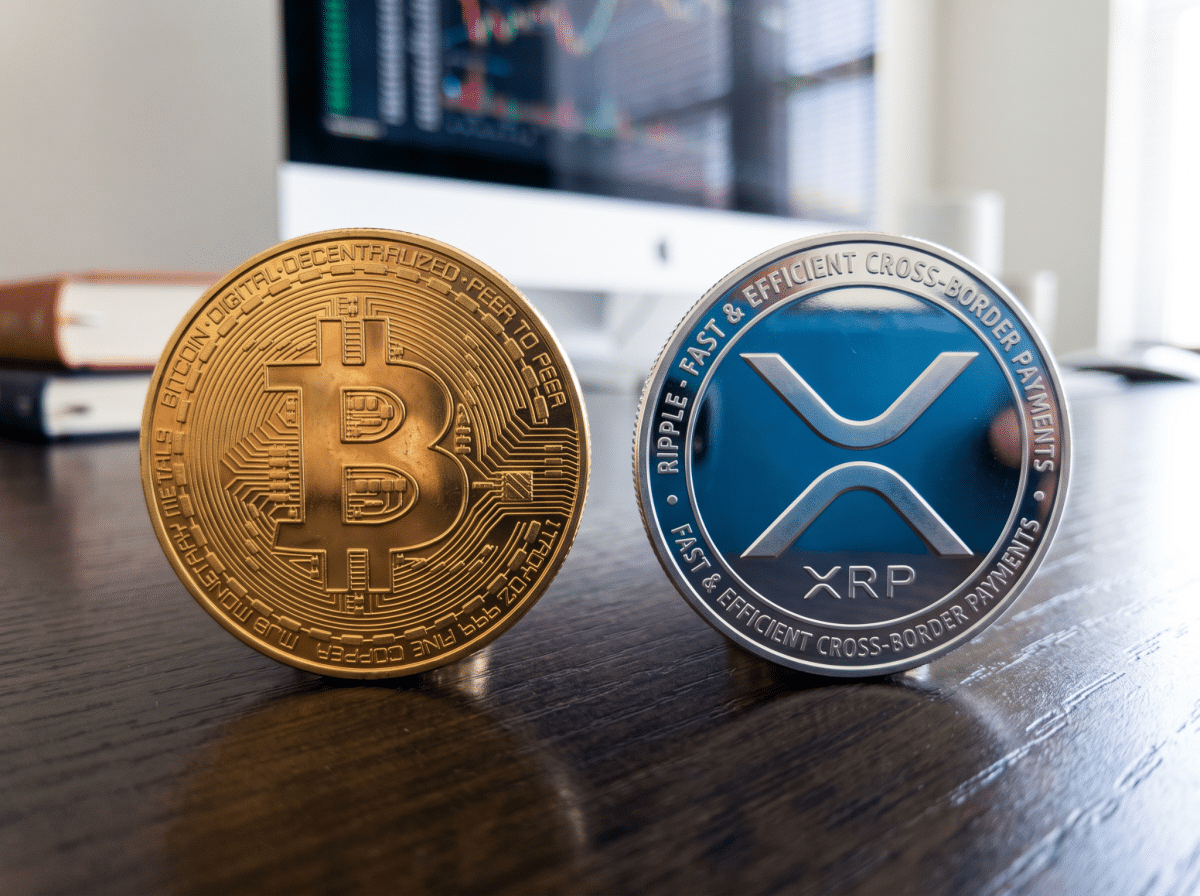
Bitcoin was designed around decentralized monetary value and scarcity. XRP is the native asset of the XRP Ledger (XRPL), a blockchain engineered for fast settlement and the movement of value across borders.
That distinction is the starting point for understanding both assets.
The useful question isn’t, “Which cryptocurrency will win?”
It’s: What specific problem does each network solve, and is there evidence that people are actually using it for that purpose?
Two Networks. Two Different Jobs.
Bitcoin uses Proof of Work, as originally outlined in Satoshi Nakamoto’s 2008 whitepaper. A global network of miners competes for block rewards to secure the network. Because block space is limited, transaction fees can fluctuate with demand.
Think digital fortress.
The XRP Ledger takes a different route. There are no miners. Instead, the network uses a consensus protocol involving independent validators. According to official XRPL documentation, new ledger versions are produced every few seconds, with consensus determining which transactions are accepted.
The plumbing looks very different:
| Feature |
Bitcoin |
XRP |
| Native Asset |
BTC |
XRP |
| Network |
Bitcoin |
XRP Ledger (XRPL) |
| Consensus Model |
Proof of Work |
XRP Ledger Consensus Protocol |
| Primary Strength |
Decentralized monetary network & digital scarcity |
Lightning-fast settlement & value transfer |
| Mining Required? |
Yes |
No |
| Transaction Fees |
Variable, market-driven |
Fractions of a penny |
| Settlement Design |
Block-based |
Ledger-based |
| What Matters Most |
Security, decentralization, monetary properties |
Speed, liquidity, ecosystem adoption |
And here’s what I’ve learned after years of watching this market: architecture matters more than slogans.
You can’t judge either network simply by asking which one is faster. You have to ask whether its design actually supports the job it was built to perform.
The Speed-and-Fee Reality Check
This is where the difference becomes impossible to ignore.
The XRPL settles transactions in roughly 3 to 5 seconds. Its recommended reference transaction fee is just 10 “drops,” or 0.00001 XRP.
Bitcoin operates differently. Transactions compete for limited block space, meaning fees can rise during congestion and fall when demand declines.
So yes, XRP is cheaper and faster for the specific settlement function it was designed to perform.
But that’s only half the story.
Bitcoin’s transaction fees are market-driven, and its base-layer architecture prioritizes a different set of properties. And if you’re actually using Bitcoin for payments, you may not be using the main blockchain for every transaction at all.
The Lightning Network is a Layer-2 system built on Bitcoin that enables near-instant, low-cost transfers away from the main blockchain.
That’s why comparing one transaction fee against another without understanding the architecture can produce a misleading conclusion.
The Bigger Question: Who Actually Needs These Networks?
Bitcoin’s strongest real-world use case isn’t necessarily buying coffee.
Its power comes from being a decentralized digital asset with scarcity as a central monetary property.
The January 2024 approval of spot Bitcoin exchange-traded products by the U.S. Securities and Exchange Commission helped reinforce Bitcoin’s institutional market structure. Major financial firms such as BlackRock entered the market because Bitcoin had developed into an institutional-grade digital asset market.
That doesn’t eliminate risk. Bitcoin remains volatile.
XRP is solving a different problem.
The XRPL was built for moving value. It includes a decentralized exchange and mechanisms for moving XRP and other tokenized assets across the ledger. Ripple, the technology company associated with the ecosystem, has spent years developing financial infrastructure targeting cross-border payments and stablecoin settlements.
But don’t make the classic retail-investor mistake:
Ripple is a company. XRP is a digital asset. The XRPL is a blockchain.
A major Ripple partnership does not automatically translate into direct demand for XRP.
That distinction is one of the most important things to understand before comparing these assets.
The Decision Problem
If you’re staring at Bitcoin and XRP and asking which one you should own, you’re starting with the wrong question.
Start with the problem each network is attempting to solve.
Bitcoin emphasizes decentralized monetary value, scarcity, security and institutional market infrastructure.
XRP emphasizes rapid settlement, liquidity and value transfer.
The market may eventually reward both for very different reasons-or reward neither to the degree investors expect. What matters is separating architecture from marketing and actual economic activity from headlines.
The takeaway: Bitcoin and XRP aren’t interchangeable bets. They represent different technological designs, different economic propositions and different risk considerations.
In Part 2, we’ll move from understanding the differences to evaluating them: how to assess utility, partnerships, token demand, regulation and risk without getting trapped by crypto-market hype.
Coming Up in Part 2: A practical framework for evaluating Bitcoin and XRP-including the partnership trap, token-demand test, regulatory picture and the metrics that matter beyond speed and price.
About This Series: This three-part breakdown examines Bitcoin and XRP through the lens of network design, real-world utility, regulatory conditions and investment risk, using the research and analysis contained in the original article.
References
Nakamoto, S. (2008). Bitcoin: A Peer-to-Peer Electronic Cash System. Bitcoin.org.
https://bitcoin.org/bitcoin.pdf
XRP Ledger Foundation. (n.d.). Introduction to the XRP Ledger Consensus Protocol. XRPL.org.
https://xrpl.org/consensus.html
Lightning Network. (n.d.). Scalable, Instant Bitcoin/Blockchain Transactions. Lightning.network.
https://lightning.network/