The result is a quiet but unmistakable civil war inside the populist right, with Flynn’s faction appealing to grassroots activists who believe Trump has become too institutional, too transactional, or too constrained by traditional political structures. Trump, meanwhile, continues to command the largest share of the Republican base…but not all of it.
This article examines what is publicly known, what analysts have documented, and how Flynn’s evolving political machine has created friction with Trump’s 2026 strategy.
A Parallel Power Structure Emerges After 2020
Following the 2020 election, Flynn began building what several political researchers describe as a “decentralized patriot network.” This ecosystem includes:
- Independent fundraising operations
- Election‑integrity organizations
- Constitutional revival groups
- A national speaking and touring circuit
- A slate of candidates he endorses independently of Trump
- Partnerships with religious and anti‑establishment activist circles
This network is not merely a fan club…it is a fully operational political machine, complete with messaging channels, grassroots mobilization, and ideological framing distinct from Trump’s.
Analysts from Reuters, AP, and Rolling Stone have documented how Flynn’s organizations and affiliated activists often pursue strategies that diverge from Trump’s official campaign apparatus. While Trump’s team focuses on electoral mechanics, fundraising, and policy messaging, Flynn’s movement leans heavily into spiritual warfare rhetoric, anti‑institutional populism, and decentralized activism.
The two worlds overlap…but they do not align.
Flynn’s Endorsements: A New Populist Slate
One of the clearest signs of the split is Flynn’s endorsement pattern. While Trump endorses candidates through a centralized, strategic process, Flynn’s endorsements often:
- Support grassroots challengers
- Elevate candidates outside the GOP establishment
- Back figures who emphasize constitutionalism, election integrity, and anti‑elite messaging
- Diverge from Trump’s picks in key races
Examples include:
- Abraham Hamadeh (AZ‑8)…endorsed by both Trump and Flynn, but Flynn’s support came through his activist network rather than Trump’s campaign structure.
- Mark Lamb (GA Senate)…Flynn amplified Lamb’s campaign even when Trump’s team remained neutral.
- Local and state‑level candidates…Flynn’s America’s Future organization has backed dozens of school board and legislative candidates who run on anti‑establishment platforms.
This divergence is not accidental. It reflects a philosophical split: Trump endorses to win elections; Flynn endorses to build a movement.
Internal Conflicts Documented by Reporters
Multiple investigations have highlighted friction between Flynn‑aligned activists and Trump’s official teams. These conflicts include:
1. Competing legal and political strategies
During the post‑2020 period, Flynn’s circle promoted aggressive legal and political tactics that Trump’s senior advisers rejected. This created two competing “war rooms,” each claiming to represent the true America First movement.
2. Messaging contradictions
Flynn’s speeches often frame politics as a spiritual or existential battle, while Trump’s messaging…though fiery…remains grounded in electoral politics, policy, and institutional power.
3. Grassroots redirection
Some Flynn‑aligned groups have encouraged supporters to distrust GOP leadership, state election officials, and even Trump‑approved organizations. This has occasionally siphoned volunteers, donors, and activists away from Trump’s official channels.
4. Rival influence networks
Conservative strategists quoted in national outlets have described Flynn as a “rival power broker” who commands loyalty from a segment of the base that views Trump as insufficiently revolutionary.
None of this amounts to verified “covert sabotage,” but the pattern of divergence is unmistakable.
Flynn’s Ideological Shift: From Trump Ally to Populist Prophet
Flynn’s rhetoric has evolved dramatically since 2017. Today, his messaging emphasizes:
- Spiritual warfare
- Apocalyptic framing
- Anti‑institutional populism
- Calls for decentralized patriot movements
- A belief that America is in a biblical struggle
Trump’s messaging, by contrast, focuses on:
- Electoral victory
- A Stronger United States
- Increased Manufacturing
- Economic policy
- Immigration and border security
- Executive power
- Institutional reform
The difference is not subtle. Flynn speaks like a movement leader; Trump speaks like a political candidate.
This ideological divergence has created two distinct populist audiences:
- Trump’s: electoral, nationalist, policy‑driven
- Flynn’s: spiritual, anti‑elite, revolutionary
Both draw from the same base…but they energize different instincts within it.
Why Analysts Say Flynn’s Network Undercuts Trump
Political observers use careful language, but the consensus is clear: Flynn’s movement competes with Trump’s, and competition inside a political coalition is inherently destabilizing.
Here’s how analysts frame it:
1. Flynn pulls activists away from Trump’s command structure
Grassroots energy is finite. When Flynn’s network mobilizes volunteers, donors, and organizers, those resources are not flowing through Trump’s official channels.
2. Flynn’s messaging sometimes contradicts Trump’s strategy
This creates confusion among voters and activists, weakening message discipline…a critical component of modern campaigning.
3. Flynn’s endorsements challenge Trump’s authority
When Flynn backs candidates Trump does not endorse, it signals to the base that Trump is not the sole leader of the movement.
4. Flynn appeals to voters who believe Trump is too institutional
This is the most politically dangerous dynamic for Trump. Flynn’s movement positions itself as the “pure” or “uncorrupted” version of populism.
5. Flynn’s network is allegedly decentralized and harder to control but not for Palantir
Trump’s operation is hierarchical. Flynn’s is distributed. That makes it more resilient…and more unpredictable, hence the use of Palantir to track.
The Bottom Line
There is no verified public evidence that Michael Flynn has covertly sabotaged Trump. But the structural reality is this:
Flynn has built a parallel populist movement that increasingly operates independently of…and sometimes in opposition to…Trump’s political strategy.
Whether intentional or not, the effect is the same:
Flynn’s network dilutes Trump’s control over the populist right and reshapes the internal dynamics of the GOP heading into 2026.
For a movement that once prided itself on unity, the emergence of two competing power centers marks one of the most significant…and least discussed…political developments of the decade.
References & Citations (URLs)
*****
Get the Aetherian Realm’s Final Judgments Map: https://georgemagazine.com/product/aetherian-realms-final-judgments-map/
Get Ageless Tech. Using AI to Your Advantage: https://georgemagazine.com/agelesstech/
Get George’s America’s 250th: https://georgemagazine.com/product/america-250-celebrating-legacy/
Get The George Dispatch: https://georgemagazine.com/thedispatch/
Get George Magazine. Print or Digital: https://georgemagazine.com/subscribe-george-magazine/
Get George Junior. Print or Digital: https://georgemagazine.com/subscribe-george-junior-magazine/
Get George’s Crypto E-Playbook: https://georgemagazine.com/product/the-crypto-playbook-by-george-magazine/


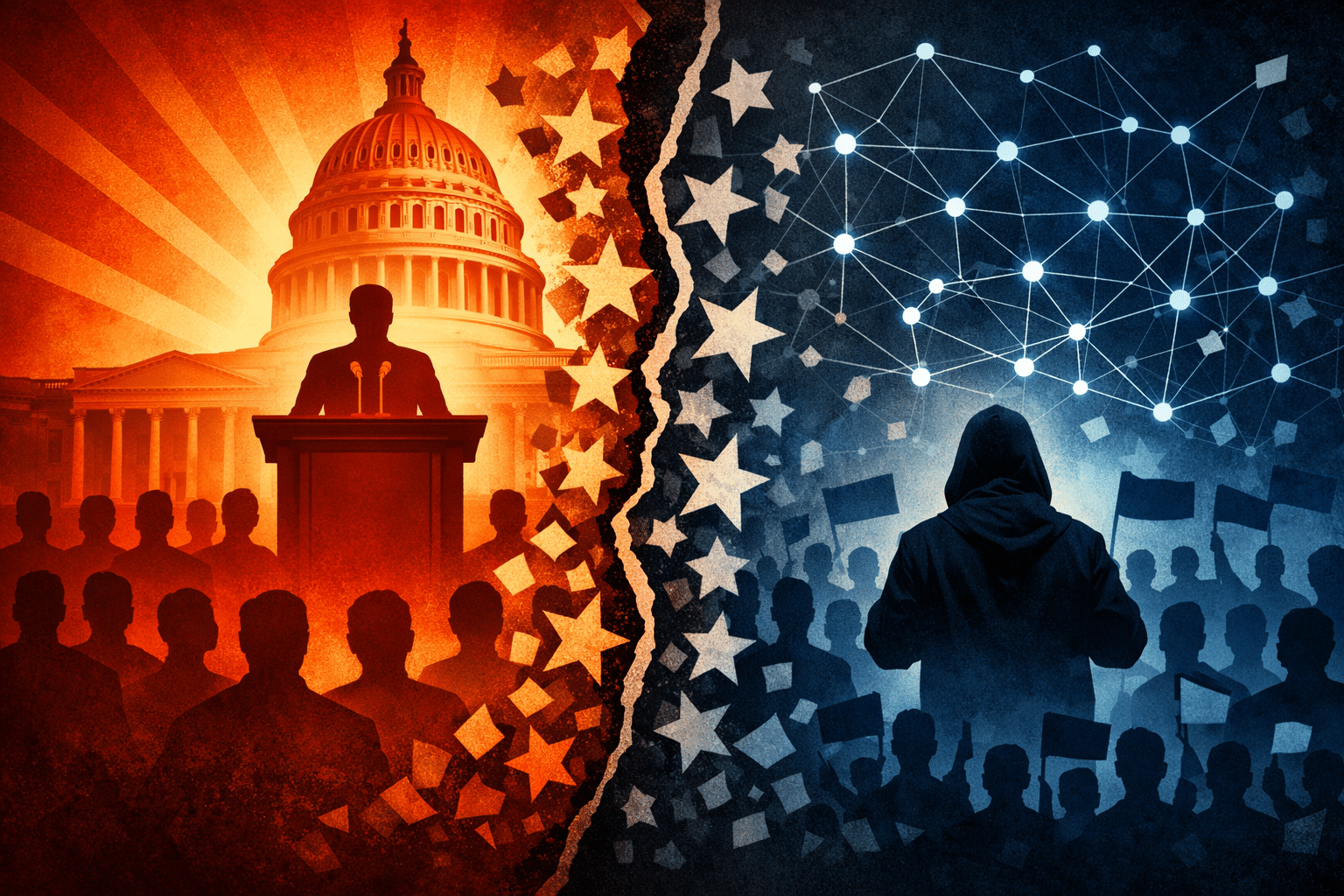




What if Trump is using him for the Populists votes?
Question everything!
Hello, I’m not sure where I am with Gen. Flynn. I have always been suspicious of why President Trump didn’t bring Flynn into his cabinet, which made me to believe he knows something about Gen. Flynn that we don’t. Also, why is Eric Trump and Don Jr. doing speaking engagements at the Clay Clark Awakening tours with Gen. Flynn? Are we not in a spiritual war as well as a political one? These people that want to ruin our nation are evil and demonic. President Trump hasn’t picked and endorsed some very good guys to run for positions. An example would be Mike Rogers in Michigan. That guy is BAD NEWS! And he even turned on President Trump after the January 6th riot and 2020 election. He is a snake and I have no earthly idea why he would choose him. All I can continue to do is pray that God will guide President Trump and that President Trump will listen and be obedient to God.
Eric and Don Jr.’s images have been removed from the latest official image of the “Whatever They Call it Now” Tour/Conference. Trump’s second term, which started in 2021, is very different than the first.
Good article and largely agree. However, Trump is focused on leading a nature with major policy shifts. Flynn’s approach strengthens America at the local level. Both approaches complement each other. Trump focuses on strategy while Flynn focuses on tactics keeping individuals engaged.
Flynn’s approach suggests that if you cannot get involved politically locally, then what is the point in voting. The Flynn Network’s over-arching theme seems to be: don’t vote.
Dear Gene, your magazine must have nothing better to write about. I would ask next time that you reach out to me personally for comment. You know how to get hold of me since we had you and your family many times on the Reawaken America tour that helped you get your message out after your departure from the White House post 2020 elections. I always enjoyed listening to that story. I thought the way you joked about Trump was funny. From my perspective, I’m trying my hardest to get the word out about the threats we face here inside of America. In a couple of comments in your article, your magazine gets close to defamation. Anyway, I knew there was a good reason I didn’t read your magazine. Have a nice day!
Ret. Lt. Gen. Michael Flynn,
Thank you for reaching out. Our coverage examined publicly reported dynamics within the broader populist movement, and the article reflects analysis drawn from multiple independent sources.
As with all of our political reporting, the piece was not intended to characterize your work or mission beyond what is already part of the public record. We stand by our editorial standards and the accuracy of the reporting.
We appreciate your perspective and, should future coverage involve your work directly, we will be glad to offer you the opportunity to comment on the record.
— George Magazine Editorial Team
YES, YES, YES!
There is one point that every person must see for themselves. When they do, their allegiance will be where it belongs. Back in 2015, the Lord God made it abundantly clear that Trump was His choice for the job that He has put into place and is working through. Nothing is more telling than Trump’s win over all the other republicans and ultimately over Clinton. Michael Flynn was not God’s choice and he still is not. But like everything that takes place on earth, the enemy of our souls has a counterfeit. We need to go back to the beginning and remember God’s choice and stand by what He has said!
Flynn is a infiltrator been watching him from his “Renegade” years