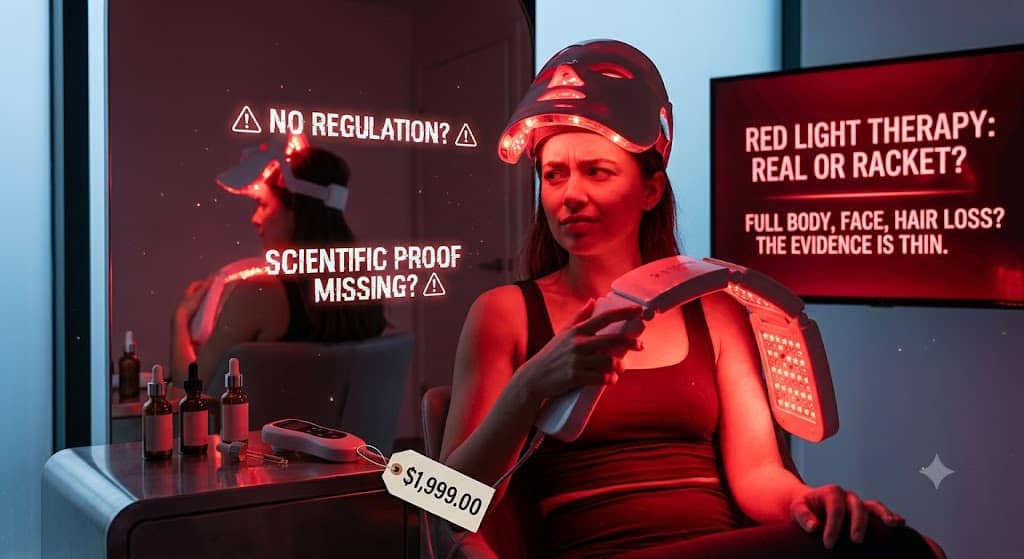
A significant issue plaguing the RLT market is its minimal regulation. In the United States, the Food and Drug Administration (FDA) clears many of these devices, but this is a far cry from approving them. The 510(k) clearance process often merely implies that a device is “substantially equivalent” to an existing one in safety, not that it actually works for its claimed therapeutic purposes. Manufacturers frequently use misleading language, exploiting FDA clearance to sound medically endorsed while leaving consumers entirely unprotected from ineffective, high-cost products. This lack of oversight allows businesses to make grandiose claims about efficacy without providing rigorous data to back them up.
Furthermore, the scientific “proof” often cited by proponents of red light therapy for face, body, and baldness is, at best, underwhelming and, at worst, nonexistent. While some initial laboratory research on cell cultures and animals suggests potential biological effects, extensive, high-quality, randomized, double-blind clinical trials are severely lacking. The studies that do exist are often small, poorly designed, or funded by the industry itself, introducing significant bias. There is no established scientific consensus on appropriate dosages, wavelengths, or long-term safety and efficacy. When it comes to treating hair loss (baldness) or achieving dramatic anti-aging effects, there is simply insufficient data to suggest it provides significant, verifiable benefits beyond a potential placebo effect.
Ultimately, the aggressive marketing of red light therapy devices, some costing thousands of dollars for home use, seems intended to capitalize on people’s hopes and insecurities. Without scientific confirmation and proper regulation, it remains an expensive, unproven fad that fits squarely within the category of medical quackery. Consumers should view these glowing claims with healthy skepticism and invest their money in proven, evidence-based treatments instead.
Wavelength Precision vs. Cosmetic Color
The studies demonstrating tissue repair, collagen production, and hair growth rely on highly specific wavelengths. The clinically relevant bands are 630 to 660 nanometers for superficial skin and hair applications, and 810 to 860 nanometers for deeper near-infrared penetration.
In clinical settings, medical-grade panels utilize precision-binned LEDs to maintain tight control over these exact wavelengths. Conversely, many consumer devices simply emit a bright red hue without guaranteeing the light falls within the therapeutic 630 to 660 nanometer range. A tinted light is not sufficient. Consumer panels often have a wider variance in their wavelengths, which can dilute their therapeutic effectiveness.
Irradiance and the Law of Dosing
The biggest disconnect between research and consumer products is the delivery of energy. In clinical trials, the dose is determined by irradiance, time, and distance. Irradiance, measured in milliwatts per square centimeter, dictates how quickly the skin receives the required energy.
For dermatologic applications, typical therapeutic irradiance levels range from 20 to 60 milliwatts per square centimeter. Medical-grade systems used in spas and clinics are designed with significantly higher light output than most at-home devices. Professional panels can deliver 150 to 180 milliwatts per square centimeter at the skin surface, whereas consumer panels typically produce 80 to 120 milliwatts per square centimeter. Because at-home tools use lower power for safety, they generally deliver weaker results and cannot penetrate as deeply into the tissue. Devices that fail to disclose their irradiance may operate entirely outside the therapeutic range, offering no clinical benefit.
Professional Clinic Spa Treatments vs. Gym and At-Home Devices
The market is essentially split into two tiers based on power and precision:
- Professional Clinic and Med Spa Systems: These devices deliver higher intensity light, allowing treatments to reach deeper skin layers and stimulate more significant cellular responses. Because the light intensity is stronger, clinic treatments can produce faster visible results in shorter sessions.
- At-Home Consumer Devices: Tools like LED masks and handheld wands operate at lower intensities to maintain safety for unsupervised use. While science confirms that red light is not bogus, the effectiveness of at-home tools is largely unknown because the strength and duration of the treatment vary wildly. At-home devices can be helpful for surface-level improvements and maintenance, but they require much longer treatment times and strict consistency to achieve noticeable progress.
Legitimate science exists, but the consumer market often sells the aesthetic of the treatment rather than the precise mechanical dose required to trigger a biological response.
The Scientific Reality of Red Light Therapy
- FDA Regulation: It is true that many consumer devices bypass rigorous clinical trials. The FDA often clears these devices based on “substantial equivalence” to existing products, which expedites the review process but does not always require new efficacy data (Rising & Moscovitch, 2015).
- Skin Rejuvenation: Clinical trials have demonstrated that red and near-infrared light can effectively improve skin roughness and increase intradermal collagen density (Wunsch & Matuschka, 2014). Furthermore, a systematic review of randomized controlled trials concluded that light-emitting diodes are effective for various skin conditions, though researchers noted that some studies suffer from small sample sizes (Jagdeo et al., 2018).
- Hair Loss: Research indicates that 650 nm red light stimulates human hair follicles and prolongs the growth phase of the hair cycle (Yang et al., 2021). Multiple studies suggest that LLLT is a potentially effective treatment for androgenetic alopecia, noting its ability to increase hair density (Pillai & Mysore, 2021). It has also been shown to boost hair growth when combined with other clinical treatments (Gentile & Ki, 2022).
References
Gentile, P., & Ki, M. (2022). Hair Growth Booster Effects of Micro-Needling with Low-Level Led Therapy and Growth Factors on Subjects Treated with Finasteride®. Applied Sciences, 12, 9164. https://doi.org/10.3390/app12189164 Cited by: 8
Jagdeo, J., Austin, E., Mamalis, A., Wong, C., Ho, D., & Siegel, D. M. (2018). Light-emitting diodes in dermatology: A systematic review of randomized controlled trials. Lasers in Surgery and Medicine, 50, 613-628. https://doi.org/10.1002/lsm.22791 Cited by: 139
Pillai, J., & Mysore, V. (2021). Role of low-level light therapy (LLLT) in androgenetic alopecia. Journal of Cutaneous and Aesthetic Surgery, 14, 385. https://doi.org/10.4103/jcas.jcas_218_20 Cited by: 85
Rising, J. P., & Moscovitch, B. (2015). Characteristics of Pivotal Trials and FDA Review of Innovative Devices. PLOS ONE, 10, e0117235. https://doi.org/10.1371/journal.pone.0117235 Cited by: 15
Wunsch, A., & Matuschka, K. (2014). A Controlled Trial to Determine the Efficacy of Red and Near-Infrared Light Treatment in Patient Satisfaction, Reduction of Fine Lines, Wrinkles, Skin Roughness, and Intradermal Collagen Density Increase. Photomedicine and Laser Surgery, 32, 93-100. https://doi.org/10.1089/pho.2013.3616 Cited by: 220
Yang, K., Tang, Y., Ma, Y., Liu, Q., Huang, Y., Zhang, Y., Shi, X., Zhang, L., Zhang, Y., Wang, J., Zhu, Y., Liu, W., Tan, Y., Lin, J., & Wu, W. (2021). Hair Growth Promoting Effects of 650 nm Red Light Stimulation on Human Hair Follicles and Study of Its Mechanisms via RNA Sequencing Transcriptome Analysis. Annals of Dermatology, 33, 553. https://doi.org/10.5021/ad.2021.33.6.553 Cited by: 30
*****
Get Ageless Tech. Using AI to Your Advantage: https://georgemagazine.com/agelesstech/
Get George’s America’s 250th: https://georgemagazine.com/product/america-250-celebrating-legacy/
Get George’s Crypto E-Playbook: https://georgemagazine.com/product/the-crypto-playbook-by-george-magazine/
Get America’s 250th George Magazine T-Shirt: https://georgemagazine.com/product/americas-250th-george-magazine-t-shirt/
Get The George Dispatch: https://georgemagazine.com/thedispatch/
Get George Magazine. Print or Digital: https://georgemagazine.com/subscribe-george-magazine/
Get George Junior. Print or Digital: https://georgemagazine.com/subscribe-george-junior-magazine/
Get “Co V Fe Fe” Shirt here: https://georgemagazine.com/product/cov-fe-fe-george-magazine/
Get the Aetherian Realm’s Final Judgments Map: https://georgemagazine.com/product/aetherian-realms-final-judgments-map/
For the “Deep Dive”: Project Looking Glass: https://projectlookingglass.org/