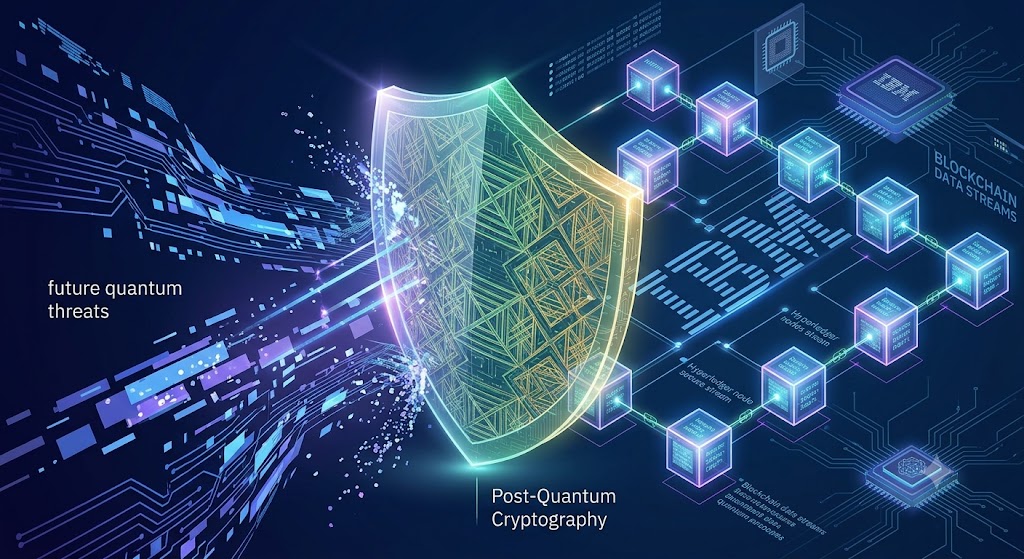
The intersection of these two fields lies in the urgent need for Post-Quantum Cryptography (PQC) within blockchain frameworks like Hyperledger.
Currently, most blockchains rely on public-key cryptography algorithms, such as Elliptic Curve Cryptography (ECC) and RSA, to secure transactions, digital signatures, and consensus mechanisms. These algorithms are based on mathematical problems (like factoring large numbers or solving discrete logarithms) that are computationally infeasible for traditional computers to solve within a reasonable timeframe. However, a sufficiently powerful quantum computer, utilizing algorithms like Shor’s algorithm, could break these codes relatively quickly. This would expose blockchain data, compromise private keys, and undermine the immutability of the entire ledger.
IBM, recognizing this existential threat, is leveraging its expertise across both domains to build “quantum-resistant” ledgers. This work involves identifying and integrating new cryptographic algorithms that are believed to be secure against both classical and quantum computers. These new PQC algorithms, often based on complex mathematical structures like lattices, are being researched, standardized (by organizations like NIST), and, crucial to this discussion, tested and implemented within the Hyperledger frameworks.
What This Means for the Future of Blockchain
This intersection signifies several critical things for the future of enterprise blockchain:
- Ensuring Long-Term Security and Trust: For organizations using Hyperledger for critical applications like supply chain tracking, financial transactions, or identity management, PQC is not optional; it is essential for long-term viability. By integrating quantum resistance today, IBM ensures that the data recorded on these ledgers remains secure for decades, even as quantum computing capability advances.
- Maintaining Cryptographic Agility: The work demonstrates the importance of “cryptographic agility”…the ability to easily update or replace cryptographic components within a system. IBM’s contributions to Hyperledger are helping build modular frameworks where PQC algorithms can be seamlessly swapped in as they become standardized and proven effective.
- Proactive Defense Strategy: This research mitigates the risk of “harvest now, decrypt later” attacks, where adversaries might collect encrypted blockchain data today, waiting for the quantum power to decrypt it in the future. Implementing PQC before powerful quantum computers arrive is the only effective defense.
Ultimately, IBM’s parallel advancement of Hyperledger and quantum computing ensures that as the power to break current encryption emerges, the defensive shields required to protect digital ledgers are already in place.
References and Citations:
- IBM Research. (2023). Security in the Quantum Era: IBM’s Quantum-Safe Roadmap. IBM Corporation.
- Hyperledger Foundation. (2022). Hyperledger Architecture Volume 1: Introduction to Hyperledger and Its Component Projects. Linux Foundation.
- National Institute of Standards and Technology (NIST). (2023). Post-Quantum Cryptography Standardization. U.S. Department of Commerce.
*****
Get George’s America’s 250th: https://georgemagazine.com/product/america-250-celebrating-legacy/
Get America’s 250th George Magazine T-Shirt: https://georgemagazine.com/product/americas-250th-george-magazine-t-shirt/
Get the Aetherian Realm’s Final Judgments Map: https://georgemagazine.com/product/aetherian-realms-final-judgments-map/
Get Ageless Tech. Using AI to Your Advantage: https://georgemagazine.com/agelesstech/
Get George’s Crypto E-Playbook: https://georgemagazine.com/product/the-crypto-playbook-by-george-magazine/
Get The George Dispatch Free: https://georgemagazine.com/thedispatch/
Get George Magazine. Print or Digital: https://georgemagazine.com/subscribe-george-magazine/
Get George Junior. Print or Digital: https://georgemagazine.com/subscribe-george-junior-magazine/
Go to Project Looking Glass: https://projectlookingglass.org/






Great article! A must read if you want to learn how hyperlinks work and why it is so important.
I truly believe understanding technology like this will help us navigate the future with greater confidence. I love learning about new innovations and the technology that’s coming.