

As polls shift almost uniformly in favor of Democrats in the final days of the 2026 midterm elections, some boosts for the opposition party are coming from the American South, a region that has been reliably Republican for decades.
Democrats currently lead in contested Senate, gubernatorial, and House races across the Southeast.
Republicans hold narrow leads or are falling behind in deep red areas such as South Carolina, Mississippi, and Texas. The party has all but given up on key Senate races in North Carolina and Georgia. In recent days, new warning signs are emerging for the GOP even in the reddest bastions, with polls showing closer races in Alabama and Louisiana.
It’s a situation that would have been unthinkable just a year ago, when the American South voted to return President Donald Trump to the White House by double-digit margins in most states.
Here’s where things stand south of the Mason-Dixon line as Election Day looms.
Related Stories


In the final days of the cycle, national attention is laser-focused on Mississippi’s Senate race.
In that race, District Attorney Scott Colom is giving incumbent Sen. Cindy Hyde-Smith a solid fight. Cook Political Report recently downgraded the race from “Solid Republican” to “Likely Republican.”
The latest poll, sponsored by Democrats, found Hyde-Smith leading by just 3 percentage points.
Asked about the shift toward Democrats in Mississippi and elsewhere, Debbie Fancher told The Epoch Times that it was driven by “the promises broken” by Trump and Republicans.
“People have woken up to—the promises were not real,” Fancher said. “They were made as a campaign, not as something that was going to happen.”
Fancher is part of a group of Democrats who protest different causes every Friday in downtown Columbus, Mississippi.
Bridget Pieschel, a Mississippi voter who’s also part of the group, told The Epoch Times that people switching their votes were being driven by kitchen-table issues.
“I think people … who are seriously considering switching the party vote, their concern is they can’t afford gas. Our hospitals in the rural parts of the state are closing,” she said.
A voter attending a Trump rally in Mississippi gave a different appraisal.
“Every election is important. This one more so than most, I think, because we’re in the middle of a war and need a strong president,” John Brown of Huntsville, Alabama, who attended the Mississippi rally, told The Epoch Times. “President Trump is our leader, and he needs Republicans in Congress to finish the job.”
South Carolina has long been seen as a reliably conservative bastion.
In 2024, the Palmetto State voted for Trump by around 18 percentage points. South Carolinians last sent a Democrat to the Senate in 1998.
Despite that, Dr. Annie Andrews is closing the gap with incumbent Sen. Darline Graham (R-S.C.), who was appointed to the seat after her brother, Sen. Lindsey Graham (R-S.C.), passed away.

Supporters cheer as South Carolina Democratic Senate candidate Dr. Annie Andrews arrives at a Get Out the Vote rally in Myrtle Beach on Nov. 01, 2026. Win McNamee/Getty Images
In a recent poll by the South Carolina Policy Council, Graham was leading by just one percentage point.
The governor’s race looks more solid for Republicans, with state Attorney General Alan Wilson leading state Rep. Jermaine Johnson by about 10 percentage points.
Also of interest is the race for South Carolina’s First Congressional District. The Republican-favoring district is currently held by Rep. Nancy Mace (R-S.C.) (who is not seeking reelection after unsuccessfully pursuing a bid for governor) but sent a Democrat to Congress—Rep. Joe Cunningham (D-S.C.)—as recently as 2018.
Margaret Weir is one of the ticket-splitting South Carolinians who will drive Tuesday’s result.
Weir, a registered Republican, told The Epoch Times that she voted against her party because she wants a change in Washington.
“There needs to be some control in our federal government that is completely out of control right now, and there needs to be some disciplinary action for what’s going on,” she said. “It’s embarrassing.”

Sen. Darline Graham (R-S.C.) speaks with a salesperson while handling a 9mm pistol during a campaign event at the Palmetto State Armory in Columbia, S.C., on Oct. 30, 2026. Win McNamee/Getty Images
Weir said the shift in the South toward Democrats signals a broader realignment.
Bob Morrow said he voted for the Republicans on the ballot because he’s “tired of the Democrats.”
He approves of Trump’s presidency, saying: “He’s closed the borders. He’s getting rid of the trafficking of narcotics and fentanyl. Everything he said he’s done.”
Morrow echoed a defense of increasing prices that Trump and his defenders have given: that prices will decrease when the war with Iran is over.
Daniel Suggs, a Republican, split his ballot by voting for Wilson for governor and Andrews for Senate because he’s “very unhappy with the politics right now” as “there’s no stop on the presidency or no checks and balances.”
A poll in Louisiana shows that Democrats are closing the gap in the state’s Senate race.
Released Nov. 1 by Lincoln Park Strategies, it shows Democratic nominee Jamie Davis and Republican nominee Julia Letlow as tied, with each candidate sitting at 47 percent support.

Stella Trainor walks to St. Paul Lutheran Church to cast her vote on Primary Election Day in New Orleans on May 16, 2026. Kathleen Flynn/Getty Images
Earlier this year, Letlow bested incumbent Sen. Bill Cassidy (R-La.), a longtime Trump critic, for the Republican nomination.
After the Supreme Court struck down the Pelican State’s 2024 congressional map—which created a second majority-black congressional district in the Sixth Congressional District—the Republican-led Legislature redrew the state congressional map, leaving no competitive House races in the state this year.
One of the most-watched races of the entire cycle is in Texas, where Democratic state Rep. James Talarico has maintained a strong lead over Texas Attorney General Ken Paxton across the election cycle.
Talarico has led in most polls conducted since July.

Supporters wait for the beginning of a campaign rally for Texas Democratic Senate candidate state Rep. James Talarico at The Espee in San Antonio on Nov. 1, 2026. Alex Wong/Getty Images
David Block of Rockwall told The Epoch Times that Paxton better reflects his Christian values.
“I think this is going to be another Beto O’Rourke scenario,” he said, citing the Texas state lawmaker who came within 2.5 percentage points of unseating incumbent Sen. Ted Cruz (R-Texas) in 2018.
Robin Shipman told The Epoch Times that a Paxton campaign event felt “almost like a prayer meeting.”
“He backs what I back: faith, freedom, the American way, Texas, and family,” she said.
Democrats also hope to use their advantages in this political environment to oust incumbent Republicans such as Gov. Greg Abbott and Lt. Gov. Dan Patrick.
Abbott has faced criticism for his early support of data centers. His Democratic opponent, state Rep. Gina Hinojosa, has embraced public opposition to data centers in her campaign.
Two years ago, North Carolina was a top political battlefield that ultimately preferred Trump to Vice President Kamala Harris by 3.3 percentage points.
Now, North Carolinians are seemingly on track to send former Democratic Gov. Roy Cooper to the Senate by margins that could end former Republican National Committee Chairman Michael Whatley’s political career.

Republican National Committee Chair Michael Whatley speaks during an event at Capital One Arena in Washington on Jan. 20, 2025. Madalina Vasiliu/The Epoch Times
In an average of recent polls, Cooper leads by about 11.7 percentage points.
In a sign that Republicans are abandoning the state’s Senate race this year, the Senate Leadership Fund has withdrawn funding from North Carolina entirely and instead sent it to other embattled states such as Kansas.
A key House race in the state’s First Congressional District is also closely contested.
Republicans have selected retired Army Col. Laurie Buckhout to face incumbent Rep. Don Davis (D-N.C.). Though the district was altered to favor Republicans, most analysts consider the seat a pure toss-up.
Though the Senate race is close in South Carolina, the same isn’t true in the Peach State.

People hold signs during a midterm campaign rally in Morrow, Ga., on Oct. 28, 2026. Photo by Megan Varner/Getty Images
Sen. Jon Ossoff (D-Ga.) is overwhelmingly favored by observers and polling to hold onto his seat in the blue-shifting state, leading Republican nominee Rep. Mike Collins (R-Ga.) by 9.8 percentage points in an average of four recent polls.
The governor’s race is closer, with Republican Rick Jackson leading Democrat Keisha Lance Bottoms by 1.2 percentage points in an average of five recent polls.

A water tower above the town in Fort Valley, Georgia, on July 24, 2023. Joe Raedle/Getty Images
As the Atlanta metropolitan area has grown, the state as a whole has trended increasingly toward Democrats in recent years, beginning with President Joe Biden’s victory over Trump in 2020.
In 2024, amid a favorable national environment, Trump reclaimed Georgia by about 2.2 percentage points; Republicans’ lowest margin of victory in the Peach State since 1996.
Several races are close in Florida, though Republicans have better signals in the GOP-dominated Sunshine State.
In the Senate race, Sen. Ashley Moody (R-Fla.) leads state Rep. Angie Nixon—a member of the Democratic Socialists of America—by 5.7 percentage points in recent polling averages.
The two are vying for the remainder of the term in the seat vacated by Secretary of State Marco Rubio.
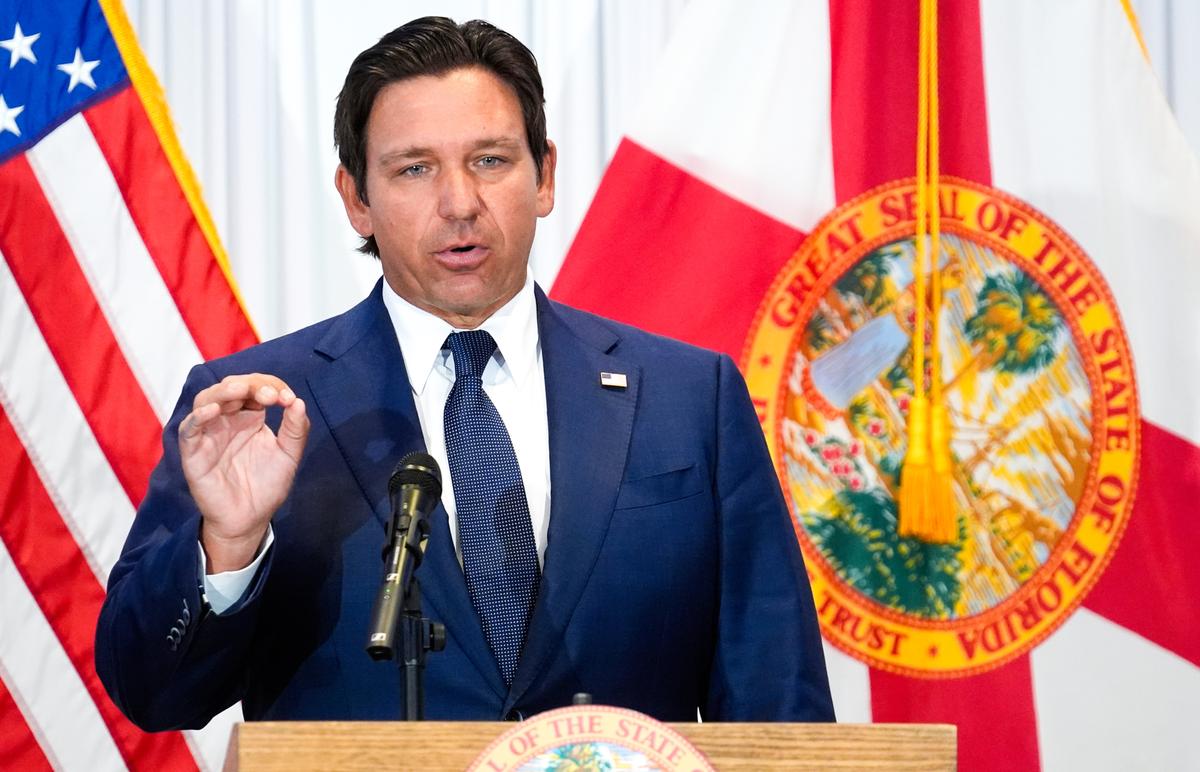
Florida Gov. Ron DeSantis during a news conference in Tampa, Fla., on Aug. 12, 2025. Chris O’Meara/AP Photo
A fight for the governor’s mansion is also on, with Gov. Ron DeSantis ineligible to seek a third term.
In polling of the gubernatorial race, Rep. Byron Donalds (R-Fla.) leads former Rep. David Jolly, who left the GOP in 2018 and joined the Democratic Party last year.
Unlike some of their regional neighbors, Alabama Republicans are well positioned in the gubernatorial and Senate races, according to polls.
Sen. Tommy Tuberville (R-Ala.) leads the gubernatorial race by 10 percentage points in an average of recent polls, though one poll showed challenger Doug Jones within 3 percent.

U.S. President Donald Trump shakes hands with Republican Alabama gubernatorial candidate Tommy Tuberville during a campaign rally in the Mitchell Center at the University of South Alabama on Oct. 02, 2026. Anna Moneymaker/Getty Images
Rep. Barry Moore leads Senate polls by more than 15 percentage points.
In one congressional race in Alabama, Rep. Shomari Figures (D-Ala.) faces an uphill battle to hold onto his seat in a newly redrawn district.

Alabama congressional candidate Shomari Figures arrives to speak on stage during the final day of the Democratic National Convention at the United Center in Chicago on Aug. 22, 2024. Justin Sullivan/Getty Images
He faces a challenge from Republican state Rep. Rhett Marques after the state redrew its congressional maps in line with the Supreme Court’s ruling on the Voting Rights Act.
Figures’s southern Alabama district was drawn earlier to include more black voters, helping him win by about nine percentage points in 2024.
Though the district is less favorable to Democrats this year, Cook Political Report rates the seat as leaning Republican, and the latest poll found the race tied.
Darlene Sanchez McCormick and Travis Gillmore contributed to this report.


Discount Applied Successfully!
Your savings have been added to the cart.